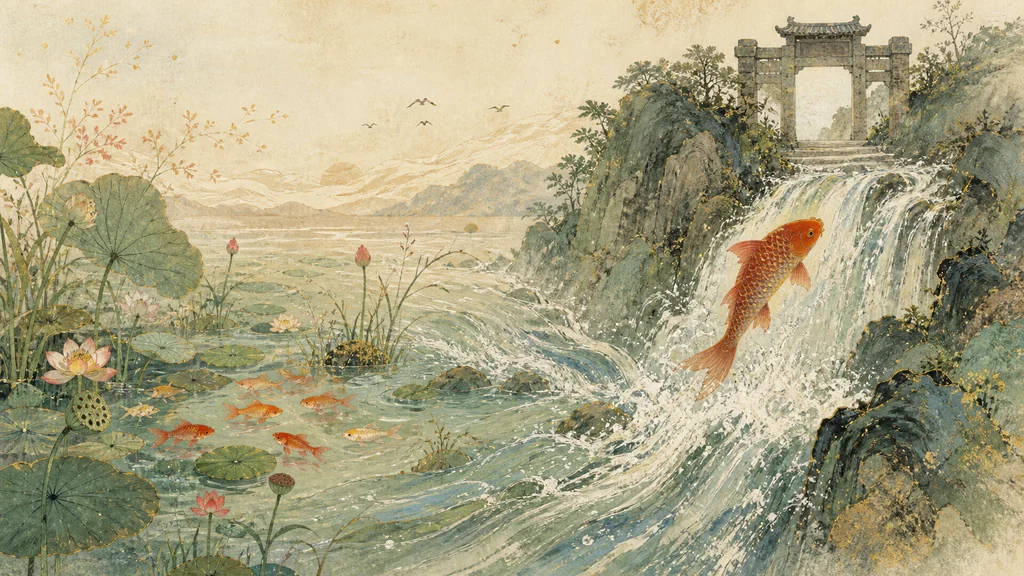
In one picture, several fish drift among lotus leaves. In another, a carp launches itself against a waterfall. Both images contain fish, but they need not carry the same message. The quiet pond often wishes for abundance; the leaping carp is more likely to tell the story of Dragon Gate.
Fish can suggest abundance through sound. In Mandarin, yú (鱼), “fish,” is pronounced like yú (余), “surplus” or “something left over.” Lotus and fish can therefore contribute to phrases such as “continuous years of abundance.” New Year settings, grain, children or written characters can make the wish more specific. A fish alone does not automatically identify the complete phrase.
The Dragon Gate picture contains an ordeal
The carp story has a clear sequence. A carp swims upstream and, after crossing the Dragon Gate on the Yellow River, transforms into a dragon. The change became a metaphor for passing the civil service examinations and gaining rank. It can now extend to examination success, university admission or a difficult professional breakthrough.
An early fourteenth-century inkstone at the Metropolitan Museum of Art places carp and dragon on the same object. The museum links its decoration to the Dragon Gate story and to success in the examinations. The object itself sharpens that meaning: an inkstone used for daily study is a more direct setting for scholarly ambition than a fish dish placed on a dining table.
Read the fish, the action and the object together
Start with the species and movement. A recognisable carp, an upward leap, rapids, a waterfall or a high gate all create a barrier to be crossed. Fish moving calmly through lotus or water plants, especially with clues for “year,” “lotus” or “surplus,” more readily support a wish for plenty.
The object also matters. Inkstones, children’s examination clothing and gifts for students tend to emphasise advancement. New Year prints, tableware and festival gifts more often wish for material abundance. Some fish paintings simply observe aquatic life or use swimming fish to suggest freedom and ease. Translating every fish into “abundance year after year” erases those differences.
Abundance belongs to a combination, not a fixed definition
The homophony of fish and surplus lets a visible animal stand for an abstract condition. A complete auspicious phrase, however, usually needs additional clues. Lotus can contribute a sound for continuity, a New Year inscription can locate the wish in the coming year, and grain or family scenes can make material plenty explicit. Without such support, a lone fish may remain a study of aquatic life.
Rebus pictures work because they are attractive, memorable and suitable as gifts as well as decodable. A viewer does not have to solve every syllable consciously to recognise the festive wish. A careful explanation should nevertheless identify the relevant sound and the images that complete the phrase instead of attaching a stock proverb to any picture of a fish.
Dragon Gate is a transformation from below to above
The defining feature of the Dragon Gate motif is not simply the presence of “fish plus dragon.” It is a process: a carp struggles upstream, crosses a difficult threshold and changes status. Rapids, a waterfall, a gate-like gorge, an upward leap or a transitional fish-dragon body make that narrative visible. On an inkstone, the equipment of study brings the ordeal into the world of examinations and advancement.
The metaphor can now describe university admission or a professional breakthrough, but modern extensions should not be projected back as the story’s only historical meaning. “Overcoming a difficult threshold” is often defensible; claiming that every carp ornament refers to one particular examination is not.
A three-step reading keeps the motifs apart
First identify species and action: is the fish recognisably a carp, and is it moving upward? Then inspect the setting: a calm lotus pond or a turbulent barrier? Finally consider the carrier and user. A New Year print, dining vessel, wedding gift and scholar’s inkstone frame the same animal differently.
Museum cataloguing, inscriptions and the date of the object deserve more weight than modern retail copy. When clues conflict, acknowledging uncertainty is more accurate than forcing a single lucky meaning. One work can combine wishes for plenty and advancement, but that double reading requires evidence from the composition rather than the claim that fish can symbolise everything.
Sources and further reading
- The Metropolitan Museum of Art, “Inkstone with dragon and carp.” https://www.metmuseum.org/art/collection/search/843762
- Palace Museum, study of fish designs and auspicious patterns. https://www.dpm.org.cn/Uploads/pdf/1566/T00053_00.pdf
- Seattle Asian Art Museum, “Plaque with winged carp-dragon.” https://art.seattleartmuseum.org/objects/1631/plaque-with-winged-carpdragon
- Asian Art Museum, “Headband depicting a fish turning into a dragon.” https://searchcollection.asianart.org/objects/2113/headband-depicting-a-fish-turning-into-a-dragon
- Nelson-Atkins Museum of Art, “Carp and Water Grasses.” https://art.nelson-atkins.org/objects/15697/carp-and-water-grasses