In 1414, a giraffe reached the court of the Yongle emperor as a diplomatic gift from Bengal. The unfamiliar animal was quickly associated with the qilin, and officials treated its arrival as an auspicious sign of virtuous rule. Paintings of the giraffe later influenced qilin rank badges worn by Ming nobles.
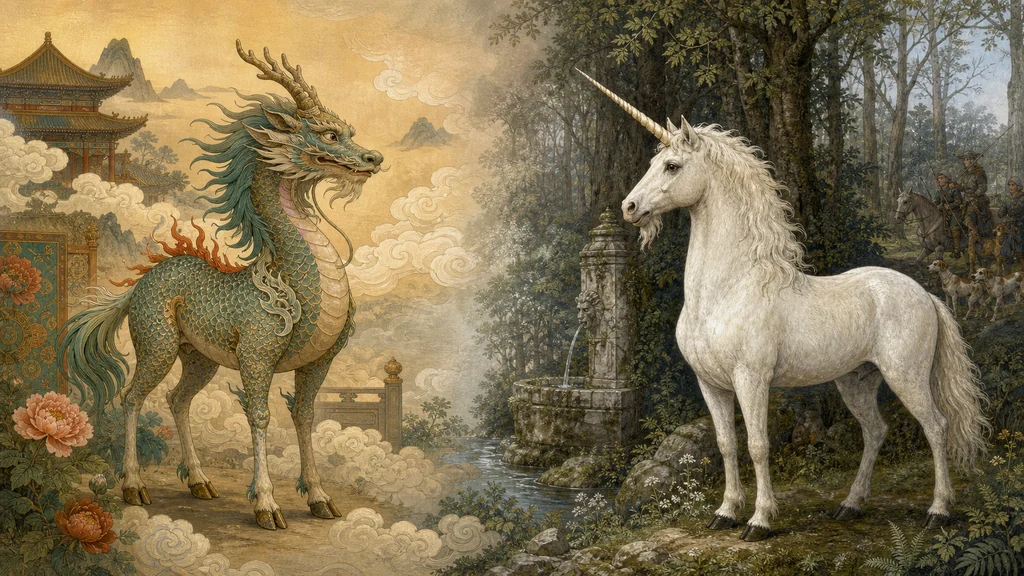
If a giraffe could enter the qilin's visual history, the creature was clearly not one eternally fixed “Eastern unicorn.” A qilin and a European unicorn are not the same mythological animal. The label “Chinese unicorn” offers a quick comparison, but it is only approximate.
A horn is not the qilin's only defining feature
The Chinese ritual classic Liji places the lin beside the phoenix, turtle and dragon as the Four Numinous Creatures. The qilin belongs first to a Chinese system of auspicious beings; it is not a regional species within the European bestiary.
The Metropolitan Museum of Art describes the qilin as a composite, hoofed creature that usually has a single horn. Its appearance could announce the birth of a sage, and qilin images served as rank insignia for nobles. On domestic objects, the creature could also express a wish for gifted sons.
“Usually one horn” does not mean one horn alone establishes identity. A Chinese export embroidery at The Met places a blue qilin beside a white, single-horned xiezhi. Both are horned, but they are different creatures. Counting horns provides one clue; it cannot settle the name.
The qilin's body kept changing
A Han-dynasty figure in the British Museum is catalogued as a qilin yet described as a sheep with a spike on its forehead. A very different Wanli-period object turns the qilin into a colorful porcelain incense-stick holder. Neither looks exactly like the scaled, dragon-headed beast common in later imagery.
An early eighteenth-century vase at The Met shows how difficult identification can be. Its animal has a deer's body and dragon-like head, horns and hooves, but its feet resemble those of a large cat. The museum therefore leaves the identification uncertain. Even a museum does not force a name from one or two matching features.
The Yongle giraffe episode shows another kind of change. Officials did not invent the qilin in 1414; they applied an existing auspicious category to an extraordinary living animal. The giraffe's long neck and patterned coat then entered some later images. This does not mean the qilin “really was” a giraffe. It means the cultural type could absorb new visual material.
A qilin's appearance often judged the condition of the age
Qilin stories ask not only what the creature looks like but why it appears. It is associated with peace, moral government and the arrival of a sage. A fifteenth-century Chinese painting in the Smithsonian collection places Confucius and the Buddha with a qilin, showing the animal in narratives of sacred and exemplary figures.
Ming rank badges brought the auspicious beast into a system of social identity. A qilin could speak about legitimate rule, noble status and family hopes. Translating all of this as “good luck” is not entirely wrong, but it thins out the political and ethical dimensions.
The medieval European unicorn lives in another story
Getty Museum material describes the medieval unicorn as a wild horse- or goat-like animal with one spiraling horn. It was swift and impossible to capture by ordinary force; only a virgin maiden could quiet it. Its horn was believed to detect or neutralize poison.
The Unicorn Tapestries at The Met Cloisters, woven around 1495–1505, show hunters and dogs pursuing the animal. The unicorn fights with its horn and purifies water at a fountain. Christian interpretations connected its uniqueness, purity, capture and death with the Incarnation and Passion of Christ.
The tapestries could also carry secular meanings involving love, marriage and hopes for children. The Western unicorn did not have only one interpretation, yet its recurring cluster—single horn, hunt, maiden, purified water and Christian allegory—is not the same as the qilin appearing in response to humane government or a sage's birth.
“Chinese unicorn” is a narrow bridge
The translation has one advantage: readers immediately imagine a rare horned creature, and the qilin is sometimes one-horned, hoofed and deer- or horse-like. But “unicorn” also imports a white horse, a maiden, a hunt and a water-purifying legend. A qilin may have scales, a dragon-like head and changing horn forms; it may belong with Confucius, virtuous rule, a noble's badge or a giraffe presentation.
For careful writing, keep the name qilin. On first mention, it is reasonable to explain that it has often been loosely called the “Chinese unicorn.” Translation can build a bridge; it cannot make both banks the same place.