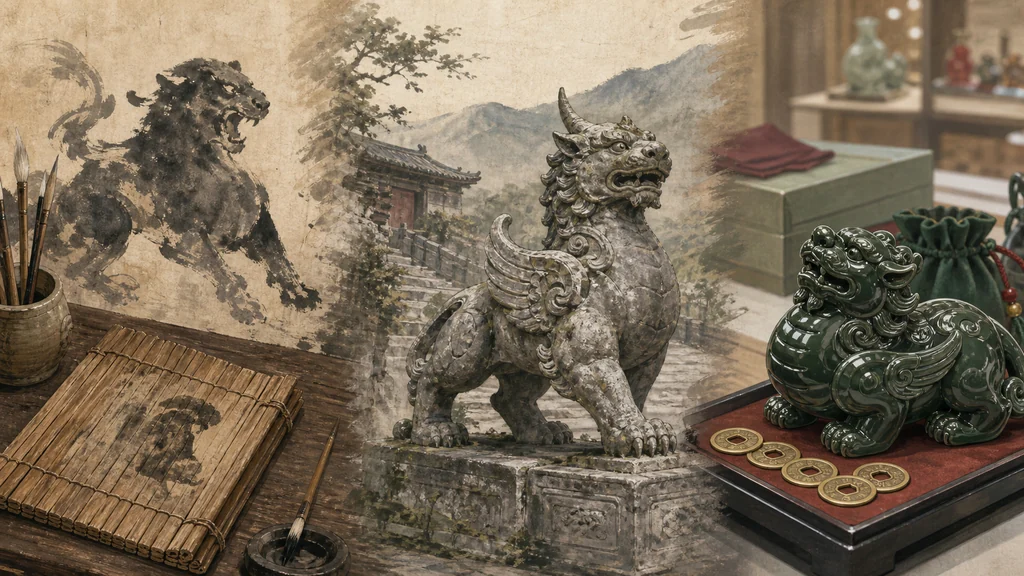
The Book of Documents compares warriors to tigers and pi: “like tigers, like pi.” The point is martial force. The passage says nothing about coins, a creature swallowing wealth, or where a figurine should face.
Contemporary pixiu sellers often provide a different package. An open mouth attracts wealth; the creature supposedly lets riches enter but not leave; activation, direction and rules about touching particular parts complete the practice. The name is genuinely old. Whether every part of this package is equally old is a separate historical question.
Traditional readers disagreed about what kind of animal pi was
The Qing philological work Jingyi Shuwen reviews interpretations connecting pi with leopard-like animals in some passages and a white fox in others. The same written name did not necessarily identify one zoological or visual species.
Later, pixiu could also refer figuratively to a valiant army. These usages support fierce-animal and military associations. They do not document the modern claim that a pixiu consumes gold but never releases it. An old word does not automatically date every story later attached to it.
Wings and horns do not provide a permanent identity card
Powerful imaginary animals appear on tomb approaches and objects from the Han through the Six Dynasties. Some have wings or horns; some resemble lions or other large felines. A Metropolitan Museum of Art study explains that several names—including tianlu, bixie and qilin—have been applied to this broad family of beasts.
Image and name therefore do not form an unchanging lookup table. A horn, wing or curled mane on an uninscribed ancient sculpture is not enough to rename it pixiu.
Modern cataloguing can retain the overlap. Taiwan's National Museum of History registers one object as a “bronze bixie” while its public description also mentions pixiu, tianlu and bixie as related names. That record shows how present-day classification groups beast traditions. It is not a label written by the original maker.
Online rules that distinguish creatures by the number of horns, the presence of wings, or fixed male and female names need dated objects and documented provenance before they can be extended across Chinese history.
Protection is easier to document than a wealth code
Fierce bodies, claws, horns and wings suit animals placed near tomb roads and entrances. The National Museum of History describes its bronze bixie as a powerful creature that prevents malign forces and disease from causing harm. Protection, apotropaic force and auspiciousness have a firmer footing in this type of historical material than an elaborate financial code.
Even protection is not one timeless definition for every beast. Placement, user, date and medium all affect interpretation. A tomb guardian, a scholar's desk ornament and a modern jewellery pendant cannot share one explanation merely because their profiles look similar. Nor does “protective” automatically mean “specialist in attracting money.”
The modern market turned wealth into a full procedure
Modern pixiu products often arrive with operational instructions. The mouth draws in wealth; “entry without exit” retains it; consecration, orientation and permitted or forbidden points of touch regulate use. Jewellery shops, figurine sellers, media articles and word of mouth repeat the details until a mixed set of claims appears to be a single, fully documented ancient system.
One modern cultural critique connects this expansion with media promotion and sales networks that re-encode elements of tradition. It focuses especially on “entry without exit” and the pursuit of windfall wealth. The essay has a strong argumentative position. It can help identify commercial mechanisms, but it cannot establish one nationwide invention date or explain every user's belief.
A narrower conclusion is more defensible. Pixiu as a wealth charm is a real contemporary practice. The classical references and museum records examined here do not show that wealth attraction, retention, consecration and handling taboos travelled unchanged from antiquity. A modern practice does not need an invented story of perfect continuity to count as culture.
Ask who supplied the name
For an ancient beast, begin with the excavation report, original record or museum catalogue. Check its date, findspot, placement and the degree of certainty attached to its name. For a contemporary object, pixiu is already a stable commercial and devotional category—but that category should not travel backward and rename every ancient winged beast.
The fierce animal in early texts, protective beasts in historical imagery and the wealth charm in today's market are related, but they do not overlap completely. Keeping those layers separate makes the history of pixiu clearer rather than less traditional.