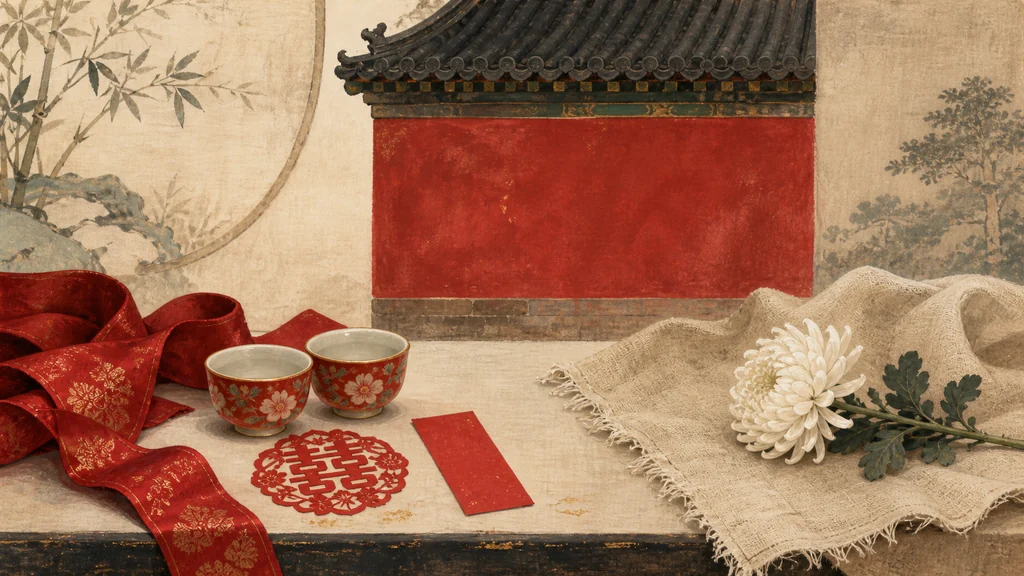
A bride’s embroidered red skirt, red paper on a door at Lunar New Year, and the vermilion walls of the Forbidden City are all visually striking. The colour is similar, but its work changes. Wedding clothes and New Year paper create a festive setting. Red architectural coatings also protect timber. Context determines what the colour is doing.
Red at weddings and New Year
An early Republican-period wedding ensemble in the National Museum of China shows a bride wearing a phoenix crown, a bright red embroidered skirt, and matching red shoes. The groom wears a robe marked with Double Happiness and carries a red silk flower across his shoulder. Beside the wedding emblem, clothing, and procession, the red is unmistakably celebratory.
Red couplets, red forms of the character 福, and other New Year decorations perform a similar role. A Palace Museum feature associates the colour with auspiciousness, warmth, and celebration. A nineteenth-century Chinese wedding banner in the Metropolitan Museum of Art combines a red ground with metallic thread, birds, flowers, and written wishes for happiness and prosperity.
Historical reds did not all come from the same material. Textiles could be coloured with safflower, madder, lac, or cochineal; paper, lacquer, and porcelain used different processes. “Chinese red” can describe a visual family, but it is not a single colour swatch shared by every period.
Palace walls and court robes give red other jobs
The vermilion walls of the Forbidden City create a grand, forceful image. Palace Museum material also explains that timber surfaces received prepared grounds and oil coatings. The red finish acted like an outer garment over the wood and helped protect the structure. “Red is lucky” leaves this material function out.
Qing emperors changed the colour of ceremonial robes according to the rite. Palace Museum records identify blue for sacrifices to Heaven, red for the Sun, and pale moon-white for the Moon. Here red belongs to a regulated ritual system. Red in a modern national flag, revolutionary memory, or political image has another public history and should not be explained as wedding colour.
Mourning normally avoids wedding red
Mourning clothes in the National Museum of China are made from undyed coarse hemp; white cloth could be used around the head. The British Museum also identifies white as a Chinese mourning colour in its account of white porcelain made for Yongle imperial memorial rites. Regional and modern practices vary, but a strong wedding red is generally unsuitable for a traditional mourning setting.
Red gifts and decorations are usually easy to understand at a wedding, a New Year gathering, or an opening celebration. At a funeral, in a condolence message, or when visiting a bereaved family, “red is lucky in China” is not a safe guide.
Start with the occasion. At a wedding, look for Double Happiness, clothing, and ritual. At New Year, look for couplets and seasonal objects. For a court object, identify its institutional use. In a modern image, consider national and political history. The colour can remain the same while its meaning changes.
Red is a material choice as well as a symbol
The same visual category can be produced by very different materials. Textile reds historically came from plant dyes such as safflower and madder, as well as insect-based colourants; lacquer, mineral pigments, paper, and porcelain required other processes. Those materials age differently and belonged to different trades and price levels. A faded textile, a freshly painted gate, and a copper-red ceramic glaze should not be treated as samples from one timeless “Chinese red” palette.
This distinction matters when identifying an object. First establish what was coloured, how it was made, and what occasion or institution used it. Symbolic interpretation comes after those material facts. Red can communicate celebration, ritual rank, protection of timber, political identity, or simply a maker's visual decision. The surrounding evidence—not the hue by itself—decides which reading is justified.
Museum labels can help separate these layers. A label that identifies a wedding hanging, a sacrificial robe, or an architectural coating supplies evidence that colour charts cannot. When the original use is unknown, describe the visible red and material first, then present symbolic readings as possibilities rather than certainties. Material and setting come first.
Sources and further reading
- Palace Museum, [Enduring Vermilion in the Forbidden City](https://img.dpm.org.cn/subject_newyear/danchenyonggu.html)
- National Museum of China, [Wedding dress from the early Republican period](https://www.chnmuseum.cn/zp/zpml/201812/t20181218_24135.shtml)
- Metropolitan Museum of Art, [Cochineal Red: The Art History of a Color](https://resources.metmuseum.org/resources/metpublications/pdf/Cochineal_Red_the_art_history_of_a_color.pdf)
- Palace Museum, [The Emperor’s Court Robes](https://www.dpm.org.cn/lemmas/241579.html)
- National Museum of China, [Mourning Clothes after the Founding of the Republic](https://www.chnmuseum.cn/zp/zpml/201812/t20181218_24219.shtml)
- British Museum, [White-glazed wine pot for memorial rites](https://www.britishmuseum.org/collection/object/A_PDF-A-427)