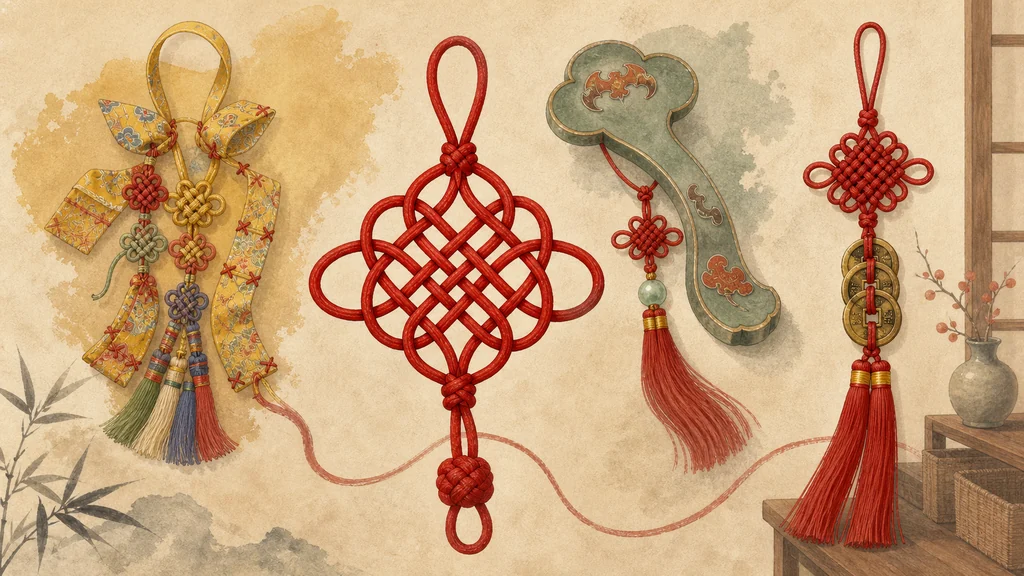
A Tang-dynasty ornamental knot in the British Museum does not resemble the large red hanging most familiar today. Excavated from Cave 17 at the Mogao cave complex near Dunhuang and dated to the eighth or ninth century, object MAS.914 uses yellow diamond-patterned gauze. Several small knots form the ornament, silk thread reinforces them, and short tassels in multiple colours complete the piece.
The object gives decorative knotting an early, physical history. It also resists a simple origin story. It is made from two kinds of woven silk, multiple knots, stitching and tassels. It is not evidence that every name used in a modern knotting manual was already fixed in the Tang dynasty.
Interlacing readily suggests connection and continuity
A knot takes separate lengths or sections of material and makes them depend on one another. A strand passes through, turns back, overlaps and tightens. Loosen one part and other parts may shift; tension turns a wandering path into a stable whole.
That structure readily supports associations with connection, union, continuity and matters brought to a conclusion. These are visual and material associations rather than supernatural properties.
Continuity should not become a false technical rule. The Dunhuang ornament itself combines several small knots, distinct textiles and reinforcing stitches. Contemporary knotters may use multiple cords, sewn joins and attached components. Some designs trace one continuous path; not every Chinese knot is literally made from one unbroken cord.
Names and attached objects make wishes more specific
The Palace Museum's exhibition on Qing imperial ruyi sceptres lists several named knots used as attachments: endless, coin, butterfly, happiness and longevity knots. The names already bring money, joy or long life into view. Tied to a ruyi and placed beside lingzhi fungus, bats, the Three Abundances or the Eight Immortals, a knot joins a larger field of auspicious imagery.
Meaning does not sit inside cord geometry alone. A name such as “longevity knot,” a ruyi, a bat motif and a birthday presentation can reinforce one another. Move the same knot to a wedding, shop doorway or ordinary household decoration and the reading can change.
A modern coin hanging combines several readable clues
The British Museum also holds a hanging ornament purchased in 2004, numbered 2004,1130.3. Six imitation Chinese coins or charms are tied with red cord. A Chinese knot and hanging loop sit above them; a red-and-gold double tassel hangs below. The inscriptions include “auspiciousness as you wish,” “gold and jade fill the hall,” “treasure that guards the house” and “peace throughout one's life.”
Here the wishes do not need to be guessed from the knot. The writing explicitly names prosperity, protection and peace. Coin forms, red cord, knot and tassels strengthen the presentation. Assigning “gold and jade fill the hall” entirely to a particular knot would ignore the inscribed coin carrying those words.
The object documents Chinese knotting in a modern retail and household setting. That use is culturally real, but a commodity acquired in 2004 cannot prove that a Tang ornament had the same colour, shape and wealth meaning.
An endless-knot image is not every decorative knot
The endless knot is one of the Buddhist Eight Auspicious Symbols. It usually appears as an interlaced band without an obvious beginning or end. A maker may turn it into an actual cord knot, but it can also be painted, carved, moulded or woven as a flat motif.
Three things need to remain distinct: the endless-knot image within the Buddhist Eight Auspicious Symbols; actual decorative knotting in cord or textile; and the broad modern craft and product category called “Chinese knots.” They overlap, but none contains every example of the others.
Different knots can acquire different wishes through established names and habits. They do not form a context-free dictionary valid for every century. First examine how a knot is made and what it is called. Then look at colour, attached objects, inscriptions, date and occasion. Interlacing supplies a broad language of connection; the whole object supplies the specific message.