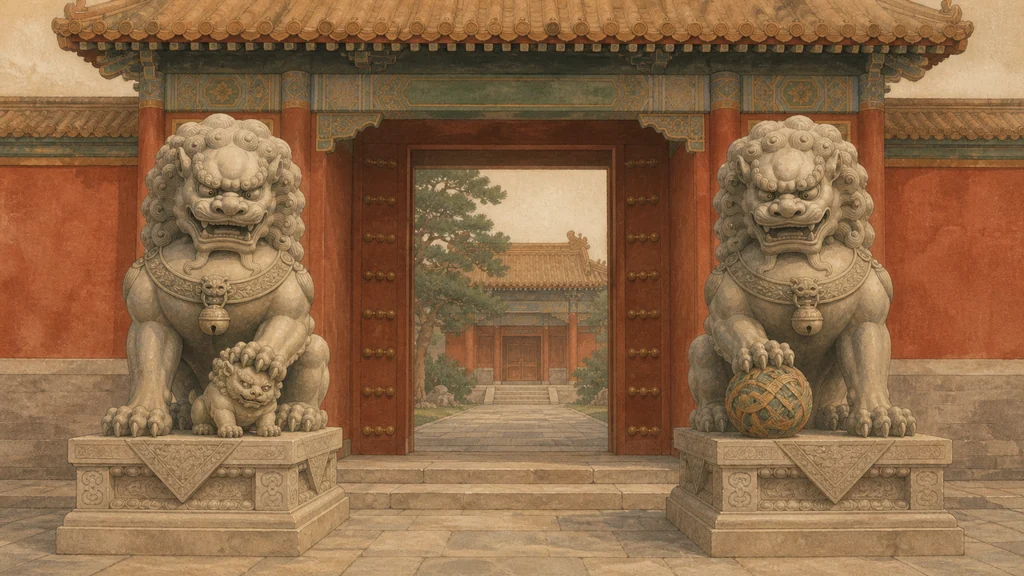
A visitor standing outside a Chinese gate can easily reverse a familiar rule. Museum writing may place the male lion on the gate's left and the female on its right, but that convention views the pair from the building, facing outward. Turn around to face the entrance as a visitor and the two sides switch.
The objects under the paws are a safer first clue. In the Palace Museum's account of the bronze lions at the Gate of Supreme Harmony, the male presses a paw onto a brocade ball, while a cub plays beneath the female. The museum's architectural record identifies the gate as the main entrance to the Forbidden City's Outer Court and describes the pair as Ming-dynasty bronze furnishings.
These are highly stylised lions, not zoological portraits. Corkscrew curls, emphatic eyebrows and muscular bodies do not provide a natural-history test for sex. The ball and cub belong to a visual convention designed to make the two figures legible as a pair.
Two lions guard one threshold
Placing one lion on either side gives the entrance two outward-facing guardians. The Palace Museum's public education material describes the Gate of Supreme Harmony pair as protective, apotropaic, auspicious and decorative. The lions are not simply two unrelated animal sculptures; their placement makes them part of the architecture of arrival.
Paired guardians have a history much older than the surviving palace examples. The Metropolitan Museum of Art's record for a mid-sixth-century Northern Qi guardian lion notes that pairs of stone lions protected Han-dynasty tombs. Lion imagery became more prevalent after its inclusion in northern Buddhist cave temples during the fifth and sixth centuries, and excavated Northern Qi tombs have yielded pairs defending the entrance to the innermost burial chamber.
That evidence establishes a long practice of using two lions to protect an entrance or important inner space. It does not show that every early pair already carried the ball-and-cub attributes familiar from later objects. The history of paired guardianship and the history of those identifying objects should not be collapsed into one undocumented origin story.
The ball and cub also identify pairs on smaller objects
A pair of stoneware lions in the British Museum, numbered 1930,0719.7-8, provides a close comparison. The museum identifies the lioness by a cub beneath her right paw and the lion by a brocade ball under his left. Both sit on separate tiered stands and have the curled manes and bushy eyebrows typical of non-naturalistic Chinese lion images.
The museum's small Kangxi-period porcelain pair Franks.72 repeats the distinction. A cub climbs the lioness's right leg, while the male has a movable brocade ball beneath his left paw. These figures were made for a scholar's desk rather than a palace gate, so they should not be used as evidence for architectural placement. They do show that the male-and-ball, female-and-cub pairing circulated across different materials and scales in the Ming-Qing visual world.
Popular explanations sometimes turn each object into a universal code: the ball becomes rule over the world, while the cub becomes descendants or fertility. Such readings may occur in particular settings, but the museum object records do not establish one meaning for every pair. What they firmly support is identification: ball with male, cub with female.
“Male left, female right” needs a viewing direction
A Palace Museum publication describes the standard post-Song arrangement as the male on the gate's left and the female on its right, explicitly defining the viewpoint as facing outward from the gate. The same arrangement can therefore be stated in two apparently contradictory ways:
- From inside the building, looking out: male on the left, female on the right.
- From outside, facing the entrance: male on your right, female on your left.
This is why a photograph caption that says only “left lion” is incomplete. First identify the ball and cub. Then confirm that the figures were designed as a pair for the same entrance. Use left and right only after the building's direction is clear. If the paws or attributes are damaged, the original pair and doorway layout matter more than the edge of a cropped photograph.
Not every Chinese lion follows this entrance convention
Lions appear beside tomb roads and Buddhist thrones, on bridge posts, incense burners, ceramics and modern shopfronts. Some occur in pairs, others alone. Some have neither a ball nor a cub. A documented palace gateway and paired museum figures demonstrate a common convention; they do not place every lion-shaped object in China under one rule.
English-language writing also calls these figures “foo dogs” or “dogs of fo.” The name is misleading if it suggests a breed of dog. They are lions transformed by Chinese artistic conventions. For a pair at an entrance, use a simple order of observation: confirm that the two figures belong together, look for the ball and cub, and only then check their positions from the gate's outward-facing viewpoint.