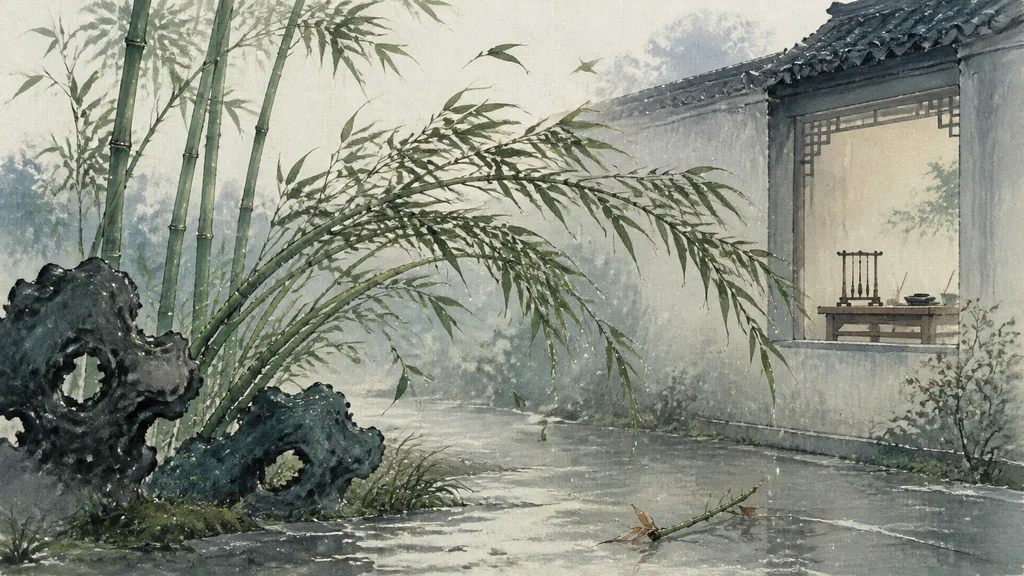
When wind presses against bamboo, the culm bends. Once the gust passes, it rises again. It is neither rigidly immovable nor easily broken. Chinese writers found in that behaviour an appealing model of character: a person may yield under pressure without losing what he or she stands for.
Several parts of the plant became moral metaphors. The hollow culm suggested humility and openness. Its distinct joints evoked jie (节), a word that can also refer to moral integrity or steadfast principle. Evergreen leaves allowed bamboo to represent constancy in winter, while vigorous connected growth suggested resilience. These are not botanical facts about virtue. Poetry, gardens and painting built the associations over many generations.
Junzi means more than “gentleman”
Bamboo is often called a plant of the junzi (君子). In Chinese ethical thought, a junzi is a cultivated person who develops judgement, principle and self-discipline. The conventional translation “gentleman” can sound merely male, polite or upper-class in modern English. Retaining junzi keeps the emphasis on moral cultivation.
Ink bamboo painting made the connection especially strong. Artists used variations of wet and dry ink and brush movements related to calligraphy to form stems, joints and leaves. Speed, pressure and pauses remained visible on the paper, allowing the painted bamboo to register the artist’s hand and temperament. Poems and colophons could then tell viewers whether a particular stand of bamboo concerned loyalty, reclusion, endurance or personal experience.
A painting gives the metaphor a particular life
Wang Fu’s bamboo handscroll in the Palace Museum has such a context. Wang endured political setbacks and exile. In a poem on bamboo, he described a plant that would not compete with showy flowers and that faced autumn storms and winter frost alone. The bamboo reflects his circumstances and chosen self-image; it is more specific than a generic label for “resilience.”
A Yuan-period Bamboo and Rocks in the Kimbell Art Museum uses bending but unbroken bamboo in relation to loyalist scholars living under Mongol rule. The surrounding poem helps establish that political and personal reading.
Bamboo also belongs to two well-known plant groups. The Four Gentlemen are plum, orchid, bamboo and chrysanthemum. The Three Friends of Winter are pine, bamboo and plum. The groups are not interchangeable. Nor does every bamboo basket or chair praise moral character. Subject, inscription, object and setting must invite the comparison before the bamboo acts as a junzi.
Form begins the metaphor but does not finish it
The joint of a bamboo culm can evoke jie because the Chinese word also participates in terms for moral integrity. The hollow interior can be read as receptiveness, and recovery after bending as flexible endurance. None is a scientific property called virtue. Language, ethical writing and repeated artistic use turned visible structures into moral comparisons.
The same plant form can support different emphases. Bamboo upright in snow may suggest constancy; culms driven sideways by wind may stress survival without breaking; vigorous new shoots may draw attention to growth. An inscription and the circumstances of production help determine which possibility matters in a particular work.
Why ink bamboo suited literati expression
Painting bamboo requires strokes for culms, joints, branches and leaves that draw upon calligraphic discipline. Differences in ink, moisture, speed, pressure and turning preserve the painter’s actions. Viewers could therefore judge not only resemblance to a plant but qualities such as control, force or reserve in the handling of the brush. The moral metaphor became connected to an actual practice of self-cultivation.
Poems, signatures and later colophons may place the bamboo within a gift between friends, a declaration about service or withdrawal, a remembered hardship, or a network of artistic exchange. The Wang Fu and Yuan Bamboo and Rocks examples matter because textual and historical evidence supports their personal and political readings, not merely because bamboo appears in them.
Do not merge the two plant groups
The Four Gentlemen—plum, orchid, bamboo and chrysanthemum—belong strongly to literati painting and distinct character associations. The Three Friends of Winter—pine, bamboo and plum—share an ability to remain vital in cold conditions. Bamboo’s presence in both does not place orchid and chrysanthemum among the Three Friends, or pine among the Four Gentlemen.
When identifying a group painting, count the plants and consult its title. A work containing bamboo alone can invite bamboo’s own associations without representing either complete set. A chair or basket made of bamboo is first evidence of material and craft; it need not personify a junzi unless form, inscription or use supplies that invitation.
Building an evidence-based reading
Begin by describing whether the bamboo is upright, bent, snow-covered or paired with rocks. Then check the maker, date, inscription and collection record. Separate meanings supported in the work’s historical setting from convenient present-day summaries. Only then use broad terms such as integrity or resilience.
This method prevents bamboo from becoming a detachable symbol label. Humility, principle and endurance remain valid possibilities, but each reading emerges from the interaction of plant form, Chinese wordplay, brush practice and specific historical evidence.
Sources and further reading
- Smithsonian National Museum of Asian Art, “A Branch of Bamboo.” https://asia-archive.si.edu/learn/for-educators/teaching-china-with-the-smithsonian/lesson-plans/learning-jueju-through-chinese-painting-a-branch-of-bamboo/
- Palace Museum, Wang Fu, “Painting of Bamboo.” https://www.dpm.org.cn/vr/stone-moat/wyd_38.html
- Palace Museum, Li Kan, “Ink Bamboo.” https://www.dpm.org.cn/vr/stone-moat/wyd_37.html
- Kimbell Art Museum, “Bamboo and Rocks.” https://kimbellart.org/collection/ap-200202
- Metropolitan Museum of Art, *Nature Within Walls: The Chinese Garden Court at The Metropolitan Museum of Art*. https://www.metmuseum.org/-/media/files/learn/for-educators/publications-for-educators/nature_chinese_garden.pdf