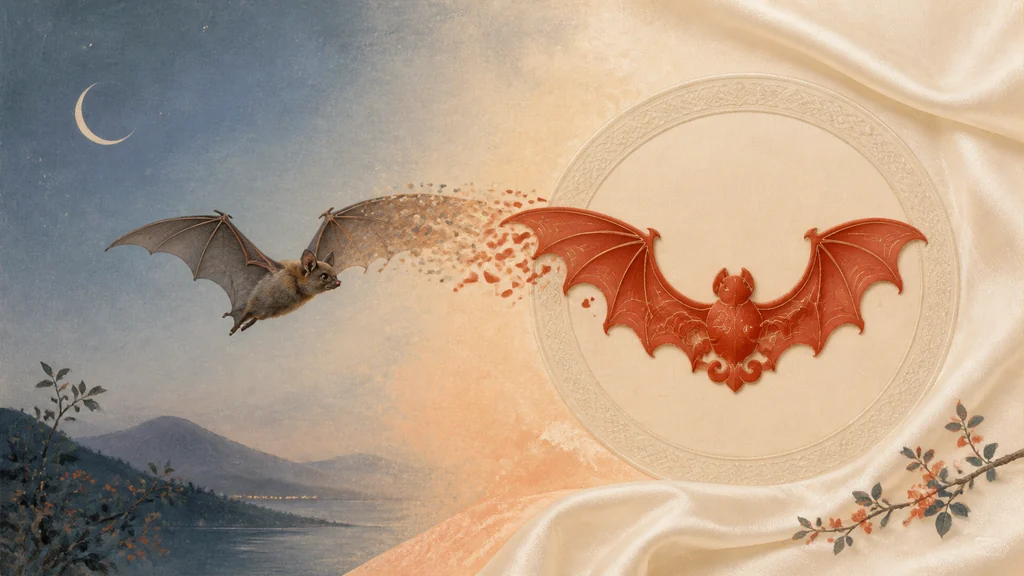
The Metropolitan Museum of Art owns an early eighteenth-century Chinese woman’s ceremonial robe covered with round embroidered medallions. Inside each roundel, five bats circle a character associated with longevity. To a viewer who connects bats with caves, darkness or vampire stories, the design may not look like a blessing at first.
The explanation begins with two Chinese characters.
The bat borrows the sound of “good fortune”
The final character in the Chinese word for bat, 蝠 (fú), is pronounced like 福 (fú), the word for good fortune or blessing. The two characters are written differently and have different meanings. Their shared pronunciation allows the image of a bat to call the other word to mind.
This is why simply translating 蝙蝠 as bat removes an important part of the design. An English reader sees an animal; a Chinese speaker can also hear the sound fú. The image functions as a visual homophone.
The connection does not come from the animal’s habits, and a bat does not supply a complete message by itself. Number, placement, neighbouring characters and the object all matter. One popular explanation says that an upside-down bat always means “fortune has arrived,” because 倒 (dào, upside down) resembles 到 (dào, to arrive). That reading may be used in some contexts, but the museum sources consulted here do not support treating it as a universal rule.
Decorative bats can also differ from animals in a field guide. On a border or inside a roundel, the body may become tiny while the wings spread into a symmetrical outline. Claws and wing tips can curl into ornamental strokes. Position beside a longevity character can be as useful for identification as anatomical detail.
Why are there five bats?
The Palace Museum holds a Qing-dynasty white-jade belt buckle measuring 13.5 centimetres long and 5.3 centimetres wide. A circular 寿 (shòu, longevity) character occupies the centre, with five bats arranged around it. The museum names the object a white-jade belt buckle with five bats holding up longevity.
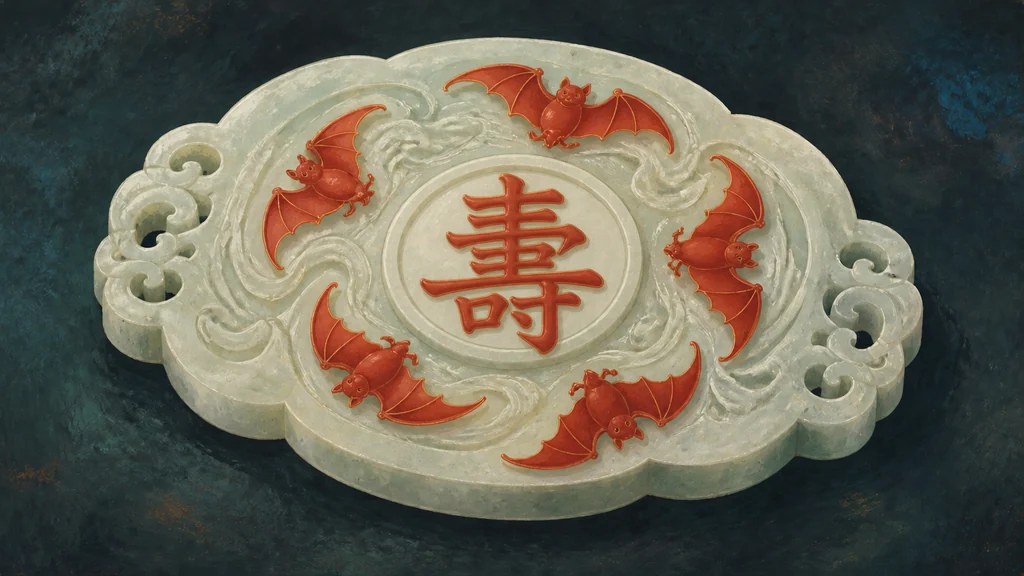
The five bats refer to the Five Blessings, 五福 (wǔfú). The “Great Plan” chapter of the Book of Documents lists them as longevity, wealth, health and peace, love of virtue, and a natural completion of life. This is not merely a list of five pleasant feelings, nor does it mean “five times as lucky.”
The name of the belt-buckle motif comes from the full composition. The bats supply the sound of 福, their number indicates the Five Blessings, and the central 寿 character makes longevity explicit. Five bats without a longevity character or a comparable central structure should not automatically receive the same name.
Why the bats change shape on a robe
The jade buckle compresses its design into a small hard surface. The Met’s ceremonial robe uses satin, silk and metal thread, so its bats follow a flexible textile and the circular movement of an embroidered roundel. Five bats link head to tail while the longevity character remains visible.
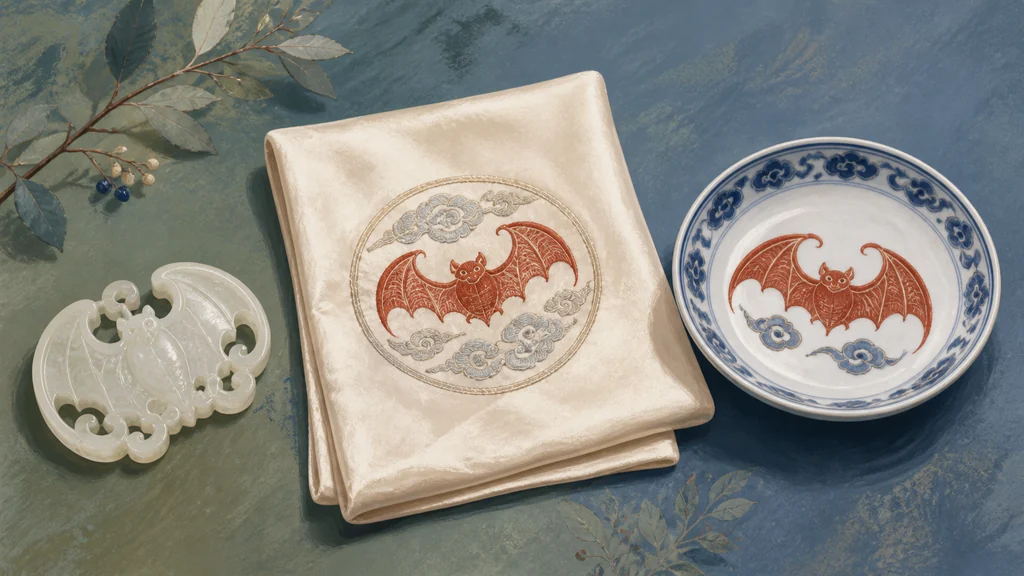
The material changes the drawing, not the underlying pun. In each case, the viewer has to look beyond the presence of a bat and ask how many there are, what occupies the centre, and which words or patterns accompany them. That separates a general wish for 福 from the Five Blessings and from the more specific five-bats-surrounding-longevity composition.