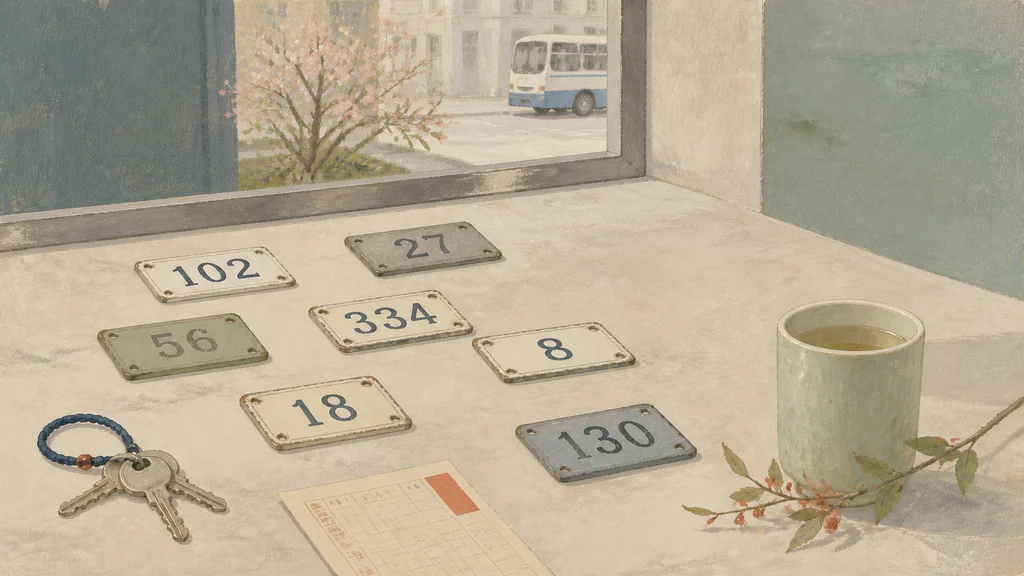
Strings of eights are often sought after in phone numbers, licence plates, addresses and opening dates. The usual explanation is that “eight sounds like prosperity.” One detail matters: the resemblance is clearest in Cantonese.
The Cantonese word for eight, baat, sounds close to faat, “to prosper,” the same word heard in expressions about becoming wealthy or successful. This makes 8 an easy verbal token of good fortune. In Hong Kong, the single-number licence plate 8 was famously auctioned for a high price. Economic research on Hong Kong plates has also measured a premium for numbers containing 8 and a discount for those containing 4.
The Mandarin link is looser
In Mandarin, eight is bā and prosper is fā. They share a vowel but begin with different consonants, so they are not homophones. The association is nevertheless widely understood across mainland China. A Cantonese sound association travelled beyond its original speech community through commerce, media and migration. It need not be presented as an ancient pun shared identically by every Chinese language.
The preference now affects public choices. Retail prices often end in 8, while repeated eights in phone numbers or addresses can command an extra charge. The opening ceremony of the Beijing Olympic Games began at 8 p.m. on 8 August 2008, giving the number’s modern auspicious reputation a global stage.
Older groups of eight have other histories
Chinese traditions also organise ideas through the Eight Trigrams, eight directions and eight musical sounds. These older structures show that eight was culturally useful long before contemporary number auctions. They do not, by themselves, prove that today’s “8 means getting rich” grew directly from the same source. The prosperity association is linguistic and especially visible in modern commercial life.
Not everyone pays more for an eight. Some people treat it seriously, others enjoy it as a custom, and many do not care. The numeral itself does not produce wealth. Repeated choices, prices and public events have made it a portable sign of hoped-for prosperity.
From a sound association to a market choice
The pun explains why the association is memorable; it does not prove that every person will act on it. Licence-plate auctions provide stronger behavioural evidence because bidders express their preferences with actual payments. Researchers can compare prices for plates containing 8 with otherwise similar plates. Studies of retail pricing likewise find sellers using terminal eights more often and fours less often in Chinese-speaking markets.
These are population-level tendencies, not predictions about an individual buyer. A repeated number may also be memorable, visually regular and scarce. Careful market research has to separate those features before assigning a premium to superstition or cultural preference.
Why repeated eights stand out
One eight can evoke prosperity; 88, 888 and 8888 add repetition and visual order. Patterned numbers are easier to remember and exist in smaller quantities, so their desirability cannot be attributed entirely to auspicious meaning. Cultural association, formal neatness and limited supply reinforce one another.
The Beijing Olympics opening at 8 p.m. on 8 August 2008 is a particularly clear act of public selection. It shows that the favourable meaning was legible to a national and international audience by that time. It does not demonstrate that every older Chinese use of an eight-part scheme carried the same promise of wealth.
Context and language still matter
Advertising, gift amounts, telephone numbers and opening times may exploit the eight association, while dates and identifiers in official records must first follow practical rules. An English explanation should also avoid saying that eight “sounds exactly like wealth in Chinese.” Chinese includes several languages and regional pronunciations. The Cantonese resemblance is strong; the Mandarin resemblance is partial.
Keeping ancient sets such as the eight directions separate from the modern prosperity pun produces a more accurate history. A number can accumulate meanings through classification, wordplay and commerce at different times. It does not need one timeless origin to become culturally powerful.
Asking prices are not the same as transactions
A seller may advertise a premium because a number contains 8, but an actual auction or completed sale shows whether buyers paid it. Even an average measured premium does not make every eight-bearing number more expensive than every ordinary one. Pattern, scarcity, market date and the number of bidders can still affect the result.
The strongest cultural claim therefore states where, when and through what evidence the preference appears. Eight has a conspicuous place in modern Chinese-speaking commercial life, but no individual is required to share it. Treating a statistical tendency as a compulsory superstition would replace observation with stereotype.
Sources and further reading
- Chinese University of Hong Kong Press, *Number 8*, sample chapter. https://cup.cuhk.edu.hk/image/catalog/preview/9789882373730_SampleChapter.pdf
- “The value of superstitions,” licence plate market study. https://pmc.ncbi.nlm.nih.gov/articles/PMC7113914/
- “Lucky numbers, unlucky consumers.” https://doi.org/10.1111/j.1745-6606.2011.01206.x
- Xinhua / China.org.cn, Beijing Olympic Games opening ceremony. https://www.china.org.cn/olympics/news/2008-08/08/content_16167366.htm
- Chinese Culture, “Lucky Numbers and Colors in Chinese Culture.” https://en.chinaculture.org/chineseway/2013-01/11/content_450104.htm