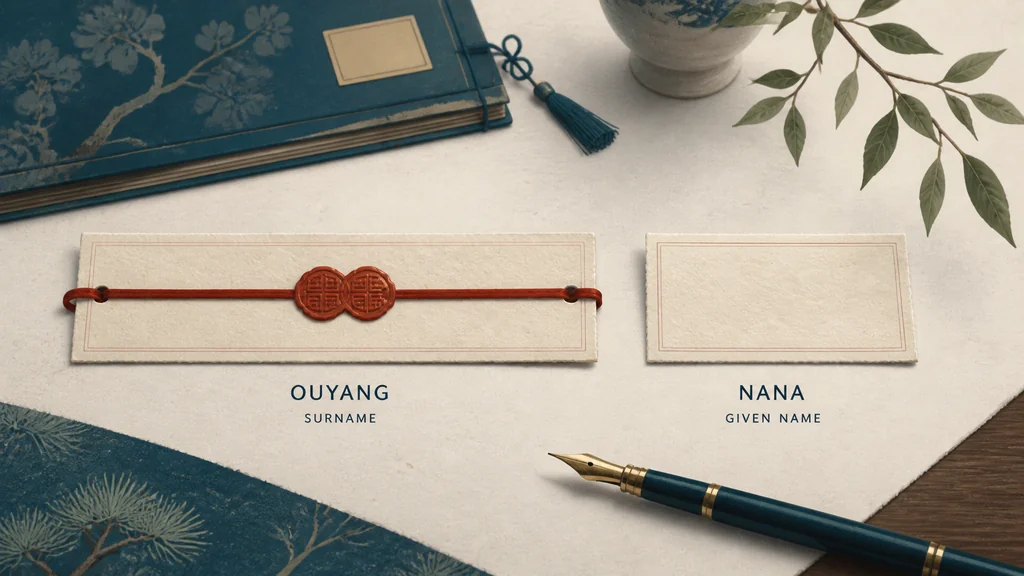
Ouyang Nana (欧阳娜娜) has four Chinese characters in her full name. Splitting after the first character would produce Ou as the surname and Yang Nana as the given name. That is wrong: Ouyang (欧阳) is one compound surname.
China’s official rules for spelling personal names define a compound surname as a surname containing more than one Chinese character, usually two. Ouyang (欧阳) and Sima (司马) are the standard examples. A name still has two basic parts—surname and given name—even when the surname occupies two characters. Sima Guang (司马光) divides as Sima / Guang, not Si / Maguang.
Pinyin makes the boundary visible. The surname and given name are separated, while the characters inside a compound surname are joined. 欧阳娜娜 is therefore Ouyang Nana, and 司马光 is Sima Guang. Ouyang is not a middle name, nor is Yang part of the given name.
Put the whole compound surname in the surname field
On a form with Surname or Family name and Given name fields, enter Ouyang under surname and Nana under given name. A website may later display the given name first, producing Nana Ouyang. The display order has changed; the fields have not.
The number of Chinese characters cannot reveal the structure by itself. A four-character name may contain a two-character surname and two-character given name, or a one-character surname and three-character given name. The national spelling standard also distinguishes a compound surname from a double surname formed by placing two surnames together.
Passports, tickets, visas and bank records add a practical constraint: follow the identity document. If the document uses capitals, fixed spacing or a particular order, reproduce those fields rather than redesigning the spelling. Do not split Ouyang into Ou Yang unless the issuing document itself does so.
Common compound surnames
Official Chinese name-transliteration guidance lists compound surnames including Ouyang (欧阳), Sima (司马), Shangguan (上官), Zhuge (诸葛), Situ (司徒), Yuwen (宇文) and Gongsun (公孙). They should be recognised as complete surnames before the given name is identified.
Identify the surname before changing the order
Character count is a poor shortcut. The useful first question is whether the opening characters form an established surname. Ouyang, Sima, Shangguan, Zhuge, Situ, Yuwen and Gongsun appear in official guidance as compound surnames. Once Ouyang is recognised as one unit, Nana can be identified as the given name. Without that recognition, a reader may cut the name at the wrong point.
Spacing in Hanyu Pinyin records this structure. A space separates surname from given name, but the syllables within a compound surname are written together. In Ouyang Nana, the space marks the surname/given-name boundary; it is not an instruction to put every Chinese character in a separate field. A service that displays Nana Ouyang has changed the presentation order, not the person’s name components.
A compound surname is not a middle name
The Chinese spelling standard distinguishes an inherited compound surname from a “double surname” made by combining two surnames. Both may occupy two Chinese characters, but their histories and functions differ. Neither distinction maps automatically onto the English-language idea of a middle name.
Putting Ou in the surname box and Yang in the middle-name box changes the documented boundary of Ouyang. It can also create mismatches among passports, airline reservations, visas and financial accounts. If a form offers only first name and last name, the complete compound surname belongs in the last/family-name field and the complete given name belongs in the first/given-name field.
A practical three-step check
First, copy the Roman-letter spelling from the identity document accepted for the transaction. Second, map the fields by meaning: surname, family name and last name ask for the family name; given name and first name ask for the personal name. Third, inspect the preview. Automatic reversal or capitalisation is usually harmless if the saved fields still match the document.
If a system imposes a character limit, forcibly inserts a space, or has already produced a booking that does not match the passport, contact the organisation rather than inventing an abbreviation. The aim is not to make the name look maximally English. It is to keep the same person identifiable across records.
Examples are guides, not guesses about strangers
Lists of established compound surnames are useful because they show where a two-character boundary is documented. They do not authorise a form-filler to infer every unfamiliar name from appearance. Regional spellings, a person’s chosen romanisation and the issuing authority’s format may differ from standard Pinyin. When the stakes are practical, ask the bearer or use the labelled document rather than silently “correcting” the name.
This distinction also matters in databases. Search systems can store the original Chinese characters, a verified romanised surname and a verified given name as separate fields. That preserves both identification and flexible display without turning one cultural naming convention into an error.
Sources and further reading
- Rules for spelling Chinese personal names in Hanyu Pinyin. https://journals.xmu.edu.cn/download/bzgf/zhongguorenminghanyupinyinzimupinxieguize.pdf
- China National Intellectual Property Administration, Chinese name transliteration rules and compound-surname appendix. https://www.cnipa.gov.cn/2019-01/20190129143232889835.pdf
- Embassy of China in Spain, guidance on keeping passport name information consistent. https://es.china-embassy.gov.cn/chn/lqsw/lingshi1/lingshi2/202506/t20250604_11640946.htm