Translating 李明 as “plum bright” looks methodical: 李 can mean plum and 明 can mean bright. The result is still wrong. 李 is the family name; 明 is the given name. A surname identifies the family and is not normally folded into a word-for-word explanation of the given name.
First separate the family name from the given name
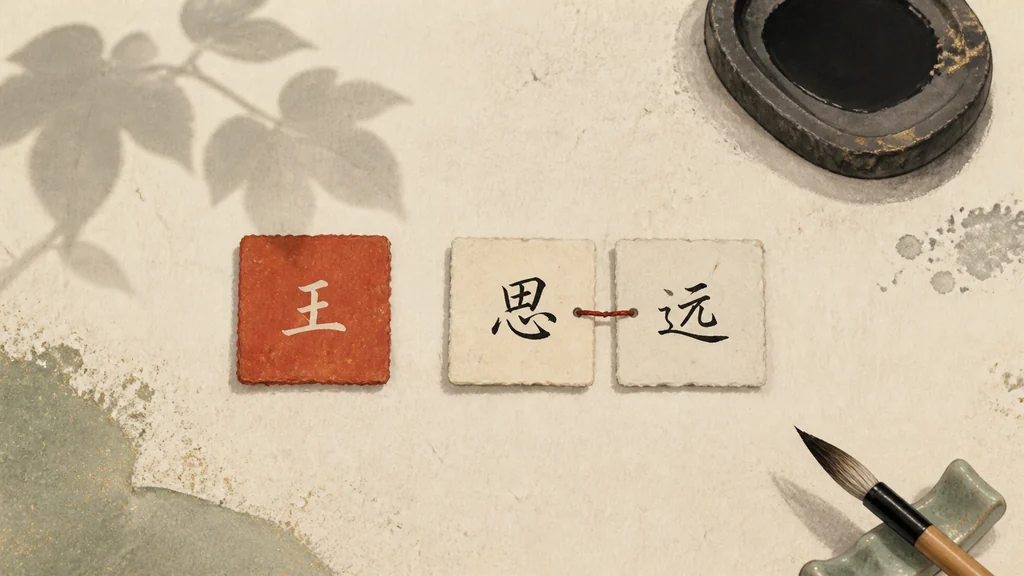
A modern Han Chinese name commonly has a one-character surname followed by a one- or two-character given name. In 王静, the given name is 静. In 陈思远, it is 思远. A compound surname changes the division: 欧阳修 is read as 欧阳 / 修, not 欧 / 阳修. If the name is split incorrectly, a detailed translation will only make the mistake look more convincing.
Surnames can also be ordinary words. 李 may refer to a plum tree and 马 to a horse, but people with these surnames were not necessarily named after fruit or animals. In an English explanation, the surname is usually romanized while the given name receives the semantic discussion.
Dictionary meanings must return to the whole name
明 can suggest brightness or clarity. 宁 may evoke peace. 远 can refer to physical distance and can also suggest a far-reaching outlook or ambition. Which association mattered to the parents depends on the other character and on their intentions.
A two-character name is not a pair of dictionary cards. 思远 may suggest thoughtful foresight or broad aspiration. 雨桐 works more like an image of rain and a paulownia tree. Some names are chosen partly for sound, tone, written balance, or the way they flow after the surname. They were never meant to have one fixed English sentence as a translation.
An outsider can describe the associations a name commonly creates. Only the person or the family can confirm which of those associations motivated the choice.
Some meanings stay inside the family
Siblings or cousins of the same generation may share a generation character. It can come from a sequence recorded in a family genealogy, while the other character is chosen individually. A name may also remember a season, a place, or an event surrounding a birth. Those stories are often invisible on the page.
Names also carry traces of their period. Research on twentieth-century Chinese naming records shifts between one- and two-character given names, while political ideals and changing tastes affected the characters parents favoured. A name can sound characteristic of an era, but that impression cannot establish a person’s exact age.
To explain a Chinese name, separate surname and given name, check the common naming associations of each character, listen to the given name as a whole, and then ask the person. The first three steps produce a responsible interpretation. The last may reveal the family story behind it.
Sound and written form also belong to the name
One romanised syllable can represent many characters. Knowing that a name is pronounced Ming does not tell us whether it is 明, 鸣, 铭 or another graph, and those choices invite different associations. Conversely, one character can have several dictionary senses whose relevance changes beside another character and after a particular surname. Explaining a Chinese name from Latin spelling alone often means guessing the written name.
Parents may also consider tonal movement, accidental phrases created after the surname, visual balance between characters and ease of writing. Those decisions may resist translation into an inspirational sentence, yet they remain genuine naming reasons. An English explanation should separate literal glosses, common cultural associations and the family’s documented intention.
A literary allusion needs a traceable source
Some names draw on poems, classics or historical figures. When the person supplies a source, the original passage can narrow the sense and explain why two characters were selected together. Without that evidence, inventing an ancient-sounding quotation because the characters look elegant turns a possibility into a false biography.
Characters can also be reused across periods. A graph strongly associated with a political slogan in one generation does not give every present-day bearer that political meaning. Frequency by birth cohort can reveal a social trend, but it cannot narrate an individual life.
A Chinese name chosen by a foreign learner needs use-testing
A combination that looks attractive in a dictionary may sound like a brand, place name or strained archaism to native readers. Several speakers familiar with the intended region can check pronunciation, gender impression, period flavour and unintended ambiguity. The person using the name still decides whether those impressions fit.
Meaning also develops through use: how someone introduces the name, what friends shorten it to, and how it relates to the person’s original name can all participate in identity. A responsible explanation does not end after translating characters; it keeps linguistic structure, social response and personal history at distinct levels of evidence.
Sources and further reading
- Zhu Bin and Celia Millward, [Chinese Given Names Since the Cultural Revolution](https://ans-names.pitt.edu/ans/article/view/1220)
- Shouhui Zhao and Richard B. Baldauf Jr, [Language Planning, Naming and Character Use in China](https://www.tandfonline.com/doi/abs/10.2167/cilp117.0)
- Li Zhonghua, [Given names in China: one-character or two-character given names](https://ojs.lib.uwo.ca/index.php/oc/article/view/17747)
- When Politics Froze Fashion: The Effect of the Cultural Revolution on Naming in Beijing
- Zhaoyang Sun, [Every character tells a story](https://www.tandfonline.com/doi/full/10.1080/14708477.2026.2656760)