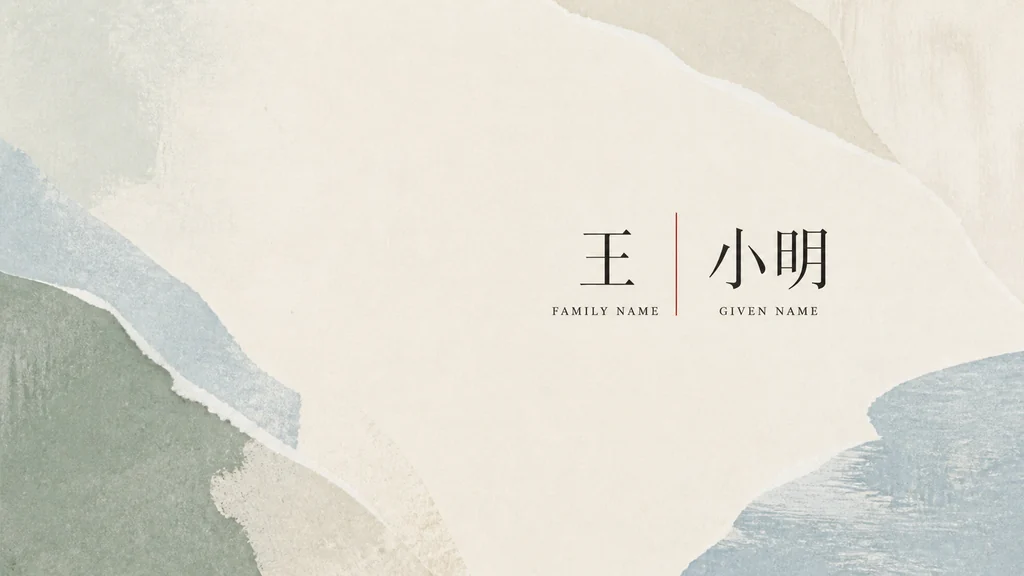
Put the name 王小明 into an English form and the problem appears immediately. The family-name field takes **Wang**; the given-name field takes **Xiaoming**. Yet the finished form may print the name as **Xiaoming Wang**. In a Chinese list, the same person would still appear as **王小明 (Wang Xiaoming)**.
Wang has not become the given name simply because it moved to the end. The parts of the name stayed the same; only their display order changed.
Wang is the family name; Xiaoming is the given name
Chinese names commonly follow the order **family name + given name**. In 王小明, 王 (Wang) is the inherited family name and 小明 (Xiaoming) is the personal name.
The English terms **family name** and **given name** travel well between languages. **First name** and **last name** are less helpful because they name positions in the usual English order. Calling Wang a “last name” when it appears first makes a straightforward Chinese name sound backwards.
One-character family names followed by two-character given names are common, but character count is not a foolproof guide. 欧阳 (Ouyang) is a two-character family name, and a given name may contain only one character. When the division matters, the person’s own spelling, the Chinese characters, or clearly labelled database fields are safer than guessing from syllables.
The family name identifies the family line
The family name links a person to an inherited family identity; the given name distinguishes the individual. Some traditional names also contain a **generation name**, a character shared by relatives of the same generation. Scholars Zhu Bin and Celia Millward describe one common traditional pattern as surname + generation name + given name.
Many modern names do not use a generation character, but the family-name-first order remains. The record supports a long-established naming convention in which the family identifier precedes the personal identifier. It does not support reducing the order to a slogan that Chinese culture values the group while Western culture values the individual.
Writing direction is not an adequate explanation either. The direction in which columns are arranged on a page is separate from the order of the components inside a name.
English contexts may keep or reverse the order
Unicode’s CLDR person-name data treats Chinese as a surname-first locale. A multilingual system can store Wang as the surname and Xiaoming as the given name, then display either Wang Xiaoming or Xiaoming Wang according to the language and context.
The Library of Congress also recognises surname first as the normal Chinese order when cataloguing Chinese names. English-language systems do not have to reverse them.
In practice, passports, publishers, forms and personal preference can produce several arrangements, especially when an English given name is added. Position is a clue, not proof. The person’s chosen form or an explicit surname/given-name label is the best guide.
Capitals and commas are aids, not universal rules
Passports, airline systems and catalogues sometimes capitalise a surname or write WANG, Xiaoming to expose the field boundary. Ordinary prose and social profiles need not follow the same typography. Capitalisation can be useful evidence in a particular record, but it is not a universal grammar for names across systems.
Adding an English name creates further possibilities: David Wang Xiaoming, Wang Xiaoming David and David Xiaoming Wang may all be adopted by individuals or institutions. Three romanised elements do not prove that the middle one is a Western-style middle name. A labelled record or the bearer’s consistent signature is safer.
Sorting, display and address are separate operations
A directory may sort by family name while prose displays the given name first. Spoken address may use a full name, a title plus surname, or a given name according to relationship. None requires the visual order to remain identical everywhere. Software that stores surname and given name separately can render each context without losing identity.
By contrast, storing one undifferentiated “full name” and guessing the surname from the final space breaks compound surnames and surname-first forms. Forms labelled family name and given name, with a preview of the final display, are clearer than rigid first/last assumptions.
Consistency matters most in official use
Everyday introductions can follow the individual’s preferred order. Passports, visas, banking and tickets should match the accepted identity document. If a system reverses the visual presentation automatically, check whether the underlying fields remain correct before entering them in reverse a second time.
Chinese surname-first order is a local naming convention; it does not require a stereotype about national character or an explanation from historical writing direction. The practical rule is simpler: identify the family-name and given-name components first, then choose how the context displays them. Order may change; the identity of each component should not be guessed anew.