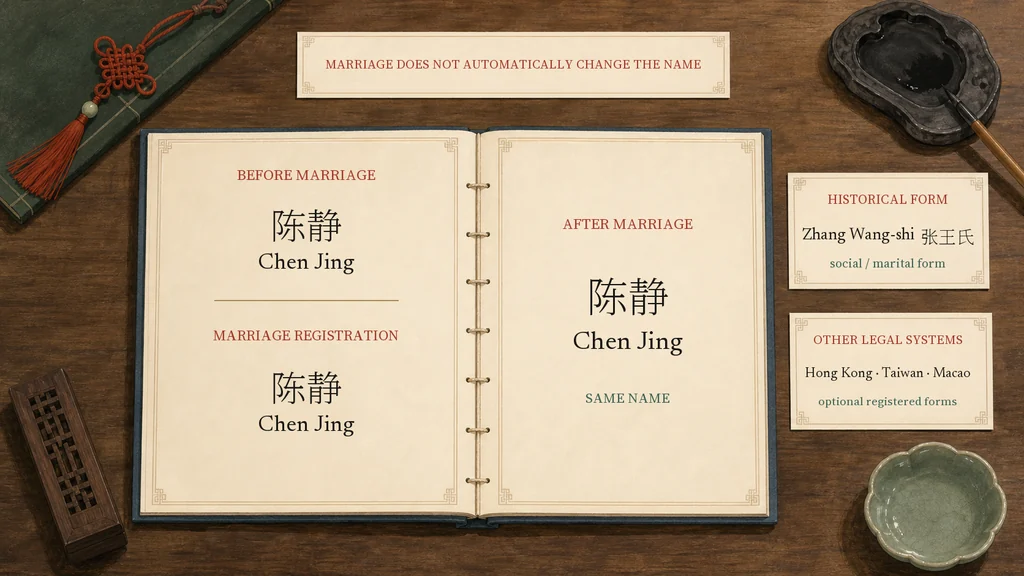
Suppose Chen Jing and Wang Hao register a marriage in mainland China. Their marriage certificate records both names, but Chen Jing’s identity card does not automatically become “Wang Jing.” Women in mainland China normally continue to use the surnames and full legal names they had before marriage.
That answer describes a general rule and practice in mainland China. It does not mean that changing a name is legally impossible, and it should not be stretched to cover every Chinese legal system or every Chinese community overseas.
Marriage registration does not automatically change a surname
Article 1056 of the Civil Code of the People’s Republic of China states that both spouses have the right to use their own names. The right belongs equally to wife and husband. Marriage does not require two people to acquire a shared legal surname.
The revised national Marriage Registration Regulation took effect on 10 May 2025. It sets out the responsible authorities, identification documents, declarations, and procedures for marriage and divorce registration. It does not make a wife’s change of surname, a husband’s change of surname, or a common marital surname a condition of marriage. Nor does a marriage certificate instruct the household-registration system to rewrite either spouse’s name.
Being married and having changed one’s surname are separate facts. Even if someone is addressed socially in English as “Mrs. Wang,” that form alone does not prove that her registered Chinese surname is Wang.
A legal name change is a separate registration
The rule that spouses retain the right to their own names is not a ban on adults changing names. Article 1012 of the Civil Code protects a person’s right to decide, use, or change a name in accordance with law, provided that public order and good customs are not violated. Article 1016 adds that a person who changes a name must complete the required registration formalities.
Detailed evidence and procedures can vary by locality and circumstance. A 2026 service notice from the Jinan Public Security Bureau, for example, lists “change of surname” as a separate household-registration matter, requiring the household register, identity card, and documents connected to the basis for the change.
That local list is not the exact national checklist for every counter. Its value is narrower: it shows that changing a registered surname is its own application, not a step automatically completed when a marriage is registered.
The usual outcome for a woman marrying in mainland China is therefore to keep her existing surname. If an adult has a lawful reason to request a different name, she or he follows the separate name-registration process.
What a historical form such as Zhang Wang-shi meant
Historical documents, genealogies, epitaphs, and family records may call a woman 张王氏 (Zhang Wang-shi). Wang is her natal surname. Zhang, placed before it, identifies the surname of the husband or family into which she married. To an English reader, this can resemble a modern married name.
An official legislative explanation published by the National People’s Congress places such husband-prefixed forms in the context of an older patriarchal marriage system. Article 11 of the 1950 Marriage Law already stated that husband and wife had the right to use their own respective names. The NPC explanation notes that married women’s continued use of their own names became customary after that law. The principle now appears in Civil Code Article 1056.
Historical forms varied across periods, regions, social groups, and kinds of document. Zhang Wang-shi shows that a text used both the husband’s family surname and the woman’s natal surname. Without evidence from the relevant register, contract, or legal system, it does not prove a procedure equivalent to changing a modern identity card.
It is also different from a hereditary two-character surname such as Ouyang. Zhang plus Wang-shi identifies a marital and social relationship; Ouyang is one surname passed as a unit.
Hong Kong, Taiwan, and Macao have different options
The phrase “Chinese women” can refer to people under different legal systems. The mainland rule answers the main question, but Hong Kong, Taiwan, and Macao do not offer identical registration options.
Hong Kong
The Hong Kong government says that a bride who wants to change the registered name on her identity card—for example, from her maiden surname to her husband’s surname—may apply to amend the registered particulars. It is an available option, not a change automatically made by marriage registration.
Taiwan
Article 1000 of Taiwan’s Civil Code states that spouses retain their own surnames. It also permits them, by written agreement and household registration, to prefix a spouse’s surname to their own. The household-registration service offers an online application and requires the written agreement.
This form of guanxing retains the person’s own surname while adding the spouse’s. It should not automatically be translated as abandoning one surname and replacing it entirely.
Macao
Article 1538 of the Macao Civil Code says that each spouse keeps his or her own surnames, but may add no more than two of the other spouse’s surnames. The Macao Legal Affairs Bureau gives the same answer in its official marriage and family guide.
These provisions establish what the law allows. They do not, without statistical evidence, tell us how many people actually use the option. “May apply” and “most people do this” are different claims.
A title, a child’s surname, and a woman’s name are different things
A married woman may accept different social titles in different languages while retaining one registered name. Another person may complete a formal name change. Neither situation can be inferred from the word “Mrs.” alone.
A child taking the father’s or mother’s surname also says nothing by itself about whether the mother changed her surname. The rules governing a child’s surname are a separate question.
Chinese legal names normally place the surname before the given name; the guide to Chinese name order explains the parts in Chinese and English contexts. The guide to Chinese compound surnames on forms explains why Ouyang remains intact and is not two spouses’ surnames temporarily joined together.
When booking a ticket, preparing a visa, opening a bank account, searching an academic record, or addressing a colleague, use the name on the person’s documents and the form she uses herself. Do not guess her surname from her marital status.
Sources and further reading
- Supreme People’s Court: Civil Code of the People’s Republic of China
- National Administrative Regulations Database: Marriage Registration Regulation, revised 2025
- National People’s Congress: Marriage Law of 1950
- National People’s Congress: explanation of spouses’ rights to their names
- GovHK: Getting married
- Taiwan Department of Household Registration: laws concerning names
- Macao Civil Code: Article 1538
- Jinan Municipal Government: changing registered information and surnames