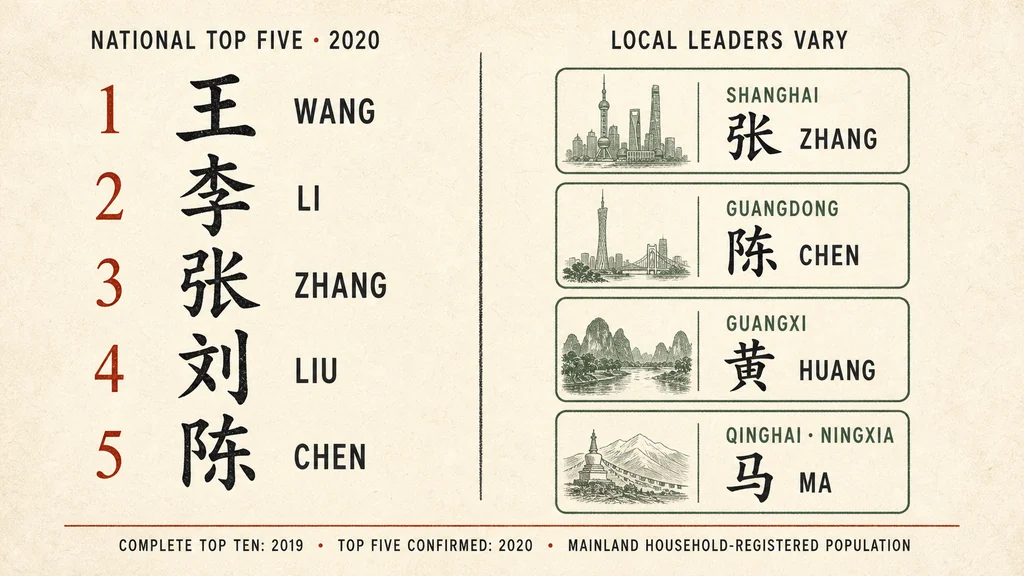
The Hundred Family Surnames begins with Zhao, Qian, Sun, and Li. That famous line is not a modern population ranking. In the 2020 national name report issued by the Chinese Ministry of Public Security’s Household Administration Research Center, the five most common surnames among the registered population of mainland China were Wang, Li, Zhang, Liu, and Chen.
One sequence belongs to a traditional primer; the other comes from a household-registration dataset with a stated year and population scope.
The complete 2019 top ten
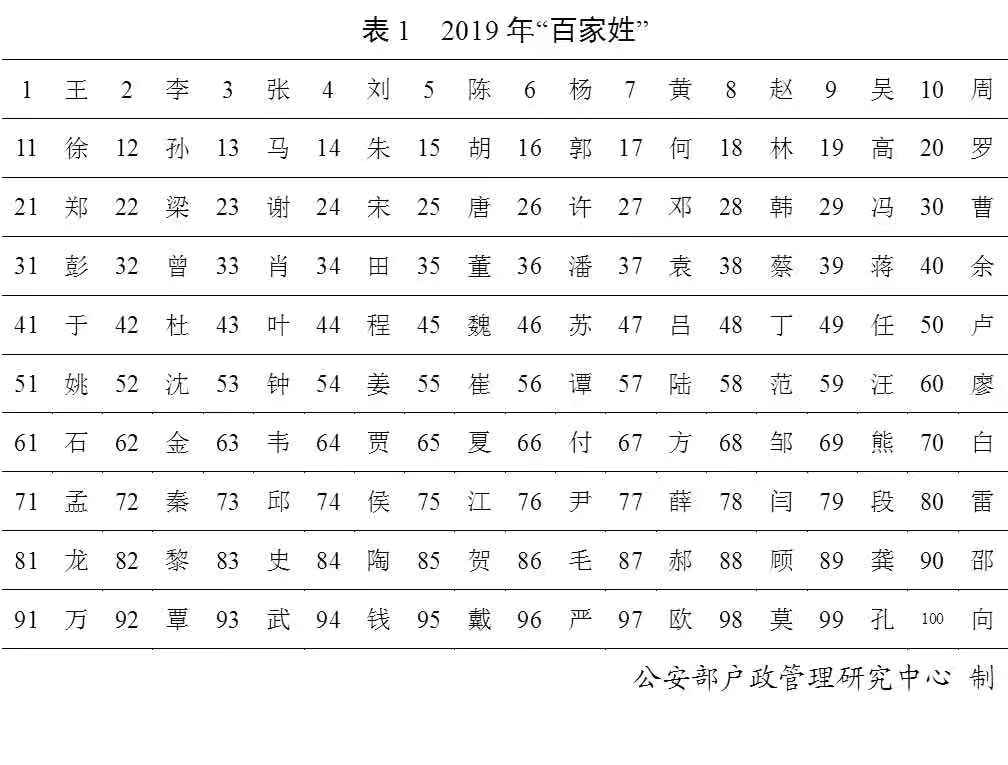
The 2019 national name report drew on China’s national household-registration information system. It covered about 1.4 billion registered people and excluded Hong Kong, Macao, and Taiwan. Its ten most common surnames were:
- 王 Wáng
- 李 Lǐ
- 张 Zhāng
- 刘 Liú
- 陈 Chén
- 杨 Yáng
- 黄 Huáng
- 赵 Zhào
- 吴 Wú
- 周 Zhōu
These are Mandarin pinyin readings paired with the characters counted in the report. In ordinary English they are often written without tone marks: Wang, Li, Zhang, Liu, Chen, Yang, Huang, Zhao, Wu, and Zhou.
The report found more than 6,000 surnames in use. Yet the top 100 already covered 85.9 percent of the registered population. Chinese surnames are highly concentrated without being limited to the hundred names suggested by the title of the old primer.
What the 2020 report updates
The 2020 report confirmed that Wang, Li, Zhang, Liu, and Chen remained the five largest surnames in the same order. Together, those five accounted for 30.8 percent of the nationally registered population.
It also reported that Li was the most common surname among babies born in 2020 and registered that year, with 726,000 such newborns. This does not displace Wang from first place in the total registered population. A newborn ranking counts one year’s registered births; the national surname ranking counts the whole household-registered population.
The full ten-name list above should therefore be labeled as the 2019 ranking. The 2020 publication safely updates the top five and their combined share, but it should not be used to relabel all ten positions as a “2020 top ten.”
The national number one is not number one everywhere
A national total combines populations with different regional histories. In the 2019 report, Wang ranked first in 16 provincial-level regions. Li ranked first in Hubei, Hunan, Chongqing, Sichuan, and Yunnan. Chen led in Zhejiang, Fujian, and Guangdong, while Huang led in Guangxi. Ma, which was not in the national top ten, ranked first in both Qinghai and Ningxia.
Shanghai offers a clear local comparison. A municipal ranking listed Zhang, Wang, Chen, Li, Xu, Zhu, Zhou, Shen, Wu, and Yang as the city’s ten leading surnames among locally registered residents. Nationally first-ranked Wang was second in Shanghai, behind Zhang. Shen, much lower nationally, entered Shanghai’s local top ten.
The provincial analysis did not produce a comparable surname ranking for Tibet. The report noted that Tibet’s population was about 94.3 percent Tibetan and that most household records there registered a personal name without a surname. A “most common surname in Tibet” cannot simply be inferred from the other provincial lists.
Why Zhao comes first in the Hundred Family Surnames
The Hundred Family Surnames, or Baijiaxing, is a four-character rhyming primer transmitted from the Song period. It arranges surnames for recitation rather than sorting them by population.
An explanatory page from Shaanxi Normal University connects its opening, “Zhao, Qian, Sun, Li,” with the political and regional setting of the Song dynasty and the Wuyue kingdom. Zhao was the Song imperial surname. These historical explanations concern the text’s context, not a census in which Zhao had the largest population.
Modern reports sometimes borrow the familiar phrase “hundred family surnames” when discussing the hundred largest surnames. That does not turn the old book into a statistical source.
Wang, Li, and Zhang are Mandarin spellings
Wang, Li, Zhang, Liu, and Chen are pinyin spellings for 王, 李, 张, 刘, and 陈. The characters identify the surname counted in the official ranking; pinyin helps an English reader approximate its Mandarin pronunciation.
Across dialects, regions, and migrant communities, related surnames may appear in English as Lee, Chan, Cheung, and many other forms. One romanized spelling also does not always identify only one Chinese character. An overseas directory organized by Latin-letter spelling cannot be merged directly into mainland household-registration data to recalculate this ranking.
In a Chinese personal name, the surname normally comes before the given name; the guide to Chinese name order explains how that works in Chinese and English contexts. Two-character surnames such as Ouyang have their own practical issues, covered in the guide to Chinese compound surnames on forms.
Whenever a list claims to show the most common Chinese surnames, look for four things together: the Chinese characters, the year, the population covered, and the region. Wang was the largest surname in mainland China’s registered population in the 2020 report. That does not make Wang the leading surname in every Chinese region or every Chinese community worldwide.