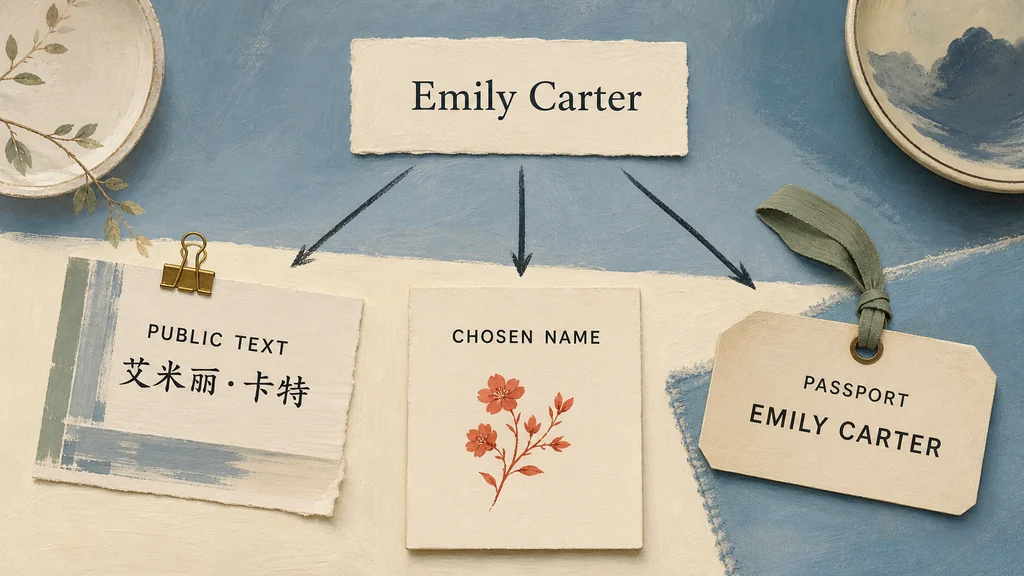
A Chinese visa application separates them on the same form. Family name and given name must match the passport. “Chinese name” appears in another field and is filled only if applicable. The passport name Emily Carter, a Chinese article's 艾米丽·卡特, and a Chinese name that Emily might choose for herself are not three fonts for one database field.
A foreign name can enter Chinese for at least three purposes. News, publishing, and subtitles need a form that Chinese readers can recognize. A learner or resident may choose a Chinese name for social use. Visas, tickets, and contracts need to match identity documents. The purpose determines whether to keep the original spelling, use a public Chinese rendering, or use the person's chosen name.
Official forms follow the passport
The visa instructions require the family and given names as shown on the passport; a Chinese name is optional additional information. Chinese railway guidance likewise tells foreign-passport users to enter the English name and order shown on the document. A fluent-looking Chinese transliteration does not replace the passport-name field.
Systems differ in their field names and technical restrictions. For a ticket, bank account, visa, or contract, follow that institution's instructions and the document being used. If a separate Chinese-name field exists, enter a Chinese form the person actually uses and the system accepts. Inventing characters merely to make the form look Chinese can break the identity match.
A public Chinese rendering helps readers identify a person
Chinese news commonly represents a foreign personal name with characters chosen for approximate sound. Editorial guidance follows the principle often summarized as míng cóng zhǔrén (名从主人): begin with the name's source language and the person's pronunciation, rather than automatically reading every Latin spelling as English.
Editors do not start from zero each time. The Xinhua News Agency Translation Office's major dictionary of world personal names contains about 700,000 entries. Publishers consult such reference works and earlier coverage. Once a public figure has a stable Chinese rendering, keeping articles pointed at the same person can matter more than introducing a newly “more phonetic” set of characters.
China's terminology authority makes the same point in its discussion of scientists' names: following the owner does not mechanically erase established forms. A public rendering provides consistent identification in Chinese text. It does not register a legal Chinese name for that person.
Mainland China, Taiwan, Hong Kong, and other Chinese-speaking communities may choose different characters. For a real person, check the person's own usage, the publication's regional style, and the established rendering in that readership. This article describes a common mainland editorial context, not one worldwide Chinese answer.
A chosen Chinese name is a new naming decision
When a person chooses a Chinese name, the purpose changes. The name will be spoken and written in Chinese interaction. It may preserve part of the original sound, or it may follow a Chinese surname-and-given-name structure with newly selected characters. It need not squeeze every foreign syllable into one character.
Characters in a public transliteration primarily carry sound. 艾米丽·卡特 helps a Chinese reader approach “Emily Carter”; it should not be mined character by character for a personality or blessing. A name intended for long-term personal use needs its whole combination, pronunciation, contemporary impression, and the person's preference checked. How to Choose a Natural Chinese Name covers that separate task.
If a scholar, diplomat, or resident already publishes a Chinese name, an editor should verify that usage before creating a fresh transliteration. Someone who has not selected a Chinese name is under no obligation to acquire one simply because a text or conversation is in Chinese.
Put each form in the setting it was made for
One person can retain an original passport name, have a stable rendering in Chinese reporting, and use a self-chosen Chinese name in daily life. The three forms serve identity verification, public recognition, and social address.
When writing, first check whether the person publishes an established Chinese name, then consult authoritative or widely used renderings. If neither exists, transliterate cautiously from the source-language pronunciation and retain the original where useful. In a meeting, use the name the person supplies. On an official form, follow the document and the field instructions.
There is no context-free conversion that turns every foreign name into one correct row of Chinese characters. A transliteration lets Chinese readers pronounce and recognize a foreign name; a chosen Chinese name belongs to the person's continuing Chinese-language use; a document name maintains formal identity.
For the reverse situation, read Why Do Some Chinese People Use English Names? For character meanings, see What Does a Chinese Name Mean?.
Sources and further reading
- Commercial Press academic publishing style guide
- Xinhua world personal-name dictionary record
- China terminology authority: scientists' translated names
- Study of rare foreign-name translation
- GB/T 16159—2012
- Chinese visa name-field instructions
- Railway-service passport-name guidance
- Principles for Chinese renderings of foreign names