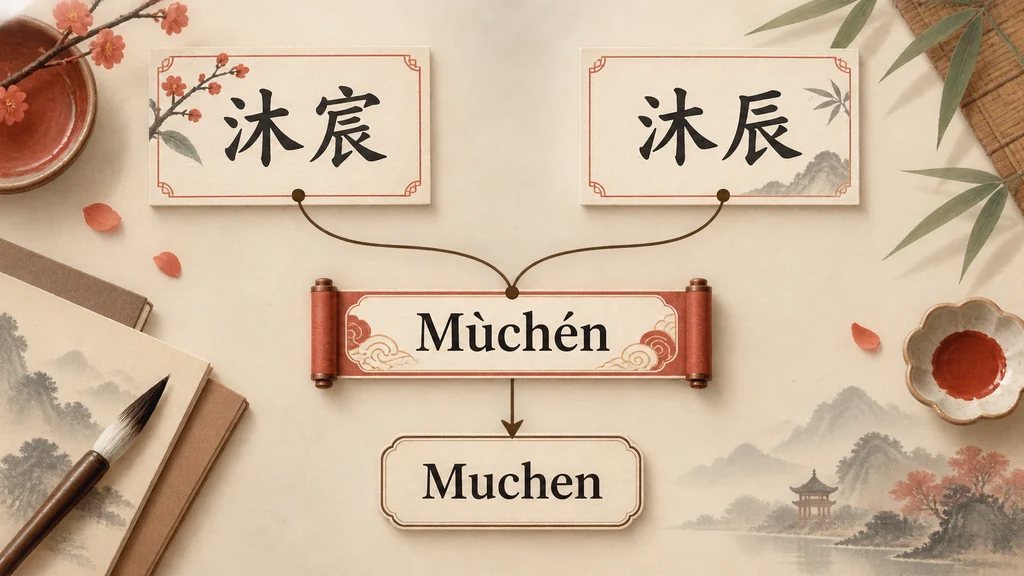
China's 2021 National Name Report lists both 沐宸 and 沐辰 among the ten most frequent names given to registered newborn boys that year. The last characters are different: 宸 and 辰 are not interchangeable pieces of writing. In Mandarin, however, both names are pronounced Mùchén. Remove the tone marks and both appear as Muchen.
Nothing has been misspelled. Hanyu Pinyin represents the sound of Standard Mandarin, while Chinese characters retain distinctions in writing and meaning. When different characters share a pronunciation, the same string of Latin letters can lead back to more than one written name.
Muchén can be written with different characters
The contrast between 沐宸 and 沐辰 sits in the final character. 辰 appears in words connected with time and celestial bodies; 宸 has its own historical meanings and associations in names. A family's reason for choosing one belongs to the person's actual written name and naming context. The pronunciation Mùchén alone cannot reveal it.
Names scholars Binbin Zhu and Julie Millward describe the wider problem. Chinese has many homophonous characters, so a sound-based romanization removes distinctions that remain visible in the Chinese script. Their paper notes that even when tone is included, the surname pronounced Yú can represent at least five different surname characters. Tone narrows the field without necessarily leaving a single answer.
For how meanings arise from the chosen characters and their combination, see What Does a Chinese Name Mean? The point here is narrower: identical pronunciation does not guarantee identical writing or meaning.
Muchen without tones loses another layer
A Mandarin syllable is commonly analyzed in terms of an initial, a final, and a tone. Yī, yí, yǐ, and yì share the letters yi but have different tones. In an English article, email address, or database that omits tone marks, all four are displayed as yi.
That creates a different ambiguity from 宸 and 辰. Unmarked Yi first collapses pronunciations that differ in tone. The syllable chén, by contrast, is identical in initial, final, and tone for both characters. Adding the tone mark solves some of the first problem but none of the second.
Chinese pinyin orthography marks a character's underlying tone, rather than rewriting it for tone changes that occur in connected speech. The stable written form therefore does not attempt to record every pitch adjustment in each spoken sentence.
A space separates surname and given name, not characters
China's rules for spelling personal names in pinyin separate the family name from the given name and capitalize the beginning of each. A two-character given name is written together. In Wáng Jiànguó, for example, Wáng is the surname and Jiànguó is the given name.
The space preserves name structure; it does not restore character shapes. Knowing that Li is the surname still may not tell you whether the person writes it 李, 黎, or with another surname character actually used in their name. If tones are absent, surnames with different tones also collapse into the same letters. Capitalization cannot recover those distinctions either.
Whether a romanized name keeps family-name-first order or appears in another order is a separate question. Why Does the Family Name Come First in Chinese? explains that issue. Changing display order does not change the underlying characters.
Identify the person through characters and records
Computer scientists Kui-Lam Kwok and Peter Deng studied how to resolve pinyin names found in English text. Their method needed a database of names, probabilities for possible character forms, and evidence from the surrounding corpus. Pinyin supplied a pronunciation range; other information had to identify the intended written name.
Scholarly publishing shows the practical consequences. Different authors can share the same pinyin name, while one author may appear under several orders, abbreviations, or historical romanizations. Recent research recommends using Chinese characters, institutional affiliation, research topics, and persistent identifiers such as ORCID. Matching only the Latin-letter string can merge two people or split one person's record.
An everyday introduction needs no algorithm. Ask the person how their name is written, or use the characters they provide on a name card, email signature, or profile. For formal transactions, follow the name fields in identity documents and authoritative records. If only pinyin is available, the accurate answer may simply be that the characters are not yet known.
Frequency cannot choose them on a stranger's behalf. The national report proves that 沐宸 and 沐辰 both occur and were both frequent in that particular list. It does not prove that a person shown as Muchen uses either one. A character may also have more than one pronunciation, so the person's own reading or a reliable record remains decisive.
Pinyin helps readers pronounce a Mandarin name and provides a standardized Latin-letter form where Chinese characters are inconvenient. It does not promise to reverse sound into one unique spelling. To identify which written name a person has—and what its characters may mean—you still need the characters that person uses and reliable identity context.
For a related example in which Lingling cannot reveal whether a form is a nickname or a complete given name, read Why Do Chinese Nicknames Repeat a Syllable? If you are choosing a new name rather than identifying an existing one, use How to Choose a Natural Chinese Name.
Sources and further reading
- Ministry of Education: Scheme for the Chinese Phonetic Alphabet
- GB/T 28039—2011: spelling rules for Chinese names
- GB/T 16159—2012: basic pinyin orthography
- Zhu and Millward: “Personal Names in Chinese”
- Kwok and Deng: “Corpus-Based Pinyin Name Resolution”
- Cao, Xu, and Iso-Sipila: person-name analysis
- 2021 National Name Report
- Xu and Hu: author-name ambiguity