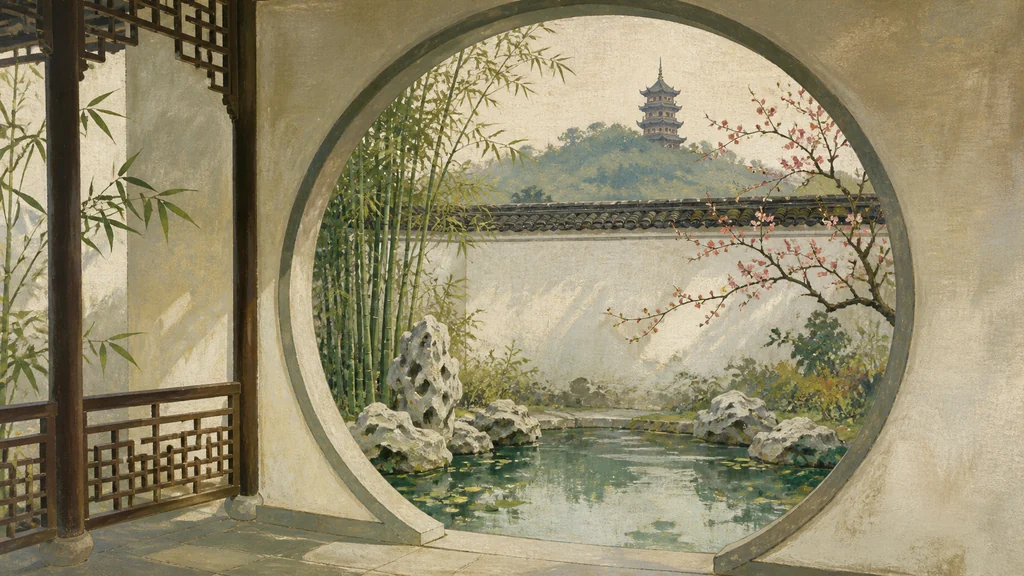
Stand inside a garden and the foreground may contain a pond, a few rocks and a white wall. Above that wall, however, a distant pagoda or a ridge outside the property appears. The garden maker has not moved either object. The design simply lets it enter the view from a carefully chosen position. This is the idea now commonly called jiejing (借景), or borrowed scenery.
The “borrowing” is visual and spatial. The object remains outside the garden, while paths, buildings and planting establish a place from which it seems to join the water, branches or roofline nearby. Move a few steps away and the composition may fall apart.
A framed view is not always borrowed scenery
Doorways and lattice windows often help by hiding clutter and retaining a particular direction. Seeing bamboo through a window does not automatically make the scene jiejing. If the bamboo grows inside the same garden, the opening is primarily framing an internal view. When it draws an external pagoda, riverbank or neighbouring tree canopy into the garden’s composition, it matches the most familiar modern meaning of borrowed scenery.
Framing and borrowing can happen together, but they describe different things. Framing concerns the edge of the picture. Borrowing concerns the way something beyond the garden boundary participates in the space within it.
The classical gardens of Suzhou occupy limited urban plots, yet their views can feel deeper than their property lines. A doorway may form the foreground, with a pond and trees in the middle distance and a pagoda rising beyond the wall. The wall remains important: it removes unwanted detail so that the pagoda appears only where the designer wants it. As a visitor turns along a covered walk, the same landmark may vanish behind an eave and return between branches.
The historical idea is wider than a distant view
Ji Cheng devoted the final chapter of his seventeenth-century garden treatise Yuanye (园冶) to jiejing. The discussion is broader than the modern shorthand of “framing a distant mountain.” It also attends to seasons, sounds, human activity and the conditions already present at a site.
Modern teaching often divides borrowed scenery into categories such as distant, neighbouring or upward borrowing. These labels can be useful for describing a view, but they should not be presented as a fixed list copied directly from Yuanye.
To recognise borrowed scenery in a garden, first locate the viewing position. Then identify what lies beyond the garden boundary. Finally, notice how walls, openings, plants, roofs and water select that external feature. The technique exists in the relationship among those parts, not in a window alone.
The property boundary remains while vision moves beyond it
Borrowing does not pretend that the wall has disappeared. It actively uses the wall. A pale surface can remove untidy nearby roofs while allowing a pagoda tip or ridge to cross its upper edge. Branches can conceal part of the landmark and connect it to planting inside; water may introduce a reflection. The legal plot stays the same size while the perceived depth exceeds it.
This dependence makes external scenery vulnerable. A mountain, established tree canopy or distant tower may participate for generations, while a billboard or later building can interrupt the relation. Unlike a rock placed inside the garden, the borrowed object is not controlled by the garden owner.
Movement and time make the view recur
A single photograph through a circular opening easily reduces the method to a static frame. Covered walks, turns and successive doorways organise a sequence: the external landmark appears at one point, disappears behind foliage or an eave, and returns from a different angle. The visitor’s movement is part of the composition.
The discussion in Yuanye also opens borrowing to seasons, sounds and activities. Dense summer leaves and bare winter branches change visibility. A bell can cross a boundary even when its source cannot be seen. Wind and birds from neighbouring water may join the experience. What is borrowed can therefore be a condition of a place at a particular time, not merely one distant object.
Framing, facing and borrowing can overlap
A doorway may create a frame, an axis may terminate in an arranged focal object, and the object inside that frame may also stand outside the property. Several design relationships can operate at once. The categories are descriptive aids rather than boxes that force a scene to have only one name.
Evidence remains the guide: locate the viewing point, confirm whether the selected feature crosses the garden boundary, identify the elements that reveal or conceal it, and observe changes with position and season. A plan or sequence of photographs explains the mechanism more reliably than the vague statement that a window “looks like a painting.”
Sources and further reading
- UNESCO World Heritage Centre, “Classical Gardens of Suzhou.” https://whc.unesco.org/en/list/813
- Wybe Kuitert, “Borrowing scenery and the landscape that lends—the final chapter of Yuanye.” https://doi.org/10.1080/18626033.2015.1058570
- Hongjun Zhou, Ryohei Ono and Akio Shimomura, “The Evolvement and Variety of the Term of Borrowed Scenery in Chinese Gardening.” https://doi.org/10.5632/jila.74.389
- Chinese University of Hong Kong Library, Yang Hongxun, “Jiejing (Borrowed Scenery) in the Chinese Garden.” https://hkapi.lib.cuhk.edu.hk/items/a2cf02b5-66ab-4769-8ff9-a2f37a458c5d