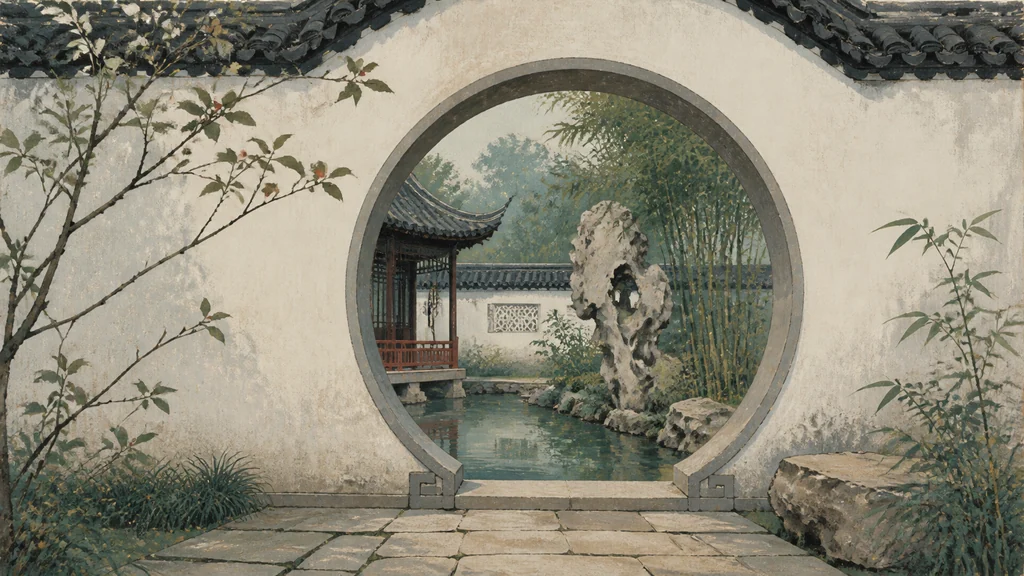
Stand in front of a moon gate and the next courtyard does not appear all at once. The round opening may show a few branches, a garden rock, the corner of a pavilion, or a strip of water. The wall hides the rest. As you approach, the picture grows; after you cross the threshold, the space opens fully.
It begins as a passage on the garden route
Walls and covered walks in Suzhou gardens often contain open doorways without doors. A circular opening is commonly called a moon gate or moon doorway because its outline resembles the moon.
Garden openings also come in square, hexagonal, octagonal, begonia-flower, gourd, and leaf shapes. The circle is memorable, but “moon gate” is not a name for every opening in a Chinese garden. Its first job is also practical: it lets a visitor move from one courtyard to the next.
Its position decides what appears inside the circle
A solid wall removes visual clutter. What remains inside the opening can be read like a picture. A garden designer positions the doorway so that plants, rocks, a pavilion, or a distant roof fall within its edge. The frame stays still while the composition changes with each step.
In the Loquat Garden at the Humble Administrator’s Garden in Suzhou, a brick moon gate frames the Pavilion of Fragrant Snow and Rosy Clouds among trees on a distant hill. Walk through and look back: the same circle now contains the Pavilion of Fine Fruit among the loquats. One doorway composes a view in each direction.
The Astor Court at the Metropolitan Museum of Art was built with reference to the Master of the Nets Garden in Suzhou. Museum publications likewise describe its windows and moon gate as frames for views seen from different positions. The circle supplies an edge; the visitor’s viewpoint and the scenery beyond complete the image.
Crossing the opening unfolds another layer
From one side, a visitor receives a preview of the next courtyard. After crossing, the previous court becomes the view behind. The wall continues to divide the spaces while the opening keeps them visually connected. The Suzhou garden authority describes this interpenetration as a way to increase the apparent depth of a garden.
Words above the opening may guide attention as well. One Suzhou moon gate bears the inscription “Lock and Key of Clouds and Mist.” Beyond it lies a waterside inner garden. Before visitors enter, the phrase has already directed them towards the hazy atmosphere of water and vapour.
The moon gate takes its name from its moon-like outline. A circle may also suggest completeness, cosmological ideas, or entry into another realm, but these associations do not provide a universal explanation for every gate. Its location on the route, the view beyond, the reverse view, and any inscription offer firmer evidence.
The circular frame is not a fixed photograph
Distance changes what the opening contains. Close to the threshold, the circle nearly fills the field of vision. Farther back, the wall becomes visible as empty ground and the pavilion, rocks and trees compress into a smaller composition. The design addresses a moving experience, not only one optimal camera position.
The two sides need not be equivalent. The Humble Administrator’s Garden example shows the same circle composing one pavilion in the northward view and another when a visitor looks back. Forward view, reverse view and the turn after crossing all contribute to placement. Inspecting only one direction misses half the design.
A doorway and an open window are not the same
A doorway admits a body and joins a walking route; an openwork or unglazed window primarily provides light, ventilation and a view. Both can frame scenery, which makes them easy to confuse in photographs. Whether the opening meets a path, reaches the floor and functions in bodily circulation helps distinguish them.
The circle is also only one among many doorway shapes. Begonia, gourd and polygonal openings can perform related work with different outlines. Calling every garden opening a moon gate erases the broader system of doors and windows in Chinese gardens.
An inscription adds language to the view
“Lock and Key of Clouds and Mist” is not a universal definition of moon gates. It is a particular inscription related to the waterside garden beyond it. Visitors read the phrase and then notice vapour, reflections, foliage and architecture through the opening. Language directs attention.
Museum language comparing a moon gate to entry into another world can capture the experience without proving a fixed religious function. A careful explanation separates curatorial metaphor, modern aesthetic association and historical site evidence. The gate remains evocative without assigning every later idea to its original designer.
Sources and further reading
- Suzhou Gardens and Landscaping Administration, [Architecture in Suzhou Gardens](https://ylj.suzhou.gov.cn/szsylj/ylys/201903/484421d38f504f5787a8f307925e3ad7.shtml)
- Suzhou Local Chronicles Office, [The moon gate in the Loquat Garden](https://dfzb.suzhou.gov.cn/dfzb/fzxh/201704/298ecfc1035f44b4b24ed541427af4d5.shtml)
- Metropolitan Museum of Art, [A Chinese Garden Court](https://resources.metmuseum.org/resources/metpublications/pdf/A_Chinese_Garden_Court.pdf)
- Metropolitan Museum of Art, [Chinese Gardens](https://www.metmuseum.org/exhibitions/listings/2012/chinese-gardens)
- Metropolitan Museum of Art, [Astor Court Family Guide](https://www.metmuseum.org/-/media/files/learn/family-map-and-guides/edu3337_asianart_astorcourt_family_guide_061721_v8.pdf)
- Suzhou Gardens and Landscaping Administration, [Moon Gate Inscriptions](https://ylj.suzhou.gov.cn/szsylj/ylwh/201604/c8b6aa5a5560499493494fb5eb80b0e7.shtml)