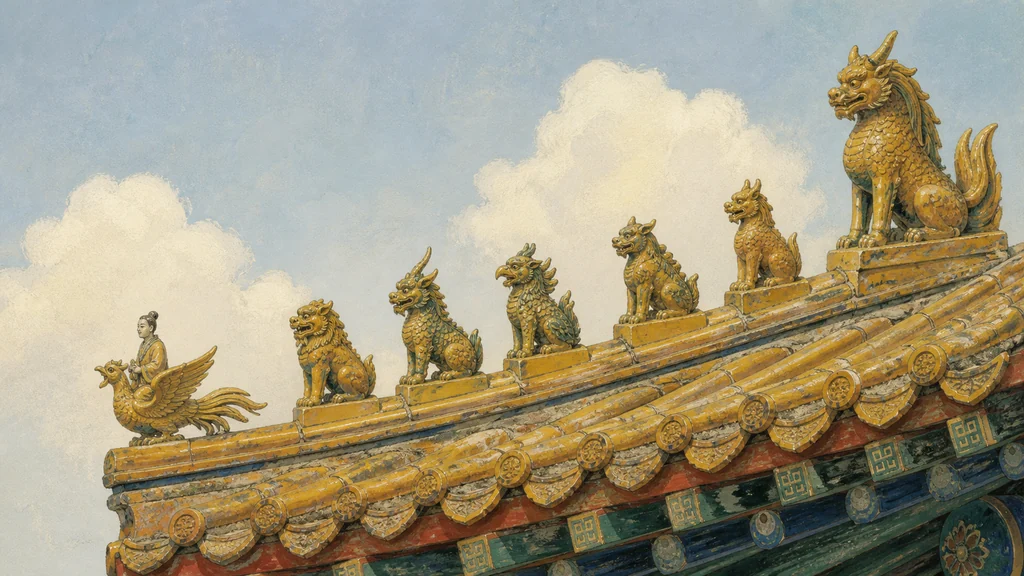
On the roof corners of the Hall of Supreme Harmony in Beijing, ten small beasts follow a figure riding a phoenix. On a lower-ranking Qing official building, the procession may shrink to nine, seven, five, three, or just one. The rider at the front is not included in the number of “beasts.”
A complete diagonal-ridge procession has several parts. The immortal riding a phoenix stands nearest the eave. The line of seated creatures behind him are the processional beasts, or zoushou (走兽). Farther up the ridge is a larger terminal figure. They may all look like “roof animals” from the ground, but official counts distinguish their positions.
Count the beasts behind the rider
Qing official architecture normally used one, three, five, seven, or nine processional beasts. More important buildings were generally permitted longer rows. The English guide published by Prince Kung’s Palace Museum describes this as a ranking system in which the number increases with the significance of the building.
The animals were not chosen at random. The full nine-beast order begins with the dragon, followed by the phoenix, lion, heavenly horse, sea horse, suanni, yayu, xiezhi, and douniu. A roof allowed three uses the dragon, phoenix, and lion; a five-beast roof continues with the two horses.
These ceramic or glazed figures were tied to the physical construction of the ridge. A Henan Museum record for a Qing yellow-glazed ridge beast connects such pieces with covering fasteners and securing ridge components. Their forms, colours, and numbers later carried decorative and hierarchical meanings as well.
The Hall of Supreme Harmony adds Hangshi
The ordinary sequence stops at nine. The Hall of Supreme Harmony adds a tenth figure after douniu: 行什 (Hangshi). Palace Museum research treats Hangshi as an extra tail figure beyond the prescribed nine, marking the hall’s exceptional status.
The hall’s “ten beasts” are therefore dragon, phoenix, lion, heavenly horse, sea horse, suanni, yayu, xiezhi, douniu, and Hangshi. The mounted immortal still stands in front, and another ridge component closes the upper end. Counting every figure produces a larger total, but that is no longer the official count of processional beasts.
The identity of the rider is less certain. Popular stories call him a relative of Jiang Ziya or King Min of Qi rescued by a phoenix. A review of the book Mythical Beasts in the Forbidden City on China’s National Reading platform notes that neither story has historical evidence.
Researchers instead compare the figure with earlier ridge images of Buddhist kalaviṅka, immortals, and Daoist “perfected persons.” The familiar phoenix-riding form became widespread on imperial buildings from the Ming period onward. The later stories are part of the figure’s folklore, not proof of a historical identity.
The number rule belongs to a particular building system
The sequence of one, three, five, seven, and nine is most useful for Qing official architecture, especially high-ranking buildings with glazed tiles. Regional temples, ancestral halls, and houses developed other ridge ornaments, materials, and arrangements. Earlier roofs did not all carry the same complete procession.
A row of small animals can indicate rank only after the building’s period, region, and architectural system are known.
Find the beginning and end before counting a photograph
An upward-looking photograph compresses the ridge, and the mounted immortal may overlap the first dragon. Locate the rider nearest the eave, then count from the dragon behind him. The larger terminal beast higher on the slope belongs to another component category. If either end is cropped, report only the visible figures rather than claiming a complete procession.
The creature names should not be forced into modern zoological species. Tianma, haima, suanni, xiezhi and douniu are historical mythical names. Transliteration with a short explanation is often more accurate than turning all of them into generic lions, horses or fish.
Rank needs confirmation from the building
A longer row generally indicates higher status within Qing official architecture, but the count cannot authenticate a building by itself. Repairs may replace components, and revival-style commercial buildings may copy a full sequence. Name, date, roof form, glaze and documentary history should corroborate the inference.
The Hall of Supreme Harmony is persuasive because several facts align: it is the principal hall of the Forbidden City, its sequence exceeds the normal nine-beast ceiling, and Palace Museum research identifies Hangshi’s exceptional position. Copying ten figures onto a modern roof does not confer the same rank.
Construction, decoration and symbolism can coexist
Connections to fasteners and ridge protection do not cancel later auspicious and hierarchical roles. One component can address a roof joint, create a rhythmic silhouette and communicate institutional status. Describing it only as waterproof hardware or only as a supernatural guardian removes part of the evidence.
A reliable account first defines location and counting, then explains the Qing ranking system, and only afterwards discusses construction and folklore. Readers can identify the ridge line in front of them while knowing which stories are later narration rather than documented origin.
Sources and further reading
- Prince Kung’s Palace Museum, [Processional Beasts](https://en.pgm.org.cn/2024-05/07/c_1122478.htm)
- Palace Museum Youth, [The Mysterious Beasts on the Roof Ridges](https://young.dpm.org.cn/en/info/1097)
- Palace Museum, [Research on Hangshi at the Hall of Supreme Harmony](https://www.dpm.org.cn/Uploads/File/2018/06/04/u5b1530b6437db.pdf)
- Henan Museum, [Yellow Glazed Roof Ridge Beast](https://english.chnmus.net/en/collection/details.html?id=418101185334805051)
- China National Reading, [Review of *Mythical Beasts in the Forbidden City*](https://www.nationalreading.gov.cn/tshzx/202512/t20251210_941933.html)
- Shanghai Landscaping and City Appearance Administrative Bureau, [Immortal and Processional Beasts](https://lhsr.sh.gov.cn/jnylwh/20220222/ccc891ca457a4c76a9729231c3c48838.html)