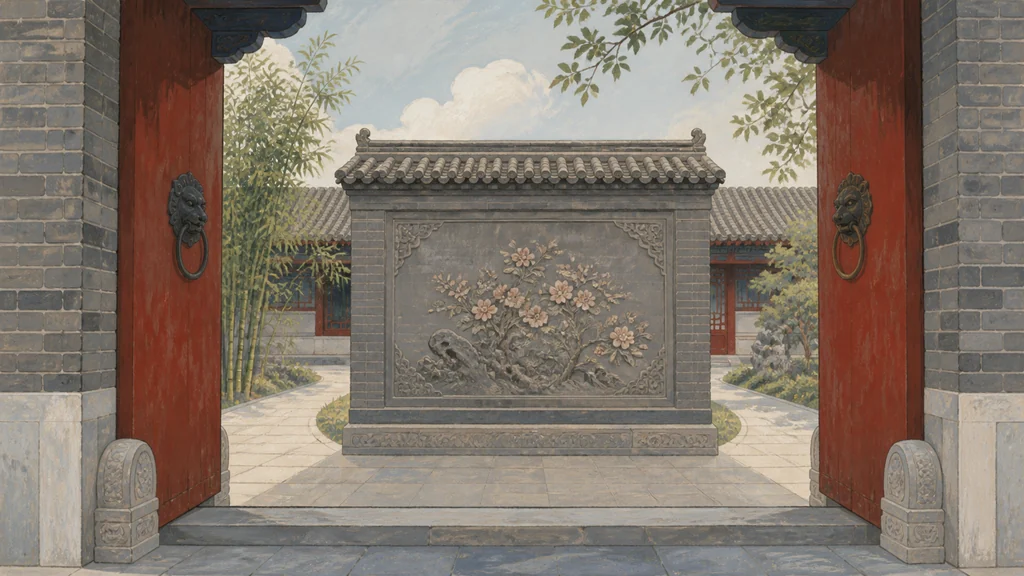
A Beijing courtyard gate can stand open while the principal rooms and people inside remain invisible from the lane. A wall just beyond the entrance catches the view. Visitors turn beside it before entering the courtyard.
This wall is called a zhaobi (照壁) or yingbi (影壁). It does not close the entrance. Instead, it creates a short transitional space between street and household. People outside cannot look straight through, and opening the gate does not expose the entire courtyard.
The Palace Museum gives three direct functions: blocking sightlines, separating inside from outside, and providing decoration. Because the wall is often the first complete surface seen after entry, brick carving, glazed tile and auspicious motifs can be concentrated there. The screen also helps one entrance, forecourt and inner living area unfold in sequence.
Feng shui is one part of the history
Traditional feng shui explanations treat a straight rush of air or qi towards the gate as something to be moderated. Prince Kung’s Palace Museum records this interpretation alongside observable architectural effects such as screening, zoning, decoration and spatial depth.
The two kinds of explanation answer different questions. Feng shui records how historical users understood and valued the wall. Privacy, a redirected route and a divided view can be read directly from the plan. Architectural function does not require dismissing the belief, and the belief should not replace the physical evidence.
Screen walls also vary in position and form. One may stand independently inside a gate, attach to the gable wall of a wing room, sit outside the entrance, or flank a large institutional gateway. Imperial and temple examples can use elaborate glazed tiles. Monumental Nine-Dragon Walls turn the screen itself into a major visual object.
For an English architectural description, “screen wall” clearly states what the element does. “Spirit wall” or “spirit screen” adds a religious or folk-belief emphasis and is best used when the source actually discusses spirits, qi or geomancy.
It changes the order of seeing and moving
The clearest way to understand a screen wall is to follow a visitor. When the gate opens, the wall receives the first view. The visitor cannot continue on a single straight path but must turn around one end. That small diversion prevents the lane, gateway and domestic court from appearing all at once. Residents gain visual shelter, while a guest passes through a brief threshold before entering household space.
A screen wall is therefore not simply another boundary wall. A perimeter wall defines the property edge; a screen reorganises sight and movement at an opening that already exists. It need not support a roof. Identifying one depends on its relationship to the gate, courtyard and route, not merely on whether its surface carries decorative brickwork.
Position changes the emphasis
A freestanding wall just inside a gate directly blocks the view from the street. A screen built against the gable of a wing can use an existing building surface to produce a similar turn. Screens outside a gate, or paired around the entrance of a large institution, face a more public setting and may act as conspicuous architectural fronts as well as devices of concealment and direction.
Glazed screens and Nine-Dragon Walls in palaces or temples can become monumental objects in their own right. A residential screen usually works within a much tighter entrance sequence. Sharing the category yingbi does not mean that these examples had the same scale, audience or symbolic rank.
Decoration belongs to the entrance sequence
Because the wall occupies the first focused viewpoint after entry, its ornament is not an arbitrary sticker. Brick carving, tilework, characters and auspicious motifs turn a required pause into a composed scene and can state wishes associated with the household or institution. The exact motif still needs case-by-case interpretation: a longevity character, a bat combination and an imperial dragon do not carry identical implications in every location.
A sound description should establish where the wall stands, what it hides, how a person moves around it and what appears on its surface before adding a documented geomantic or folk explanation. This avoids reducing the object to a simplistic “wall that stops ghosts,” while still preserving the beliefs through which historical users understood it.
Compare the view with and without the wall
A plan, doorway photograph and reverse view can test an interpretation. Stand outside the gate and record what the screen hides; move around its end and note when the main court appears. This reveals whether the wall primarily blocks a direct view, redirects circulation, marks an inner boundary, or serves as a monumental front. Ornament alone cannot answer those questions.
The same method keeps regional and institutional differences visible. A compact Beijing residence, a temple forecourt and an imperial glazed screen may share a family resemblance while organising very different scales of movement and authority.
Sources and further reading
- Palace Museum, “Zhaobi.” https://www.dpm.org.cn/lemmas/243943.html
- Palace Museum, “Yingbi.” https://www.dpm.org.cn/lemmas/241573.html
- Prince Kung’s Palace Museum, courtyard culture and screen walls. https://www.pgm.org.cn/pgm/wftj/201808/659b8f7a45bc497ab12d233be3ea6caf.shtml
- Beijing Municipal Cultural Heritage Bureau, gate and screen-wall sightlines. https://wwj.beijing.gov.cn/bjww/resource/cms/article/362762/515604/2018071114320631049.pdf
- Mengbi Li, “The evolution of the zhaobi.” https://doi.org/10.1080/13602365.2020.1734049