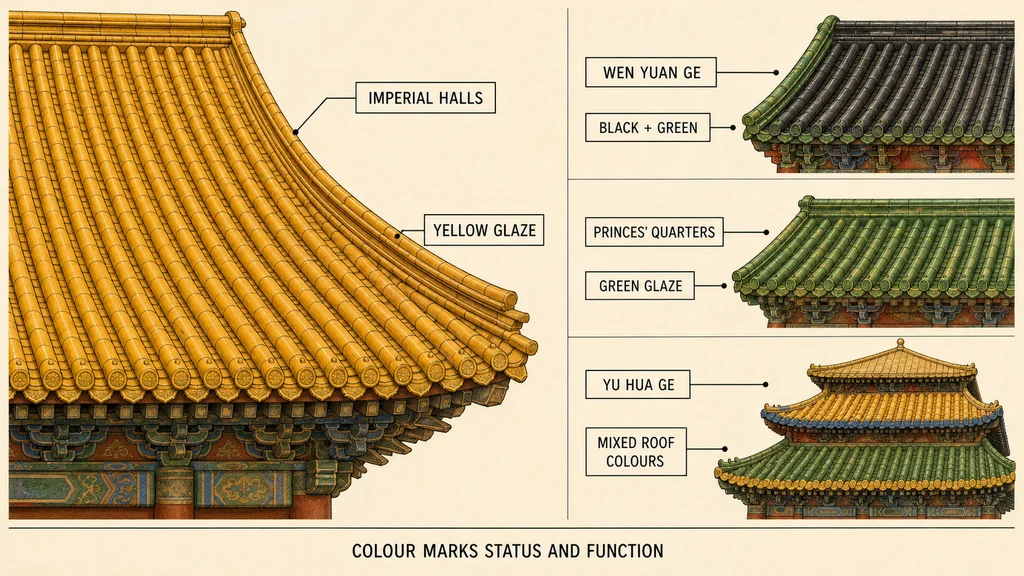
From Jingshan Hill, the Forbidden City looks as if it has been roofed in gold. Up close, the surface is not metal. Rows of ceramic tiles carry a fired yellow glaze that catches the sun.
During the Ming and Qing dynasties, that colour also carried institutional weight. Yellow-glazed roofs marked the emperor and the highest imperial buildings. Yet the palace contains black, green, blue-edged, and mixed-colour roofs as well. Those exceptions show that roof colour identified function and status rather than simply decorating a uniform skyline.
The yellow surface is glaze over a ceramic tile
An architectural glazed tile has a ceramic body and a coloured glaze layer. A scientific study of early Ming yellow-glazed tiles found a high-lead, low-temperature glaze in which iron contributed to the colour. The result belongs to the tested early Ming samples; it is not a timeless formula for every kiln and repair campaign.
The glaze produces colour and shine and helps limit water entering the tile body. It does not make a roof indestructible. Temperature changes, freezing and thawing, moisture, and long exposure can crack or detach glaze and weaken the ceramic beneath it.
Kiln conditions, recipes, age, weathering, and replacement tiles also produce visible differences. “Forbidden City yellow” should not be treated as one exact modern colour code.
Yellow tiles had to match the building's status
The Palace Museum describes strict Ming and Qing controls over architectural glazed ceramics. In Qing regulations cited by the museum, princely residences could use green glazed tiles on principal gates and halls, while officials and common households were forbidden to use glazed roof tiles without authority. Yellow glazed tiles were associated with imperial palaces and tombs, as well as temples or ritual buildings that received imperial permission.
This was an architectural rule, not a ban on every yellow object in ordinary life. Colour was also only one part of the hierarchy. Roof form, tile size, painted decoration, and the number of ridge figures could further distinguish buildings.
The Hall of Supreme Harmony and the Hall of Preserving Harmony both have yellow roofs, but research combining the Da Qing Huidian with surviving fabric identifies different tile sizes. The first uses larger second-size tiles; the second uses third-size tiles. The theoretically largest first-size tiles were not simply placed on the most important hall. Written categories must be checked against actual construction.
Yellow placed the imperial palace at the “centre”
Palace Museum researchers also explain the main colour scheme through the Five Phases and five directions. Yellow corresponds to earth and the centre; red corresponds to fire. Red walls and yellow roofs can therefore be read through the generative relation in which fire produces earth.
For the Ming and Qing seat of government, yellow made centrality visible across the skyline. This is a cultural framework for interpreting and arranging colour. It is not the chemical reason a glaze fires yellow, nor does it erase practical questions of supply, approval, maintenance, and architectural function.
The imperial library creates a black roof among the yellow ones
Behind the Hall of Literary Glory stands Wen Yuan Ge, completed in 1776 to house the Siku Quanshu, or Complete Library of the Four Treasuries. Its roof uses black glazed tiles with green glazed edging. The Palace Museum relates black to water in the Five Phases and explains the colour as a wish for water to restrain fire around a library.
Symbolism did not make the roof a fire-suppression device. Nor was black and green the library's unchanging colour from the beginning. A 2024 study in npj Heritage Science notes that an earlier Ming Wen Yuan Ge in Beijing had a yellow-tiled roof. The extant scheme belongs to the Qianlong-period reconstruction of the imperial library.
Wen Hua Dian changed from green to yellow
Wen Hua Dian, the Hall of Literary Glory, once served as a place where the crown prince conducted affairs. The Palace Museum connects its former green glazed roof with its eastern location, the association of east with wood, and the growth of the heir.
In the Jiajing reign, the building again became an imperial side hall and a venue for classical lectures. Its roof changed to yellow. The building did not move; its user and function changed, and the colour followed.
Palace gardens and religious buildings use still more combinations. Jing Fu Gong has green tiles with yellow edging. At Yu Hua Ge, the lower roof uses green tiles with yellow edging, the middle roof uses yellow tiles with blue edging, and the top is covered with gilded copper tiles. Three levels carry three roof treatments suited to the layered appearance of this Tibetan Buddhist building.
The colour of a roof is useful evidence, but it should be read with the building's date, function, form, and documented history. To identify the shapes beneath those colours, see four common Chinese roof types. The guide to Chinese roof-ridge beasts explains another visible ranking system, while why Chinese roofs curve upward separates colour from roof geometry.