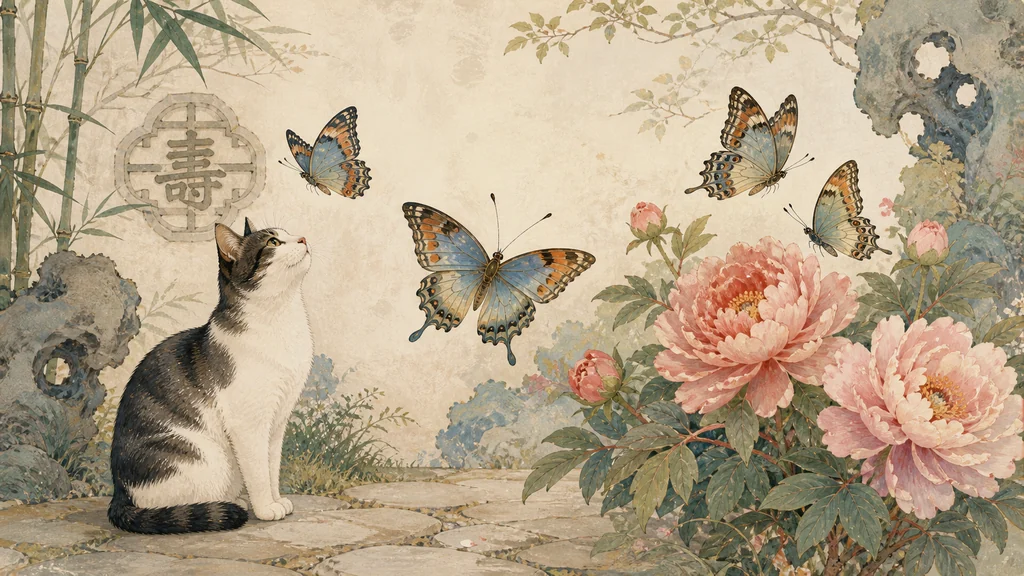
**A butterfly can point to longevity, love, or simply the arrival of spring. The deciding evidence is usually not the insect alone, but the cat, flowers, paired partner, written character, object, or occasion around it.**
The Palace Museum's Ming-dynasty Cat and Butterfly shows a cat crouching below a butterfly. Its curators read the scene as a wish for long life rather than only a playful encounter. The reason lies in a Chinese sound association.
The character for butterfly, 蝶 (dié), sounds the same as 耋 (dié), a word for advanced age. Add a cat and 猫蝶 (māo dié, “cat and butterfly”) can echo 耄耋 (mào dié), a term for elderly age. The first syllables are similar rather than exact homophones in modern Mandarin, so the familiar formula is a rebus, not a letter-for-letter sound equation.
A Qing court painting makes the longevity reading even harder to miss. In One Hundred Butterflies Forming the Character Shou, scores of butterflies compose a large 寿 (shòu, “longevity”). The butterfly–dié sound link, the visible character, and the court birthday setting all point in the same direction. Sources vary on the precise age at which màodié begins; “advanced age” is the sound conclusion.
Two butterflies among flowers can carry a marriage wish
The Palace Museum describes butterfly roundels on Yongzheng-period famille rose porcelain in a different way. Butterflies appear with flowers, and the pattern offers a wish for marital harmony. Here the visible relationship—two butterflies flying together or meeting among blossoms—matters more than the dié pun.
Pairing also belongs to the visual language of mandarin ducks, although ducks and butterflies have separate literary and material histories. A Double Happiness character beside butterflies makes a wedding setting clearer; it does not transfer the history of 囍 or mandarin ducks to the insects.
A late nineteenth-century butterfly robe at The Metropolitan Museum of Art holds both readings at once. Butterflies move among roundels containing longevity characters, giving the garment a clear long-life theme. The museum also notes the butterfly's association with joy and weddings, but says only that the robe might have been worn for such an occasion. It is fair to see longevity and festivity together; calling it a confirmed wedding robe would go beyond the record.
Sometimes a butterfly is simply a butterfly in spring
A Palace Museum study of Butterflies at Play on a Fine Spring Day concentrates on wing patterns, species once found around Hangzhou, and the painter's close observation of nature. In the same study, cat-and-butterfly works are specifically identified with the màodié birthday tradition. Butterflies could function as auspicious signs, but they never stopped being real insects in flower-and-bird painting.
Cats or butterflies forming 寿 give a longevity reading direct support. Paired butterflies, blossoms, 囍, or a wedding object pull the image toward love and marriage. When title, composition, object, and use supply none of those relationships, the image does not need to be forced into an auspicious code.
Number alone does not establish the meaning
“One hundred butterflies” may invite an immediate association with a hundred years, but the court painting offers more than quantity. The insects visibly compose the character 寿, while the title and birthday context reinforce the reading. Another work containing many butterflies but no longevity character, cat, inscription or birthday record cannot inherit the same interpretation from abundance of insects alone.
Flowers require similar care. Butterflies and blossoms can serve a marriage wish, but both also belong to the ordinary subject matter of flower-and-bird painting. A paired arrangement, companion flight, wedding object or Double Happiness character strengthens the romantic reading. A single butterfly settled on a flower may instead emphasise season and observation.
Describe first, interpret second
For an unfamiliar object, record four things before assigning a symbol: the number of butterflies; any cat or written character; the insects’ relationship to flowers and one another; and the type of object carrying the design. Then consult title, date, collection record and use. This order keeps a familiar lucky phrase from pre-empting the evidence.
When a museum says that a robe “might” have been used for a wedding, retain that uncertainty. Cautious wording often reflects the limits of provenance rather than weak writing. Turning a possibility into a fact replaces the object’s history with a more satisfying but less reliable story.
Transformation and love need their own evidence
Because a butterfly emerges from a pupa, modern viewers readily associate it with transformation. The Butterfly Lovers story also connects butterflies with romantic devotion. Those associations have real lives in contemporary culture, but they do not automatically explain a Ming or Qing court object. A reading of a particular work should show that the story was relevant to its date, title or use.
There is therefore no context-free answer to what a Chinese butterfly means. The die sound association, the cat-butterfly rebus, pairing, a visible longevity character and the function of an object supply different kinds and strengths of evidence. Checking them separately produces an interpretation that can be tested.
Sources and further reading
- Palace Museum: *Cat and Butterfly*
- Palace Museum: *One Hundred Butterflies Forming the Character Shou*
- Palace Museum: Butterfly roundel pattern
- Palace Museum study of butterfly painting and cat-butterfly subjects
- The Metropolitan Museum of Art: *Butterfly*, 02.18.371
- The Metropolitan Museum of Art: *Woman's robe with butterflies*, 1970.145
- The Metropolitan Museum of Art: Longevity in Chinese Art