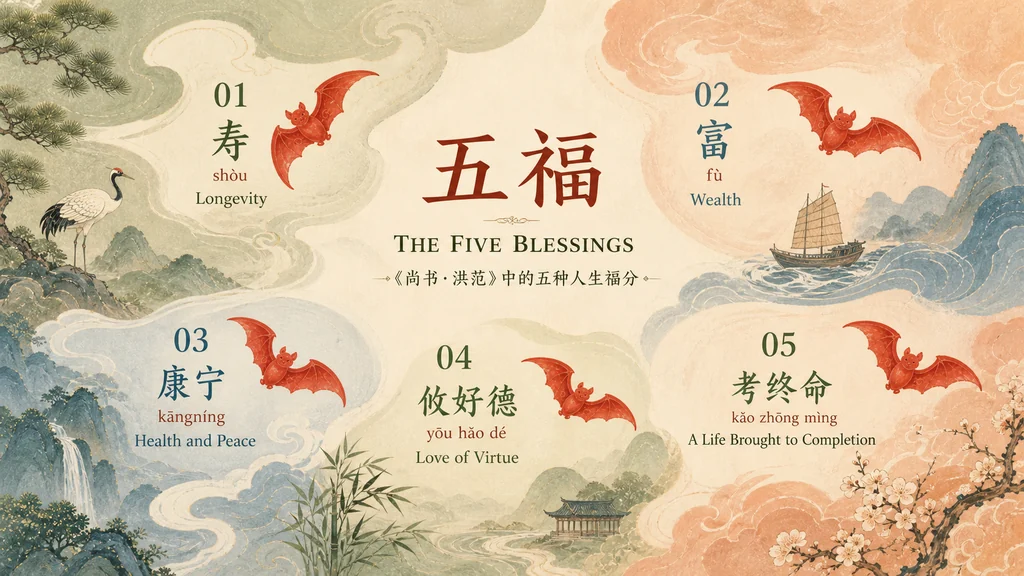
The Five Blessings are longevity, wealth, health and peace, love of virtue, and the completion of one’s allotted life. The list comes from the Hongfan chapter of the Book of Documents. Its last two blessings are often flattened in English, even though they change what the list means.
The five named in the Book of Documents
The Chinese text reads: “一曰寿,二曰富,三曰康宁,四曰攸好德,五曰考终命。” In the same order, these are:
- **寿 (shòu)** — longevity
- **富 (fù)** — wealth or material sufficiency
- **康宁 (kāngníng)** — health and peace
- **攸好德 (yōu hào dé)** — a love of virtue
- **考终命 (kǎo zhōng mìng)** — bringing one’s allotted life to its proper end
The first three fit easily into a modern list of good things. The fourth concerns what a person values and chooses to follow. The fifth treats the completion of a lifetime as a blessing too.
<!-- IMAGE 1: original 16:9 editorial illustration of five symbolic forms arranged around a central unlettered roundel. No generated text. -->
The fourth blessing is about valuing virtue
In 攸好德, the character 好 does not mean that a person merely possesses virtue. It carries the sense of liking or taking delight in what is good. A traditional explanation quoted by the Palace Museum glosses the phrase as finding joy in the moral way.
English summaries sometimes replace this blessing with “happiness.” That removes 德, the word for virtue. “Virtue” alone also misses the active preference expressed by 好. The Metropolitan Museum of Art uses “love of virtue,” a compact rendering that preserves both parts of the phrase without pretending to settle every nuance of the classical Chinese.
The fifth blessing includes the end of a lifetime
考终命 is often introduced as a peaceful or natural death. Those phrases are useful shorthand, but the Chinese expression also concerns a life reaching its completion rather than being cut short.
The Hongfan places the Five Blessings beside a contrasting list called the Six Extremes. In that setting, the blessings describe favourable human conditions: long life, sufficiency, health and peace, a commitment to virtue, and a life brought to its proper end. They are not five interchangeable forms of luck.
This is why **the Five Blessings** is a better general translation than “five happinesses” or “five kinds of good luck.” Short English labels remain useful, but the last two need a sentence of explanation.
How five bats came to represent the Five Blessings
The Book of Documents gives the five-part list; it does not prescribe an animal image for it. The visual association developed through wordplay. The word for bat, 蝠 (fú), is pronounced like 福 (fú), blessing or good fortune. Five bats can therefore stand for the Five Blessings.
A Qing-dynasty white jade belt buckle in the Palace Museum places five bats around a round 寿 character. The museum identifies it as a “five bats holding up longevity” design: the bats supply the Five Blessings, while the central character makes the wish for longevity explicit.
An eighteenth-century silk tapestry panel in The Metropolitan Museum of Art also contains five bats. The museum reads them as the Five Blessings, but here they appear with fish, stone chimes and clouds rather than circling a 寿 character. Five bats may signify the Five Blessings; the more specific name “five bats holding up longevity” needs the longevity character or an equivalent central arrangement.
<!-- IMAGE 2: The Met, Panel with Fish, Bats, and Clouds, 18th century, 60.157.6a,b, Public Domain. -->
Related guides
How to recognize the idea on an object
Begin by counting the bats, but do not stop there. Five bats are strong evidence for the Five Blessings because the number supplies the five-part list and the bat supplies the sound fú. A central 寿 character narrows the design toward the familiar “five bats surrounding longevity” arrangement. Fish, chimes, clouds, peaches, or other companions may add further wishes rather than changing every bat into the same fixed sentence.
The object's catalogue, inscription, and date remain important. A single bat can simply stand for blessing, while five bats can be distributed around a textile or vessel without forming one standard composition. The classical list and the later rebus belong to connected but different stages: the text names desirable conditions of life; decorative art turns their number and sound into a visible shorthand. Count, placement, and accompanying characters should be read together.