A late Northern Song dish in the British Museum, made around 1086–1127, has no wedding scene and no written blessing. Its white porcelain center shows only two mandarin ducks swimming among reeds. Yet the museum describes the paired birds as emblems of marital bliss. The meaning lies less in either bird alone than in the relationship made visible by the pair.
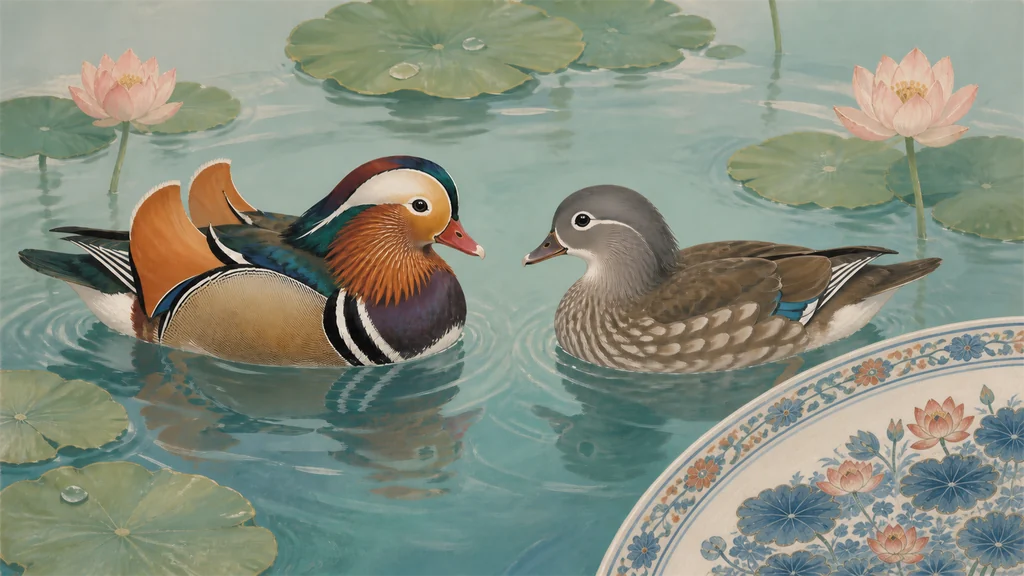
Mandarin duck is the usual English name for 鸳鸯 (yuānyāng). A male in breeding plumage is brightly colored, with a white facial crescent and distinctive orange “sail” feathers. The female is largely gray-brown, with a pale eye-ring. When artists place male and female together, viewers can recognize two visibly different individuals sharing the same stretch of water.
That visual pair became a marriage symbol through repeated cultural use. Poetry turned the birds into language for human companionship. Ceramics, textiles, and wedding gifts gave that language a physical form. A belief that mandarin ducks remain together for life strengthened the association, although modern behavioral research does not support it as an absolute rule.
Poetry turned a pair of birds into a pair of lovers
Mandarin ducks entered Chinese poetry long before the surviving objects discussed here. The poem “Yuan Yang” in the Book of Poetry describes the birds as a pair and places them within an auspicious address. Its later lines wish the recipient long life and good fortune, however, so the poem should not simply be labeled a wedding song or declared the single origin of the marriage symbol.
A much more explicit lovers’ comparison appears in the Tang poet Lu Zhaolin’s “Ancient Intentions of Chang’an.” The verse pairs two images of inseparable companions and ends with a wish to “be mandarin ducks and not envy immortals.” The birds have become a model for two people who choose companionship over even an immortal existence.
The poem did not need to invent the symbol by itself. It demonstrates that a Tang audience could understand becoming mandarin ducks as a lovers’ wish. Once that comparison circulated in familiar verse, a pair on a dish, vase, painting, or garment could carry the same human relationship without spelling it out.
Wedding objects gave the poetic wish a durable form
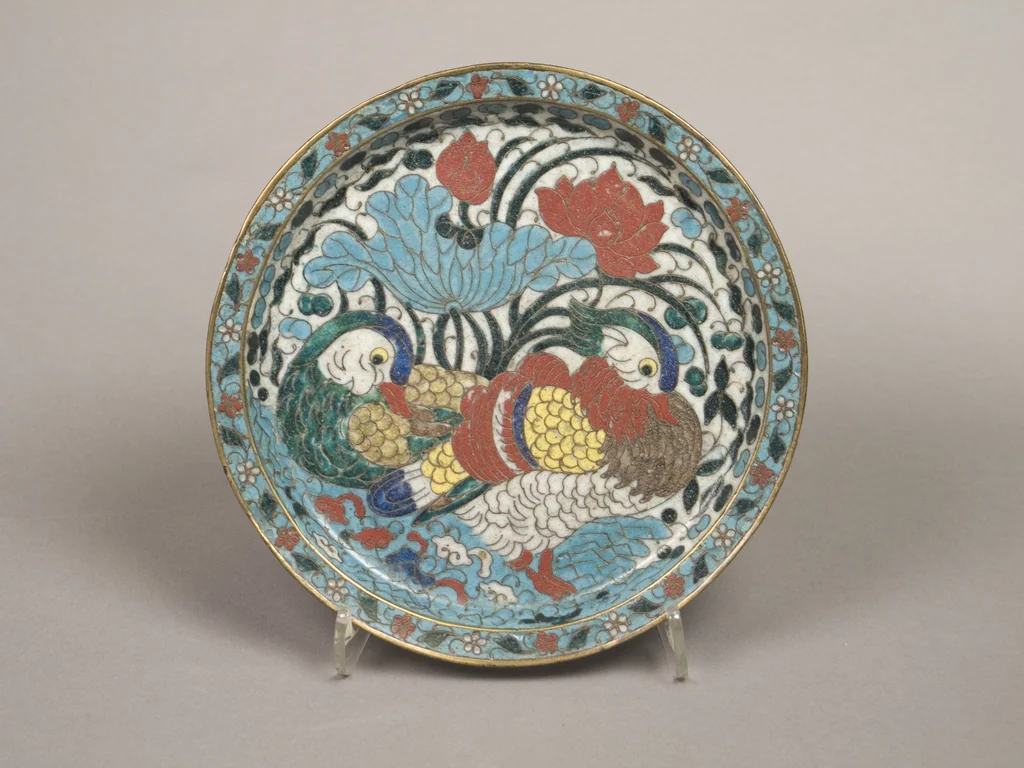
The Metropolitan Museum of Art owns a cloisonné enamel dish from the late fifteenth or early sixteenth century showing mandarin ducks among lotuses. The museum explains that the birds were thought to mate for life and therefore symbolized marital fidelity. It also notes that mandarin-duck designs often decorated wedding gifts, while the pairing of ducks and lotuses expressed a harmonious conjugal relationship.
A Zhengtong-period meiping vase in the British Museum, made at Jingdezhen between 1436 and 1449, expands the scene to two male-and-female pairs swimming in a lotus pond. Its curatorial record says that paired male and female mandarin ducks became popular on porcelain and clothing from the Yuan dynasty onward, and that objects bearing the design were often given as wedding gifts.
The same record preserves an important limit. The vase’s date, manufacture, and painted design are documented, but its own use as a wedding gift remains speculation. A motif can have a recognized marriage meaning without every surviving object having a known bridal owner or a recorded wedding occasion.
Lotuses in these scenes should not automatically be read as the lotus-and-fish rebus for “abundance year after year.” With no fish, there is no fish/abundance sound substitution. A lotus pond is a natural setting for water birds; in the Met’s interpretation of its dish, the lotus also joins the ducks in a wish for harmony between spouses.
Across verse, enamel, porcelain, and clothing, the paired birds became something that could be displayed, worn, or given. They conveyed a hope that two people would remain companions, live harmoniously, and be faithful within their shared life.
“Mates for life” is a cultural belief, not a biological rule
The British Museum calls the idea that mandarin ducks mate for life a mistaken belief. That belief still matters historically: it helped people connect the birds with marital happiness. Evidence that a community held an idea is not the same as evidence that its description of animal behavior was exact.
A 2022 peer-reviewed study followed free-living mandarin ducks in London’s Richmond Park. The researchers observed strong seasonal pair bonds. Some male and female partners formed the same pair again in successive breeding seasons when both survived. The study also states that mandarin ducks do not necessarily mate for life.
These findings clarify rather than erase the Chinese symbol. People could observe the birds moving in pairs; poetry recast the pair as lovers; wedding objects repeated that comparison until it became a familiar wish for fidelity and harmony. The cultural meaning does not depend on proving that every wild mandarin duck keeps one partner forever.
In a Chinese wedding object or auspicious artwork, a clearly identified male-and-female pair facing one another, swimming together, or sharing a lotus pond can usually be read in this marital sense. A single water bird—or two birds whose species cannot be identified—needs further support from physical features, the object record, and the surrounding design.
Sources and further reading
- British Museum: late Northern Song dish with paired mandarin ducks
- British Museum: Zhengtong-period meiping with mandarin ducks in a lotus pond
- The Metropolitan Museum of Art: Dish with mandarin ducks and lotuses
- Chinese Text Project: “Yuan Yang” in the Book of Poetry
- Chinese Text Project: Lu Zhaolin record
- Bird Study: behavior of free-living mandarin ducks in Richmond Park