January 28 and January 29, 2025, were only one day apart, yet the zodiac year changed between them. The Hong Kong Observatory's Gregorian–Chinese calendar marks January 29 as the first day of the first Chinese lunar month and the beginning of the yǐsì Year of the Snake. January 28 still belonged to the previous Chinese calendar year.
This is why a Gregorian birth year is not always enough to identify a zodiac animal. People born in January or February may fall before that year's Lunar New Year and therefore still belong to the previous animal year.
The twelve slots came before the animal names
The number twelve comes directly from the twelve Earthly Branches: 子 (zǐ), 丑 (chǒu), 寅 (yín), 卯 (mǎo), 辰 (chén), 巳 (sì), 午 (wǔ), 未 (wèi), 申 (shēn), 酉 (yǒu), 戌 (xū) and 亥 (hài). The branches combine with the ten Heavenly Stems to make a sixty-unit cycle beginning with jiǎzǐ and ending with guǐhài. The Hong Kong Observatory notes that stem-branch year notation has been used for more than two thousand years.
The branches can be understood as twelve recurring positions in a time sequence. Animals made those positions easier to recognise and picture: the Rat was paired with zǐ, the Ox with chǒu, and so on until the Pig was paired with hài. The animals did not independently create a twelve-year calendar; they became the visible layer of an existing twelve-part framework.
The order runs from Rat to Pig
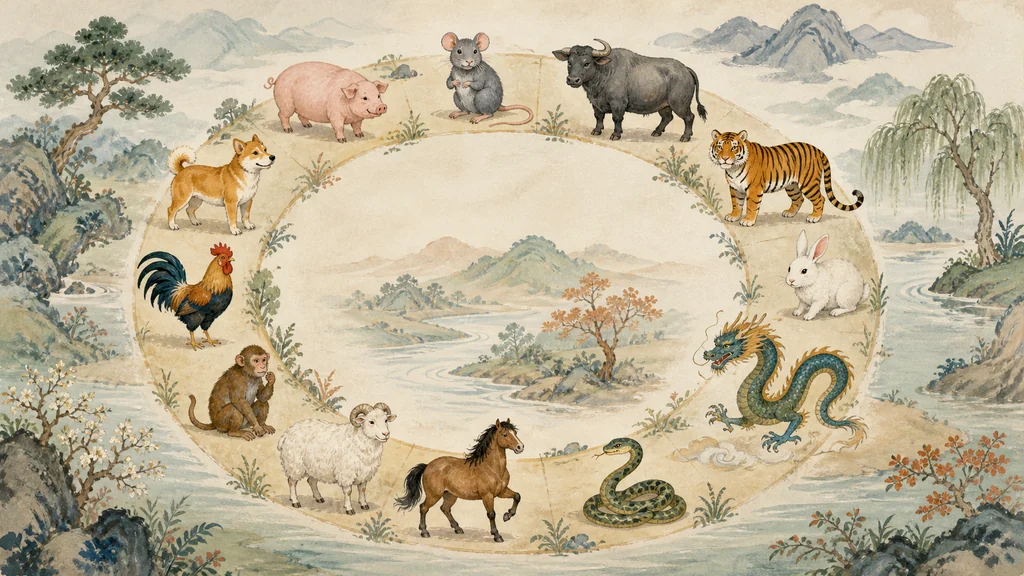
The standard sequence is Rat, Ox, Tiger, Rabbit, Dragon, Snake, Horse, Sheep, Monkey, Rooster, Dog and Pig. A Metropolitan Museum of Art exhibition explains that the association between these animals and the Chinese calendar appeared in the third century BCE and was firmly established by the first century CE.
Material evidence also shows the cycle becoming a visible set. The Met's publication Chinese Decorative Arts notes a complete group in a tomb ceiling dated 533 and the later popularity of zodiac figures in Tang tombs.
Two English names need care. The Chinese category 羊 (yáng) is broader than any single English species label, so museums and other sources variously use sheep, goat or ram. 鸡 (jī) may appear as chicken or rooster. These translation choices do not change the animals' positions in the branch cycle.
The Great Race is a memory story, not proven origin evidence
A widely told story says the animals competed in a race and their finishing order became the zodiac order. Versions add details such as the Rat riding on the Ox, the Cat missing the race, or the Jade Emperor presiding. The story makes it easy to remember why the Rat comes first and the Pig last.
It does not function as a historical record of how the calendar system formed. Calendar and museum evidence can show when the animal sequence was in use and how it was paired with the branches. It does not establish one documented reason why every animal received its particular position. Treating the race as a confirmed origin fills an unanswered historical question with a memorable tale.
An eighteenth-century vase shows the whole sequence
The British Museum's small meiping vase PDF,C.635 was made at Jingdezhen in the eighteenth century. Its underglaze-blue and copper-red decoration shows all twelve zodiac creatures in a landscape. The museum record lists them in order from Rat to Pig.
The vase demonstrates that the complete cycle could operate as a unified visual subject on Qing porcelain. It does not prove that a personality or future is determined by a birth animal.
Check Lunar New Year before assigning an animal
For its official calendar, the Hong Kong Observatory changes the stem-branch year on the first day of the first Chinese lunar month. This is not January 1. It is also different from the practice of some fortune-telling calendars that use Lìchūn (立春, “Spring Commences”) as their changeover point. The Observatory distinguishes the beginning of the Chinese calendar year from the solar term that begins the seasonal cycle.
For the zodiac animal used in ordinary Lunar New Year contexts, start with the birth year, then check whether the birth date had reached that year's Lunar New Year. The Observatory provides conversion tables for 1901–2100. A Gregorian year gives you a likely animal; an actual January or February date tells you whether the previous animal still applied.