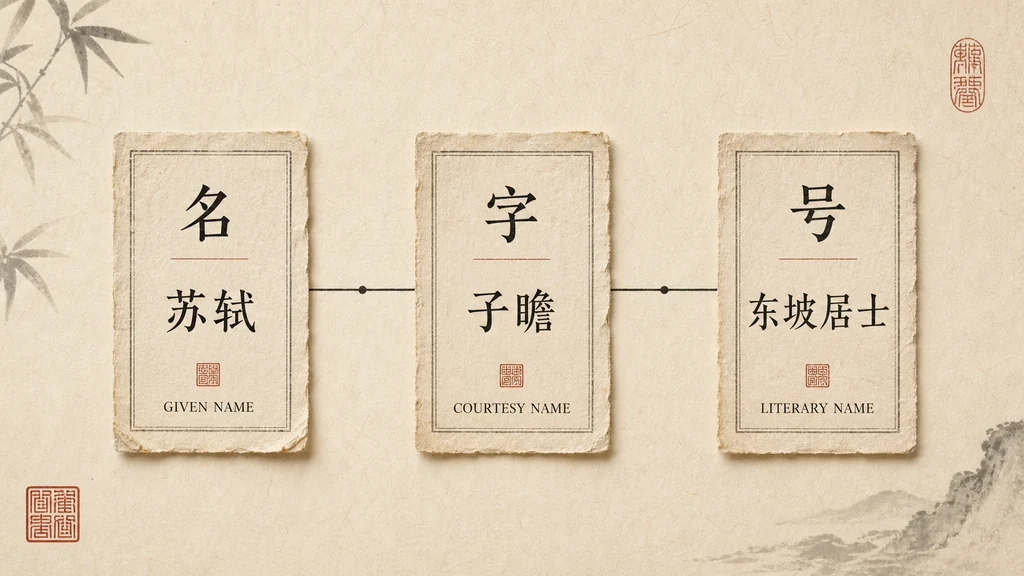
Su Shi, Su Zizhan, and Su Dongpo are not three different people. Shi was his personal name, Zizhan his zi (courtesy name), and Dongpo Jushi his hao (literary name or sobriquet). The three forms could coexist because they did different work. They were not the ancient equivalents of first, middle, and last name.
Ming: the personal name at the center of an identity
Early biographies often identify the parts explicitly. The Records of the Grand Historian says that Confucius was named Qiu, had the zi Zhongni, and belonged to the Kong lineage. Qiu is the ming, or personal name; Zhongni is the courtesy name; Kong is the surname.
A personal name did not have one timeless rule governing who could utter it. A senior addressing a junior, a person referring to himself, an official record, and a later historian could use names differently. Avoiding the name of a respected person captures social distance, but is not an absolute ban for every setting. For the modern order, see Why Do Chinese Names Put the Family Name First?
Zi: a courtesy name associated with adulthood
The “Meaning of the Capping Ceremony” in the Book of Rites says, “After the capping, he was given a courtesy name; this was the way of adulthood.” Within that ritual model, receiving a zi followed the male coming-of-age ceremony and marked entry into adult social relations.
A zi was not a middle name or a universal registration field. In biographies, letters, inscriptions, and literati exchange, a person might be addressed by surname plus zi: Su Zizhan, for example. The Library of Congress likewise records zi as a separate name form in East Asian authority data. Some personal names and courtesy names echo in meaning, but biographies and inscriptions are stronger evidence than wordplay.
Hao: a more flexible adopted identity
Su Shi's hao grew from a particular episode. A biographical account says that while living at Huangzhou he built a residence at the Eastern Slope and styled himself Dongpo Jushi, “Resident Scholar of the Eastern Slope.” Dongpo was neither his birth name nor the courtesy name associated with adulthood.
A hao could refer to a residence, studio, religious outlook, artistic identity, aspiration, or personal experience. It might be self-chosen or established through other people's usage, and one person could have several. “Nickname” is therefore too narrow as a universal translation.
- Ming: Shi (轼). The personal name under which his official biography is headed.
- Zi: Zizhan (子瞻). A courtesy name used in adult and literary relations, often with the surname.
- Hao: Dongpo Jushi (东坡居士). A self-adopted name linked to his life at Huangzhou.
A correspondent writing “Zizhan,” a critic discussing “Dongpo,” and a historian recording “Su Shi” could be signaling genre, relationship, or perspective rather than competing over one correct name.
Not every title ending in hao is a personal hao
Posthumous names were normally awarded after death; temple names belonged to ancestral temple commemoration; era names organized the calendar. Taizong in Tang Taizong is a temple name, while Qianlong is an era name. Neither is the ruler's self-chosen hao.
A generation name is also separate: it is a character shared by members of a family generation, not the same thing as a historical person's zi.
The three-part set was never universal
Surviving evidence favors emperors, officials, writers, artists, and local elites because their biographies, correspondence, and inscriptions were preserved. Practice varied by period, status, gender, region, and documentary survival. The Book of Rites presents a ritual norm; the biographies of Confucius and Su Shi preserve individual cases. Neither is a census of everyone in historical China.
When an unfamiliar name appears, look for the source's own signals: does a biography say “named,” “courtesy name,” or “styled himself”? Then notice whether it appears in an official history, a letter, an inscription, or later criticism. That keeps the social work of historical names visible without forcing them into a modern passport form.