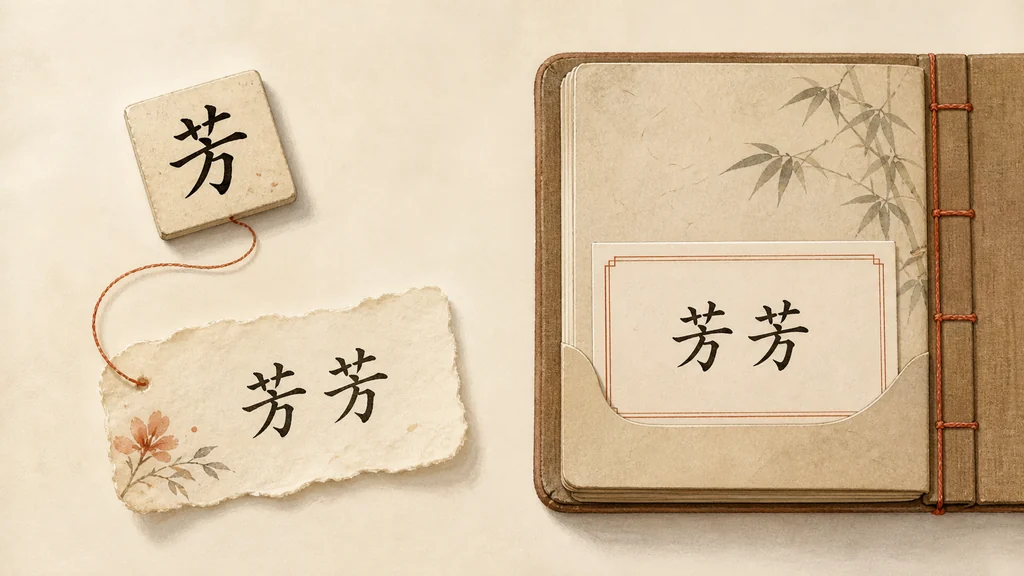
A teacher reads “Zhou Fangfang” from the class register, and a student answers. After school, another parent calls “Fangfang” at the gate, but she is calling her daughter Chen Yafang. The two forms sound the same. Zhou Fangfang's legal given name already contains two Fang syllables; Chen Yafang is called Fangfang only inside a familiar relationship.
The linguistic process is reduplication: a name element is repeated. Research by Qi Wang and Anders Holmberg analyzes Mandarin names such as Guoguo and Xining Chinese Sansan as pet names. In these forms, repetition contributes endearment and familiarity. It is not empty sound, but neither is it a permission slip for anyone to invent a nickname.
Repetition does not necessarily make a name shorter
Take a fictional person named Chen Xiaoyu. If her family has always called her Yuyu, the pet name may be built from the Yu in her given name. One syllable becomes two. The address is actually longer, unlike an English shortening such as Robert to Bob.
The pattern Yu → Yuyu explains a possible structure, not an automatic procedure. A new classmate cannot simply inspect Xiaoyu, select one character, and double it. Which element is used, who may use it, and whether the person welcomes it all come from a real family, friendship, or other close group.
The linguistic analysis of Chinese personal names also distinguishes family names from given names. This affectionate reduplication is built from given-name material. It is not a reason to turn the surname Wang into “Wangwang.”
Why doubled forms often sound child-directed
Adults speaking to young children often use reduplicated words such as fanfan for food or eating, cheche for a car, and gougou for a dog. The repeated rhythm can sound gentle and may help children segment and learn words. The link between reduplication and child-directed speech therefore has empirical support.
Mengru Han and Yan Gu compared reduplication in Mandarin child-directed and adult-directed speech. They found a greater variety of reduplicated forms in speech to children. Yet the second half of their result matters: only the tokens adults judged specifically child-directed occurred more often in child-directed speech. Reduplication is prominent around children, but not every doubled expression belongs exclusively to baby talk.
A child called Yuyu at home may also be known by that name among classmates. Years later, parents and childhood friends can keep using it. A form of address does not expire automatically on an eighteenth birthday.
Adults use doubled names too—but access is narrower
Research on nicknames in urban China records family names that continue into adulthood and pet names created between romantic partners. Between adults, a reduplicated name can preserve a childhood relationship, mark romantic intimacy, or carry a shared memory. It does not necessarily infantilize the person.
The more intimate the address, however, the more restricted its use may be. A mother calling her adult daughter Yuyu does not grant the same form to a new coworker. A private name between partners does not become public simply because a third person overhears it once.
People also differ. One adult may enjoy a childhood pet name; another may accept it only at home; a third may find it too childish in professional life. The research does not provide a universal age at which reduplicated names must stop.
Fangfang may already be the full registered name
Return to Zhou Fangfang on the class register. Wang and Holmberg's study shows that reduplication can itself form a two-syllable Chinese given name. Fangfang may therefore be the complete name selected and registered by the family, not a nickname derived from a more formal single Fang.
Romanization makes the distinction even harder. Lingling may represent the same Chinese character twice, or two different characters with identical or similar pronunciation. Pinyin alone cannot tell whether it is a registered name, a family address, or a stage name. The person's Chinese characters, self-introduction, and reliable records are needed.
If an adult introduces herself as Fangfang, use Fangfang. There is no need to remove one syllable in search of a “more formal” version. If mutual friends explain that only her family uses Fangfang, begin with the public name she gives you. The affectionate sound does not authorize the relationship by itself.
Chinese pet names repeat a name element primarily to mark familiarity and affection, not to shorten it. The pattern has a real association with speech to children, but it can continue among adult relatives, partners, and friends. The same surface form may also be a complete given name. To know which Fangfang you are hearing, first identify the name, then the relationship.
For the broader boundary among full given names, family pet names, and other nicknames, read Do Chinese People Shorten Their Names? What Do Xiao, Lao, and A Mean Before a Chinese Name? covers a different group of relationship-based forms. For name length, see How Many Characters Are in a Chinese Name?.
Sources and further reading
- Wang and Holmberg: “The structure of Chinese personal names”
- Wang and Holmberg: “Reduplication and the structure of nouns in Xining Chinese”
- Han and Gu: Reduplication in Mandarin Chinese child-directed speech
- Wang: “Nicknames in Urban China—A Two-Tiered Model”
- Wong: Address and reduplicated names
- Lin: “Exchange of Terms of Address”
- 2021 National Name Report