Robert may become Bob, and Elizabeth may become Liz. Chinese names also produce affectionate forms and nicknames, but there is usually no comparable national list of fixed short forms.
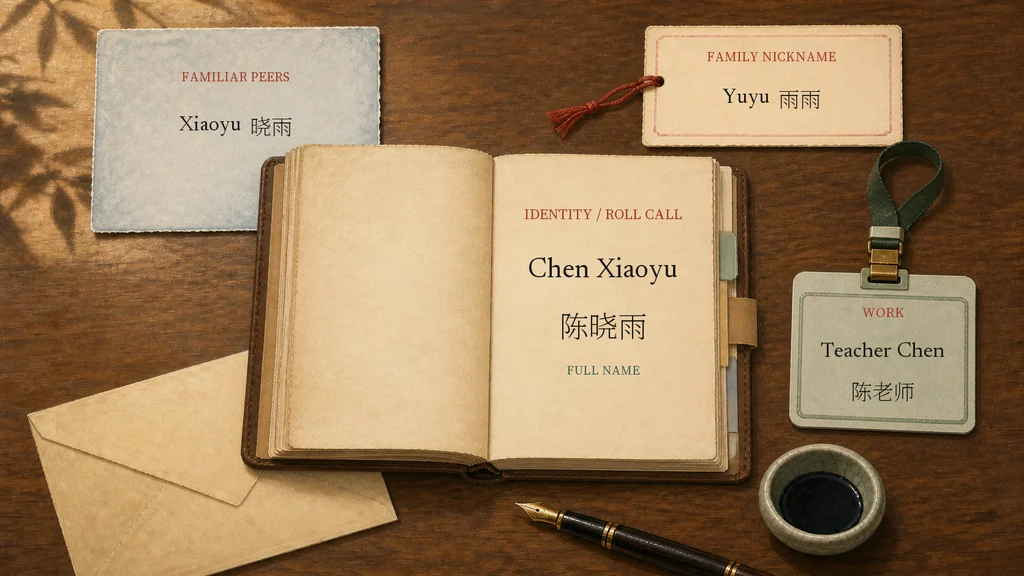
Imagine a person named Chen Xiaoyu (陈晓雨). Her family, classmates, and colleagues might call her Chen Xiaoyu, Xiaoyu, Yuyu, or Teacher Chen. Those forms do not sit on a single scale from “formal and long” to “friendly and short.” Each one belongs to a relationship and a setting.
Xiaoyu is still the complete given name
In 陈晓雨, 陈 (Chen) is the surname and 晓雨 (Xiaoyu) is the entire given name. Calling her Xiaoyu omits the surname, but it does not turn her given name into a new shortened name. It is not quite the same operation as Robert becoming Bob.
China's 2021 national name report counted given-name length after removing the surname. Among the mainland household-registration population, two-character given names accounted for 84.55%, one-character given names for 13.97%, and other lengths for 1.48%. For many people, then, the two characters you hear are simply their full given name—not a nickname.
Familiarity does not automatically remove the surname, either. An Open University Chinese course notes that full names remain common forms of address even among friends or family. One household may use a full name every day; another may use it to call across a room, tease someone, or make clear which person is meant. Character count alone does not reveal the tone.
Yuyu has to come from a real relationship
Chinese can form an affectionate name by repeating an element of a personal name. Linguists Qi Wang and Anders Holmberg note that proper-name reduplication occurs in Mandarin and other Chinese varieties and is often used for pet names with an endearing effect. If Chen Xiaoyu's family has called her Yuyu (雨雨) since childhood, that can be a genuine nickname.
The important part is that people in her life already use it. There is no rule telling a new acquaintance to take the final character of every two-character given name and repeat it. Doing so uninvited may sound childish, overly intimate, or simply wrong.
There is another complication: a repeated form can itself be a registered given name. A separate corpus study and native-speaker judgment experiment on Chinese personal names found that reduplication can build a disyllabic given name. A form such as Fangfang (芳芳) may be one person's complete official given name and another person's family pet name. Its appearance does not settle the question.
A childhood name may not be shorter at all
A family childhood name, sometimes called a “milk name,” or a nickname created among friends does not have to be a clipped version of the registered name. It may come from a personality trait, a family wish, a childhood event, or an old joke understood only by one group. It can be shorter than the official name, the same length, or longer.
A University of Edinburgh study of address-term exchange treats a nickname as an informal name established within a community, often motivated by a name variant, a personal feature, or shared experience. It distinguishes that kind of nickname from the ordinary use of a complete given name. Calling someone Xiaoyu can signal friendliness without turning Xiaoyu into a nickname.
Some childhood names continue into adulthood; others remain inside the family. A nickname can be warm, teasing, or insulting. There is no reliable evidence that every Chinese person has one, and a legal name does not reveal what someone's relatives call them at home.
A more formal form may be longer
An MIT Mandarin course contrasts the rapid English-language move toward first names with professional address in Chinese, where surname plus title may persist longer. Chen Xiaoyu may be Chen laoshi (陈老师, Teacher Chen) at a school or Chen jingli (陈经理, Manager Chen) at work. The appropriate form gains characters rather than losing them.
Forms such as Xiao + surname, Lao + surname, and, in some regions, A + name element also add material. Their use depends on age, hierarchy, region, familiarity, and group convention. They are not safe templates to apply to every person called Chen, and their differences deserve a separate explanation.
The larger point is practical: closeness in Chinese does not force a name to become progressively shorter. One person can use different forms at home, at school, and at work—or continue to use the full name in all three.
Follow the name the person gives you
At a first meeting, use the name from the person's introduction. In a workplace, notice the email signature, name badge, and form colleagues already use. If those clues disagree, ask.
To identify the surname and given name first, see Chinese name order and how many characters are in a Chinese name. An English name such as Ethan belongs to a different naming context and is not necessarily a shortened Chinese name; see why some Chinese people use English names.
Do not select one character from a two-character given name or invent a reduplicated pet name for a new acquaintance. “What would you like me to call you?” is more reliable than guessing.
Sources and further reading
- Natural Language & Linguistic Theory: Reduplication and the structure of nouns in Xining Chinese
- Journal of East Asian Linguistics: The structure of Chinese personal names
- MIT OpenCourseWare: Learning Chinese, Unit 2
- The Open University: Beginners' Chinese — Introducing oneself
- Michigan State University: Elementary Chinese I
- University of Edinburgh: Exchange of Terms of Address
- Hunan Provincial Public Security Department: 2021 National Name Report