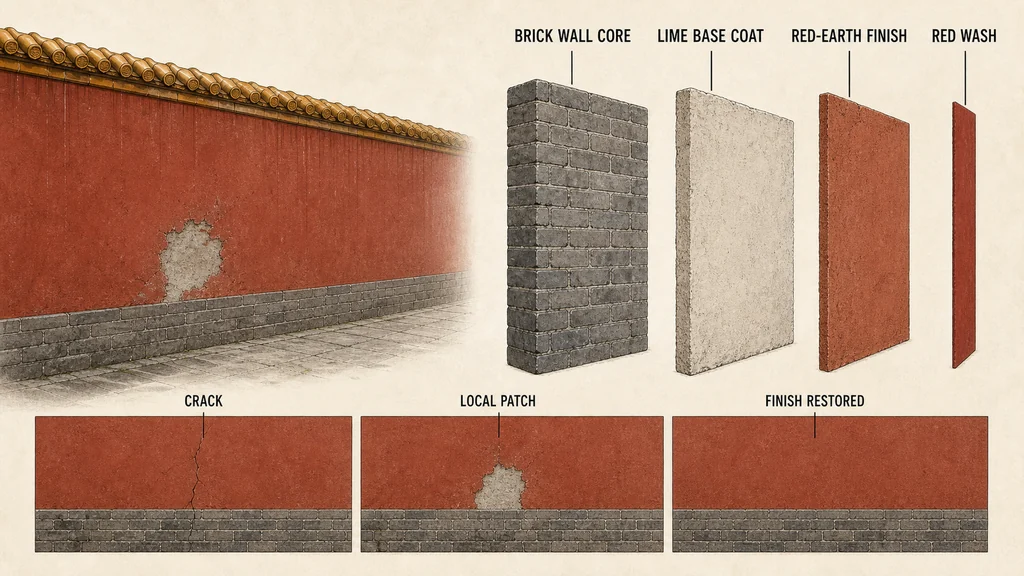
Where a red palace wall loses a small piece of its surface, the material beneath is usually not red brick. Greyish plaster and masonry appear under the colour. Much of the red belongs to outer finish layers—red plaster and red wash—applied over a wall core.
Those layers help protect the masonry from direct weathering. Their colour also gives the palace a clear visual identity. The walls visitors see today have been patched and maintained over many generations; they are not a single untouched coat from the palace's completion in 1420.
The red lies outside the brick wall
A common palace courtyard wall can be understood as several layers: a brick wall core, a base plaster, a red finish plaster, and an outer red wash. Lime is important in the base layers. Red earth colours the finish, and a final wash helps even out the surface.
Qing building records describe the process. The Yongzheng-period Da Qing Huidian states that the outside of palace-gate walls used red earth while the inside used lime. Volume 53 of the official Gongcheng Zuofa gives a red-wash recipe containing first-grade red earth, glutinous-rice liquid, and alum.
The enormous perimeter fortification needs a separate description. Official conservation records identify a rammed-earth core enclosed by thick brick masonry; the wall is roughly nine metres high. It and the smaller courtyard walls may both present red surfaces, but they do not share one simple cross-section.
Iron oxide gives the red earth its colour
Researchers sampled “palace-wall red” at the Forbidden City, the Altar of Land and Grain, and the Altar of Agriculture. Their analysis found that white lime layers were principally calcium carbonate. Red plaster contained iron oxide and calcium carbonate. Red wash included iron oxide, calcium carbonate, and calcium sulphate; traditional samples involved glutinous-rice liquid, while modern repair layers could contain organic polymers.
Iron oxide in the red earth is the main colourant. It is therefore misleading to describe every Forbidden City wall as “painted with cinnabar.” Materials differ by location, period, and repair layer. A dark red appearance alone cannot identify one expensive historical pigment.
The plaster protects the masonry first
Base and finish plasters separate the brick core from direct exposure, level the surface, and provide layers that can be repaired locally. Rain, sun, and Beijing's winter freeze–thaw cycles often affect these exterior layers first.
A Palace Museum survey records hollow or detached areas, cracks, loss, powdering of fibre-reinforced plaster, salt efflorescence, fading, and darkening from moisture. The perimeter wall has also suffered weathered bricks, mortar loss, cracks, and loss of rammed earth. Maintaining a red wall means managing water, salts, adhesion, drainage, and colour together.
The present red is the result of continuing maintenance
The Qing recipe for applying red wash shows that renewing a surface was already a maintenance operation. Modern conservation begins by investigating cracks, hollow areas, earlier repair layers, and moisture before deciding what can remain and what requires local replacement.
When reviewing a repair proposal for the northwest section of the palace wall, the Beijing Municipal Cultural Heritage Bureau required research into earlier work, construction, materials, and deterioration, together with material and craft trials. The aim is not to make every surface look newly painted. It is to recover protection while disturbing historic material as little as possible.
The red visible now can therefore contain both old fabric and later repairs. There is no evidence for a single fixed schedule on which every wall in the palace is completely repainted, and today's colour should not be treated as an untouched 1420 colour sample.
Red walls and yellow roofs form the palace's main colour scheme
Palace Museum research describes red walls and yellow roofs as the dominant colours of the Forbidden City. Within the Five Phases and directional system, red corresponds to fire; yellow corresponds to earth and the centre. The two can also be interpreted through the productive relation in which fire generates earth.
Across the palace, red walls contrast with yellow glazed roofs, white stone terraces, and grey paving. The contrast makes the imperial complex stand apart from a cityscape long dominated by grey brick. Court convention, visual design, and Five-Phase interpretation all contribute; “red simply means happiness” is not a sufficient architectural answer.
A red wall and a red column are different surfaces
Palace gates, window frames, and timber columns are often red too. Timber normally receives a prepared ground and oil-based decorative finish. A wall uses brick, lime plaster, red-earth finish, and red wash. The colours can look related from a distance, but their substrates, recipes, deterioration, and repair methods differ. Conserving a red wall is not the same operation as conserving a red timber column.
For the other half of the palace's main colour pair, see why Forbidden City roofs are yellow. The guide to Chinese screen walls explains how walls shape an entrance, while the central axis of a Beijing courtyard shows how enclosing walls participate in a larger plan.
Sources and further reading
- Xinhua: The Materials Science of the Forbidden City's Red Walls
- Surface Technology: Constituent and Colour Difference of Palace Red Walls
- Palace Museum: Survey of Wall-Surface Deterioration
- Ministry of Culture and Tourism: Forbidden City Wall Conservation Project
- Palace Museum: The Enclosing Wall of the Forbidden City
- Beijing Cultural Heritage Bureau: Northwest Wall Repair Review
- Palace Museum: Architectural Colour and Glazed Components