In 1783, a ruyi made of gold, turquoise, and silk was presented to the Qianlong emperor. Its curved handle ends in a broad head decorated with a bat and peaches. The National Museum of Asian Art translates ruyi as “as you wish.” It reads the bat and peaches as additional emblems of good fortune and immortality.
Those wishes occupy different layers of the same object. The name 如意 (rúyì) already suggests satisfaction or the fulfilment of one’s wishes. The bat and peaches make the blessing more specific: good fortune and long life. Qing craftspeople could combine several auspicious ideas without making them mean the same thing.
How to recognize a ruyi
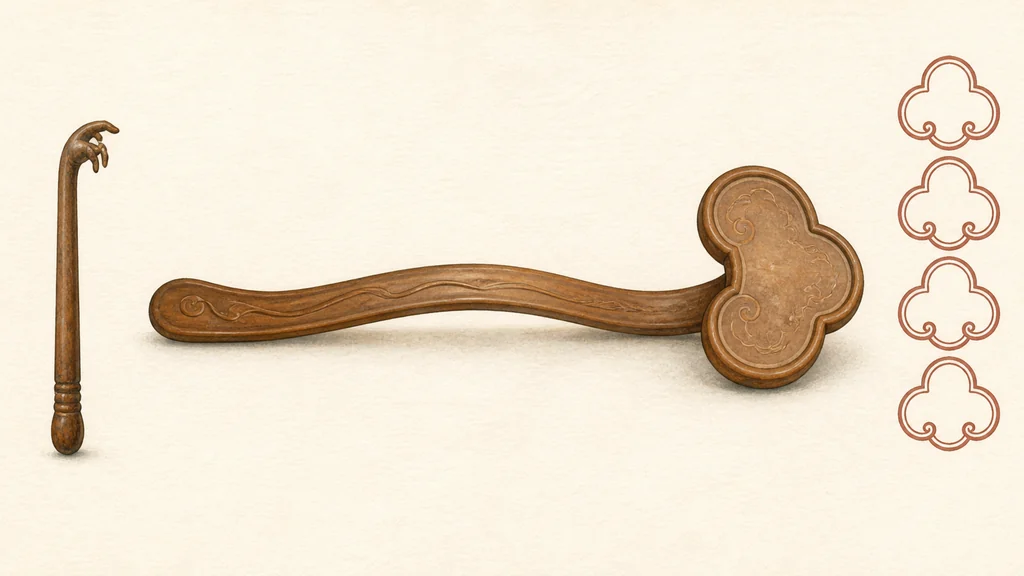
A complete ruyi usually has a long handle, a gently curved shaft, and an enlarged head. The head may preserve the outline of a bent hand. It can also resemble a three-lobed cloud, a heart-like form, or the cap of a lingzhi fungus. The Palace Museum describes these shifting shapes as like a heart, a cloud, or fungus. There was no single head design that every ruyi had to follow.
An eighteenth- to nineteenth-century cloisonné example at The Metropolitan Museum of Art measures 44.5 centimetres long. The museum notes that ruyi were made in metals, different woods, ivory, and other materials. They could be placed on stands or displayed in vases and brush pots among useful and exotic objects.
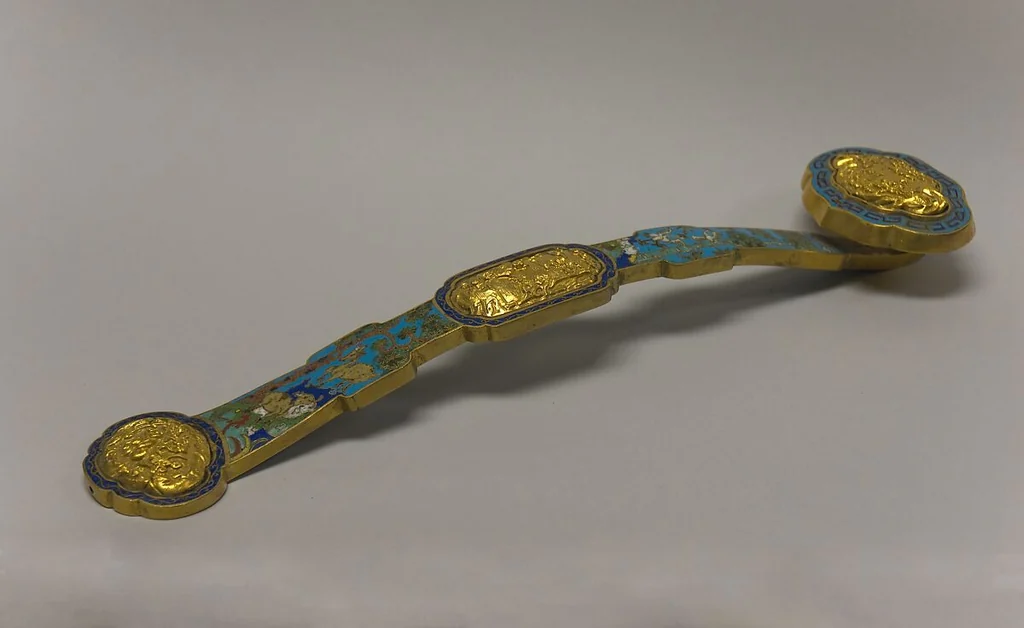
English catalogues commonly call the object a ruyi scepter. “Scepter” is a convenient description of its long-handled form, but it can suggest a European emblem of royal authority. Ruyi did appear in court ritual and beside imperial thrones. They also served, at different times, as backscratchers, implements held during learned conversation, collectors’ objects, room displays, and congratulatory gifts. The English label alone cannot determine how one particular ruyi was used.
A name linked to an old backscratcher
An early form was a long-handled scratching tool called a 爪杖 (zhuǎzhàng, claw staff). Its end could be shaped like fingers or a claw. A Northern Song Buddhist reference work, the Shishi yaolan, explains that when an itch was beyond the reach of the hand, the claw staff could scratch it “according to the person’s wish”—hence the name ruyi.
This later textual explanation is not a dated record of the word’s first appearance. Nor does it settle every question about where the object began. Long-handled scratching tools existed in both China and India, and one older theory connected the ruyi with an implement brought to China with Buddhism.
Research published by the Palace Museum also points to two fragmentary Eastern Zhou ivory objects excavated at the ancient capital of the state of Lu in Qufu, Shandong. One end resembles a palm with curved fingertips attached to a long cylindrical handle. The researcher argues that this evidence places a comparable Chinese object at least as early as the Warring States period.
The claw staff is an important source for the ruyi’s early form, but the evidence does not reduce exchange between China and India to one undisputed line of invention. Nor is ruyi a rebus in which one character substitutes for a homophone. It is the established name of the object; as a whole, the word means in accordance with one’s intention or wishes.
From scratching tool to conversational prop
The long-handled object did not remain only a practical scratching device. The Palace Museum records that around the Han and Jin periods it could be called a 握君 (wòjūn, something held in the hand) or 谈柄 (tánbǐng, an implement held during conversation). Learned gentlemen carried or gestured with it during “pure conversation.” It could also accompany dance, signal cultivated ease, or even be used for defence.
The modern Chinese word tanbing can mean a subject of conversation. In this historical setting, however, the handle itself was held while people talked.
After the Song dynasty, ruyi increasingly became interior display objects. An eighteenth-century bamboo-veneer ruyi at The Met carries a poem composed by the Qianlong emperor. The verses praise it as an ideal scholarly object, at home where witty conversation takes place and comparable to meeting true gentlemen. A Qing court display could still summon an older image of learned conversation.
The head also became less like a realistically carved hand. Three-lobed cloud forms and lingzhi-shaped heads became prominent. By the Ming and Qing dynasties, a ruyi could look like an elaborate work of decorative art without retaining a functional claw.
A court gift made to embody good wishes
The name supplied an auspicious message, while the object’s long association with handling and display gave it an air of cultivated antiquity. In the Ming and especially the Qing court, ruyi became prominent gifts and festive furnishings.
The Palace Museum reported in 2003 that its collection contained more than two thousand ruyi. Most had been presented by officials; others were made by imperial workshops on command. Metal, jade and other stones, bamboo, wood, and ceramics all appeared. At enthronements, New Year celebrations, birthdays, and imperial weddings, officials could offer ruyi and the court could award them in return. They also stood near thrones, couches, and writing tables.
That scale belongs to the Qing court, not to every household in China. A specific palace ceremony should not be turned into a universal custom.
The court also designed new forms. During the Qianlong period, the three-inlay ruyi placed carved jade plaques at the head, middle, and tail of a wooden handle. A zitan and jade example in the Palace Museum is 51.1 centimetres long. The emperor particularly admired versions that incorporated older jades. Ancient material entered a newly invented structure.
Imperial wedding records offer a focused example. The Palace Museum states that an empress carried an apple and a gold ruyi bearing the Double Happiness character when she entered the palace in her phoenix sedan. She later presented a ruyi to the empress dowager. This was a specific Qing court procedure, not evidence that every Chinese wedding required a ruyi. Double Happiness identifies the marital setting; the ruyi retains its broader good wish.
The gold ruyi presented to Qianlong in 1783 belongs to this world of ceremonial giving. It did not promise that an owner’s wishes would literally come true. Its name, valuable materials, cultivated shape, and act of presentation turned a wish into an object that could be held or set on a table.
When the ruyi head became a pattern
The enlarged head could leave the full handle behind and become a decorative outline. Repeated three-lobed cloud or fungus-like curves appear as borders on ceramics, textiles, furniture, and architecture. An eighteenth-century boxwood ruyi in the Cleveland Museum of Art takes the form of lingzhi. The museum associates the fungus-shaped head with immortality. That longevity meaning belongs to the chosen form; it does not make the whole word ruyi mean only “long life.”
A complete ruyi might also carry bats, peaches, the Three Abundances, the Eight Immortals, or Double Happiness. Named knots could hang from its handle. These additions direct the general good wish toward fortune, longevity, marriage, descendants, or other blessings. A ruyi decorated with the Buddhist Eight Auspicious Symbols does not itself become one of those eight emblems. A Chinese knot tied to the handle also keeps its own name and context.
One isolated curl in a border cannot be identified as a ruyi head from resemblance alone. On a complete object, look for the long handle, curved shaft, and enlarged head. In a pattern, check repetition, neighboring motifs, and the museum’s catalogue name. The object’s name can express wishes fulfilled; its fungus or cloud-shaped head can add another association; surrounding images can make the blessing more precise.
Sources and further reading
- Palace Museum: Ruyi exhibition, 2021
- Palace Museum: The origins and development of ruyi
- Zhang Linjie: A study of changes in the ruyi
- Palace Museum: Qing court ruyi exhibition, 2003
- Palace Museum: Zitan three-inlay ruyi with jade plaques
- The Metropolitan Museum of Art: Ruyi Scepter, 29.110.45
- The Metropolitan Museum of Art: Ruyi scepter with Qianlong poem
- National Museum of Asian Art: Ruyi sceptre, F1937.45
- Cleveland Museum of Art: Scepter in the Shape of a Ruyi Fungus