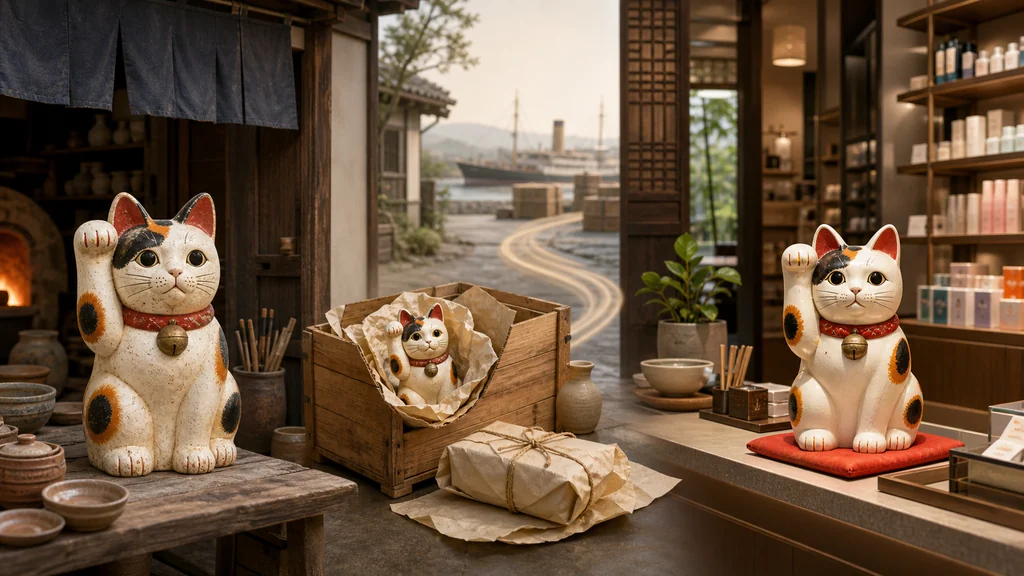
The lucky cat is Japanese, not a traditional Chinese symbol. In Japanese it is called maneki-neko, literally a “beckoning cat”: a seated cat raises one front paw as if inviting good fortune or customers to come closer.
The confusion is understandable. The name is written with Chinese-derived characters, the figure appears in shops in China and in Chinese restaurants around the world, and sellers often place it beside objects marketed for wealth. But where an object is displayed is not the same as where that object type formed. Chinese businesses can adopt a Japanese good-luck figure without turning its origin Chinese.
The evidence points to Edo Japan, but not to one proven origin story
The Edo-Tokyo Museum describes the maneki-neko as an auspicious object that originated in Edo, the city now called Tokyo. Its exhibition places two familiar strands side by side: the story of a cat beckoning the lord Ii Naotaka at Gotokuji Temple, and the production and sale of beckoning cats in the Imado area.
Those local traditions show how the figure became attached to temples, pottery and urban memory. They do not establish one tale as a documented moment of invention. A Japan Tourism Agency text is deliberately cautious: the origin is unclear, and the earliest lucky-cat figurines are thought to have appeared around the middle of the nineteenth century.
It is therefore safer to identify an Edo Japanese setting than to declare Gotokuji, Imado or another claimant the single birthplace. Origin legends and dated manufactured objects are different kinds of evidence.
The raised paw represents a Japanese beckoning gesture
A British Museum example makes the basic pose easy to see. Made in Kyoto in 2000, the ceramic cat is white with black patches, red ears, a red collar and a gold bell. Its left paw rises to its ear, and the figurine sits on a separate red mat. The museum notes that maneki-neko are often placed in Japanese shop windows or entrances to encourage customers to enter.
A common Japanese beckoning motion extends the hand with the palm angled down or outward while the fingers repeatedly curl. To someone accustomed to beckoning palm-up, that motion can resemble a cat batting the air. The animal is performing an invitation, not waving goodbye.
A raised left paw is often said to bring customers, while a raised right paw brings money, luck or friends. These are conventions, not a universal code. The British Museum explicitly qualifies the distinction as typical rather than absolute, and makers produce many combinations of paws, colours and accessories.
The large coin and plump body were shaped by modern pottery production
Many lucky cats sold today have wide eyes, large ears, a rounded body and an oversized gold coin. That familiar look is connected to modern ceramic production rather than one unchanged ancient design.
The Japan Tourism Agency records that Tokoname in Aichi Prefecture did not begin producing maneki-neko until the late 1930s. By 1950, the city had become Japan's leading producer, and its characteristic full-bodied style was established. The year is not the birth date of the lucky cat; it is a milestone in one production centre's history.
Simple late-Edo clay figures, ceramic and plaster cats made by different kilns, and modern plastic or motorized displays belong to a changing family of objects. What now looks “standard” was reshaped by potters, souvenir markets and retailers.
Export and restaurant display made the cat internationally familiar
An SFO Museum exhibition notes that Japanese manufacturers began exporting maneki-neko during the Meiji period, from 1868 to 1912. It also addresses the misunderstanding directly: lucky cats are so often seen in Chinese restaurants and shops that many visitors are surprised to learn of their Japanese origin.
The figure travels well. A restaurant entrance benefits from an object that communicates welcome and hoped-for prosperity without a long explanation. Exports, tourism, restaurant décor and local retail choices all helped it enter new cities.
Museum evidence does not supply one reliable date or route for its arrival in mainland China. There is no need to invent one. The object type formed in Japan and later acquired new settings and interpretations in China and elsewhere. A Chinese shopkeeper using one is not simply “using it wrong”: origin and adoption can both be true.
A lucky cat and a pixiu are not the same kind of “Asian money charm”
Lucky cats and pixiu figurines may now share a counter, doorway or online product category. Their histories are nevertheless different. The maneki-neko is defined by a cat and a beckoning paw, with evidence concentrated in Japanese histories of auspicious objects, pottery and shop display. Pixiu involves an ancient Chinese animal name, historical guardian-beast imagery and a much later commercial emphasis on wealth.
When you encounter a lucky cat, ask three questions: Where did this object type form? How did it reach the setting in front of you? What does its present owner want it to communicate? The lucky cat is Japanese, and it is also an international commercial good-luck figure adopted in China and many other places.