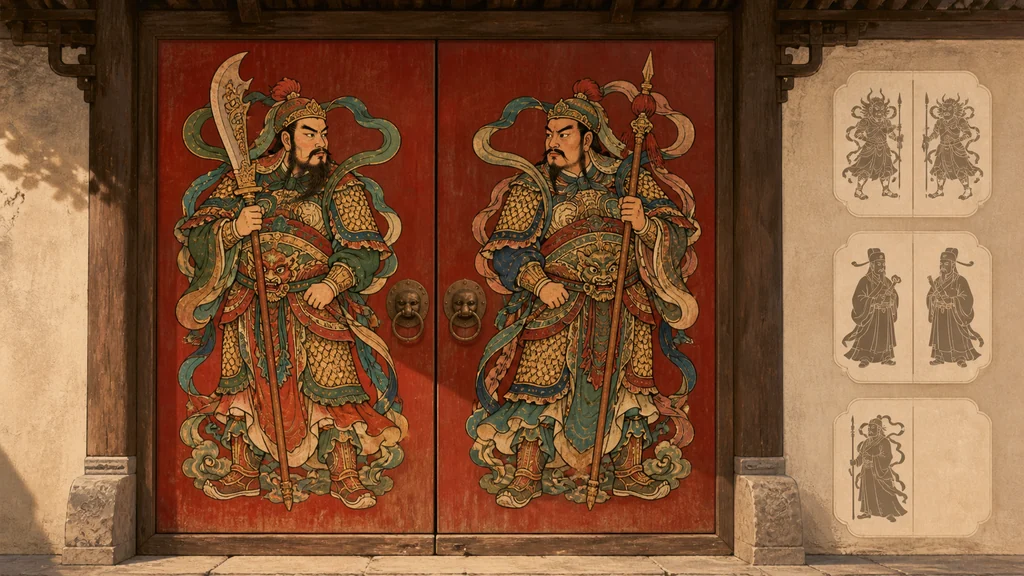
A pair of prints in the Asian Art Museum turns two separate sheets of paper into one guarded entrance. Qin Qiong occupies one sheet and Yuchi Gong the other. When pasted on the leaves of a double door, the armored generals face inward toward each other and watch the same threshold.
Qin Qiong (秦琼), also known by his courtesy name Qin Shubao (秦叔宝), and Yuchi Gong (尉迟恭), also called Yuchi Jingde (尉迟敬德), were early Tang generals. They became the best-known pair of military door gods, or menshen (门神). An early twentieth-century woodblock print from Zhuxianzhen in The Metropolitan Museum of Art identifies the pair by those names.
One general for each door leaf
Paired door-god prints are designed as a unit. Their scale, poses and sightlines answer one another across a double entrance. The Asian Art Museum explains that the figures face each other so they can observe everything passing through the doorway. A twentieth-century pair at the University of Michigan Museum of Art was likewise made to protect a house from harmful influences while encouraging favorable ones.
Armor and weapons give the two historical generals the visual authority of guards. In the Asian Art Museum's Shandong pair, Yuchi Gong carries a steel whip and Qin Qiong a sword. Saw-toothed banners rise behind them—features derived from opera costumes, not documentary pictures of Tang military dress.
Weapons, facial colors and left-right placement vary among printmaking centers such as Mianzhu, Yangliuqing and Zhuxianzhen. A single face color is therefore a weak universal identification rule. Names printed on the image, the relationship between both sheets and the print's place of production provide better evidence.
How two Tang generals entered the door-god story
The story repeated in museum records begins with the Tang emperor Taizong troubled at night by demons or terrifying dreams. Qin Qiong and Yuchi Gong stand armed outside his palace door, and the disturbance stops. Rather than make the generals keep watch every night, the emperor has their portraits placed on the doors.
This legend explains why later viewers could treat historical soldiers as supernatural guardians. It is not presented in the sources used here as a surviving Tang court order. The British Museum dates the pair's appearance as door guards in printed images to the sixteenth century; they later became especially popular on the two leaves of street doors.
Surviving twentieth-century prints from Shandong, Mianzhu and Zhuxianzhen show that the pair traveled across major New Year print traditions. They do not prove that a Tang palace door looked like a modern woodblock print, or that its guardians carried the same weapons and wore the same theatrical costume.
The doorway and the wish can change the guardians
Qin Qiong and Yuchi Gong were not the beginning of the door-god tradition. The Palace Museum connects earlier practice with Shentu and Yulei (神荼、郁垒), legendary figures who bound harmful ghosts. By the end of the Han period, sources record their images being painted beside entrances at the end of the year; later peachwood charms could carry divine images, names or auspicious writing.
The cast continued to expand. Armored military door gods emphasized protection and the expulsion of harmful forces. Civil door gods dressed as officials could promise rank, wealth, longevity or blessing. Celestial officials, children, immortals and opera figures also entered paired prints, while the demon-queller Zhong Kui could guard a single door by himself.
Location and material changed the image as well. Paper New Year prints could be pasted on a household door and replaced after weathering through the year. Qing palace guardians might instead be painted on silk or cloth and hung for the festival. A main entrance could call for martial defenders; an inner door or a household seeking blessings might receive civil officials or another auspicious pair.
Qin Qiong and Yuchi Gong remain the easiest military pair to name. Yet menshen describes the guardian or blessing-bearing role at an entrance, not an eternal two-person roster. When different figures appear, the door's location, the figures' dress, the period and the household's wish help explain who has taken the watch.
Sources and further reading
- The Metropolitan Museum of Art: New Year Picture of Door Gods Qin Qiong and Yuchi Gong
- Asian Art Museum: Door gods Yuchi Gong and Qin Qiong
- British Museum: Door Guard Yuchi Gong
- The Palace Museum: New Year blessings and door gods
- National Heritage Board: Nian Hua exhibition
- University of Michigan Museum of Art: The Military Door God Yuchi Gong