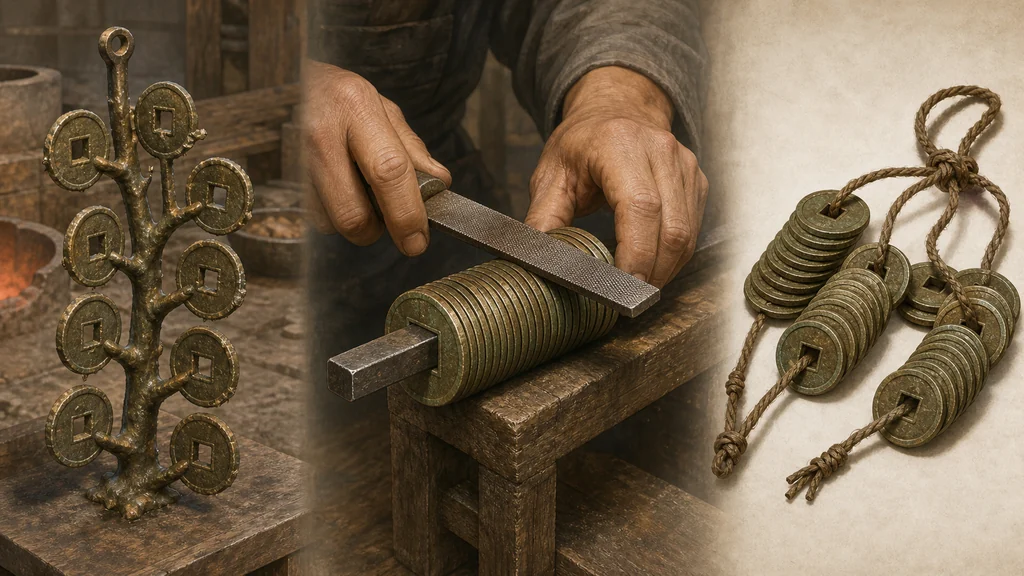
Cast Chinese coins did not emerge from their moulds as perfectly smooth individual discs. Molten metal flowed through channels into several coin impressions. Once the casting cooled, the connected pieces formed what collectors call a “coin tree.” Workers broke off each coin, leaving sprue marks and rough edges that still needed filing.
The square hole was useful at this stage. A stack of coins could be placed on a square rod. The straight sides locked coin and rod together, preventing the coins from spinning while their outer edges were filed. After the coins left the mint, the same opening allowed many low-value pieces to be threaded on cord for counting, carrying and payment.
This separates two related questions. Why was there a hole? It accommodated a rod and later a string. Why was the hole square? A square rod could stop the stack rotating during finishing.
Warring States round coins had both round and square holes
The round coin with a square hole was not a completely new shape suddenly invented by the First Emperor. The British Museum's Money Gallery guide explains that during the Warring States period, some states issued round coins with either round or square central holes. Their inscriptions usually indicated weight or value.
One British Museum coin associated with the state of Qi is a 36-millimetre copper-alloy disc with a square hole. It predates the Qin unification and demonstrates that the form was already in circulation.
After unifying China in 221 BCE, Qin adopted the round, square-holed banliang coin and replaced competing regional systems. The important change was imperial standardization. Qin made the form central to a unified currency; it did not produce the first square-holed round coin in history.
The square hole helped workers make the outside round
Traditional Chinese cash was cast rather than struck one coin at a time. Impressions in a mould were linked by channels that carried molten metal. Once the coin tree was removed and broken apart, workers had to clean the central openings and remove projecting metal from the rims.
A University of California, Santa Barbara history resource illustrates workers filing outer edges and square holes, with groups of coins placed on rods for final finishing. Numismatic accounts explain the mechanical advantage: a round coin on a round rod can rotate when a file pushes against it. A square hole on a square rod resists that rotation, allowing several rims to be worked together.
The square hole did not make the coin's outer edge square. It helped workers make that edge more consistently round.
Minting methods varied by period, mint and available technology. The square-rod process is a well-supported typical workflow, not a claim that every coin over two millennia passed through an identical sequence of tools.
In the market, the hole became a way to organize cash
A single copper cash coin had little purchasing power, so transactions could require large numbers of pieces. A cord passed directly through the central holes and converted loose coins into a bundle that was easier to count, move and pay out.
For display, the British Museum assembled a string of 1,000 genuine Chinese coins. It also holds a group dating to around 1910 with 800 Chinese, Japanese, Vietnamese and Hong Kong cash coins divided into nine bunches. The Cleveland Museum of Art has a string of Qianlong-period Chinese coins. These objects confirm that stringing was a real practice, not merely a function inferred from the shape.
A string or guan was often reckoned as 1,000 cash, but an actual cord did not contain exactly 1,000 coins in every place and period. Short strings, local conventions, conversion practices and transaction charges could change the physical count. The hole enabled organization; it did not guarantee one permanent number.
“Round heaven, square earth” is a later interpretation
A circular rim surrounding a square opening readily evokes the Chinese phrase “round heaven, square earth.” That reading fits a wider history of Chinese cosmological and design ideas, and it has become a genuine part of how the coin is explained and reused.
The evidence levels are different, however. No mint document in the sources used here records a Warring States or Qin designer declaring that cosmology caused the square opening. The square rod, batch filing and coin strings have observable mechanical relationships and surviving material evidence.
Practical origin and symbolic interpretation do not have to cancel each other. A structure can solve production and circulation problems first, then acquire meanings of cosmic order or good fortune through centuries of familiarity. The distinction is about chronology and evidence, not about forbidding later symbolism.
The hole kept working after the coins stopped circulating
Square-holed cash eventually became material for objects beyond payment. A nineteenth-century coin sword in the British Museum ties Qing coins to iron rods with colored cord and was used as a protective object. A modern hanging ornament combines imitation coins, red cord, a Chinese knot, tassels and inscriptions wishing for good fortune and peace.
The hole still has a physical function in these objects: thread can pass through and bind several pieces together. But the coin has moved from currency into decoration and blessing. These later uses cannot explain why Warring States mint workers first adopted the form.
Read a square-holed coin in chronological order. Begin with casting and edge finishing; then examine strings used in circulation; only after that consider protective, cosmological and decorative meanings. The square hole endured because it served both production and the marketplace. Its symbolic life grew around that successful structure.