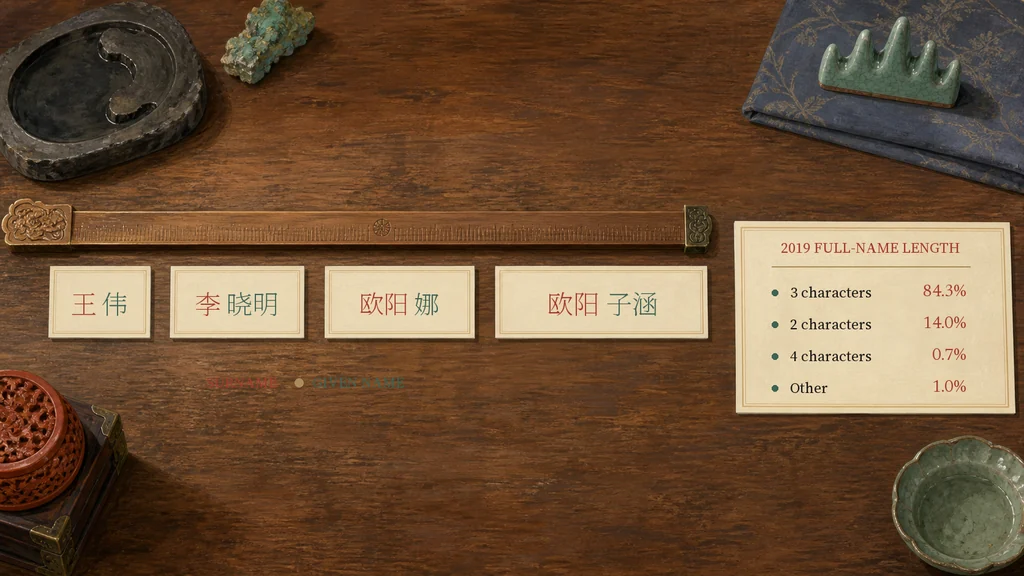
Split four sample names into surname and given name and the usual patterns become visible: Wang | Wei (王|伟) has two Chinese characters, Li | Xiaoming (李|晓明) has three, Ouyang | Na (欧阳|娜) also has three, and Ouyang | Zihan (欧阳|子涵) has four. These are invented examples used only to show structure.
For people registered in mainland China, a Chinese full name commonly has two to four Chinese characters, and three-character names are by far the most common. That is a statistical pattern, not a rule that every Chinese name must follow.
What the national data says
A 2019 national name report from the Ministry of Public Security's Household Administration Research Center counted full-name length in the mainland household-registration population. It reported:
- three-character full names: 84.3%;
- two-character full names: 14.0%;
- four-character full names: 0.7%; and
- names of other lengths: 1.0%.
The dataset did not include Hong Kong, Macao, or Taiwan. The report also qualified its general description of two-to-four-character names by noting that some ethnic-minority naming systems differ. “Three characters is most common” is therefore a scoped description of this mainland registration dataset, not a universal definition of a Chinese name.
A two-character name often combines a one-character surname with a one-character given name, as in 王|伟. A three-character name often combines a one-character surname with a two-character given name, as in 李|晓明. But 欧阳|娜 is also a three-character name: 欧阳 is a two-character compound surname and 娜 is a one-character given name. 欧阳|子涵 shows a possible four-character structure.
The same total length can therefore hide a different boundary between surname and given name.
Surname length and given-name length are separate questions
Most familiar Han Chinese surnames contain one character. Compound surnames such as 欧阳 (Ouyang), 司马 (Sima), 诸葛 (Zhuge), and 上官 (Shangguan) contain two characters but function as one inherited surname. They should not be split merely because they occupy two character positions.
The Ministry of Education's 2011 report on language use found 785 distinct surname forms in its media-name corpus: 497 one-character surnames, 278 two-character surnames, and 10 three-character surnames. These figures count surname types found in that corpus. They are not population shares and do not mean that compound surnames are nearly as common among people as one-character surnames.
A separate 2021 national name report removed surnames and counted only the given name. In that dataset, two-character given names accounted for 84.55%, one-character given names for 13.97%, and given names of other lengths for 1.48%.
This helps explain the familiar three-character full name: a common one-character surname followed by the most common two-character given-name length produces three characters. It is an explanation of the pattern, not an exact calculation. The 2019 figures describe full names, while the 2021 figures describe given names after surnames were removed; the reporting years and denominators also differ. The two sets of percentages should not be added or used to calculate the precise share of one surname-plus-given-name structure.
“Character” means a Chinese character, not a Latin letter
In this question, character means one Chinese character. 李晓明 contains 李, 晓, and 明, so it is a three-character full name. Its romanized form, Li Xiaoming, contains a different number of Latin letters and a space, but that does not change the length of the Chinese original.
Spaces in romanization are not a reliable way to reconstruct the Chinese boundary either. Ouyang Na represents 欧阳|娜, while Li Xiaoming represents 李|晓明. Both Chinese full names have three characters, yet their surnames have different lengths.
For a passport, airline booking, visa, bank form, or academic record, use the surname and given-name fields on the person's document. Do not guess which part is the surname by counting letters or spaces in a romanized name.
Can a Chinese name have more than four characters?
Yes. The 2019 report itself placed 1.0% of full names in an “other lengths” category, so two to four characters cannot be treated as a hard maximum.
China is multilingual and multiethnic, and not every registered name follows the common Han Chinese pattern of a one-character surname plus a one- or two-character given name. Names represented in Chinese characters may be longer, and some transliterated forms use a middle dot. The Ministry of Public Security's standard-character search page, for example, uses both 张三 and 阿里木·巴图尔 as sample name inputs. The second example is evidence that official systems encounter formats beyond a short, uninterrupted string of two or three Han-name characters; it is not a template for every minority name.
A public explanation from Shanghai police likewise noted that name length does not have a simple, universally applicable upper limit. Local guidance is supporting evidence here, not a substitute for the national statistics.
Do not force every ethnic or transliterated name into one surname-given-name formula. When a name is longer, contains a middle dot, or follows an unfamiliar tradition, rely on the person's documents, their own stated form, and appropriate cultural context.
How to count and split a Chinese name
Start by counting the Chinese characters in the original name. Then identify whether the opening characters form a known compound surname. Finally, confirm the surname-given-name boundary from the person's documents or reliable context rather than inferring it from total length alone.
Chinese names usually place the surname before the given name; see Chinese name order. For why Ouyang should stay intact in English-language fields, see how to enter Chinese compound surnames on forms. A list of the most common Chinese surnames can help you recognize many frequent one-character surnames, but it cannot replace the name holder's own information.
Sources and further reading
- China Daily: 2019 National Name Report
- Hunan Provincial Public Security Department: 2021 National Name Report
- Ministry of Education: 2011 Report on Language Use in China
- Ministry of Public Security: Standard Chinese Character Search for Names
- Ministry of Education: GB/T 28039—2011, Basic Rules of Chinese Phonetic Alphabet Orthography
- Shanghai Information Office: Police Explanation of Registered Name Characters and Length