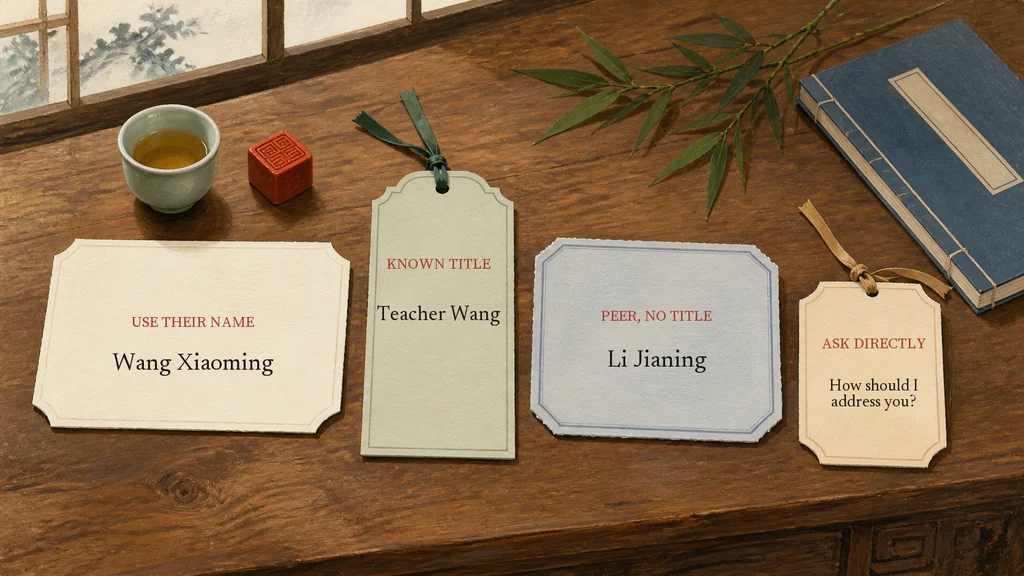
“Hello, I'm Wang Xiaoming.”
At a first meeting, Wang Xiaoming is a safe form to use. If the introducer says, “This is Teacher Wang,” use Wang laoshi (王老师). If the same person says “Call me James” at an English-language conference, use James.
There is no single Chinese title that fits everyone. The best first clue is the form the person has just given you.
A badge says WANG Xiaoming: which part should you use?
Chinese names normally put the surname first. In 王晓明, 王 (Wang) is the surname and 晓明 (Xiaoming) is the given name. Capitalizing WANG on a badge often helps identify the surname, but it does not tell you whether the person prefers Wang, Xiaoming, or the full name in conversation.
Do not reverse the name to “Xiaoming Wang” merely because English normally places a family name last. Do not jump immediately to Xiaoming, either. Begin with the complete form the person supplied. If the badge, email signature, and spoken introduction disagree, ask: “What would you like me to call you?”
That question is especially useful across Chinese-speaking regions and international settings, where individuals may present Chinese names, English names, or romanized names in different orders.
When the role is known, use surname plus title
In a school, 王老师 (Wang laoshi, Teacher Wang) is natural. In a hospital, you may hear 李医生 (Li yisheng, Doctor Li). At a company, colleagues may call someone 陈经理 (Chen jingli, Manager Chen). The surname comes before the title.
An MIT Mandarin course notes that English-speaking settings may move to a given name quickly, while professional address in Chinese can retain surname plus title for longer. It is a useful starting point only when the role is real and relevant.
If the person teaches, Teacher Wang works. If everyone on the project calls a colleague Manager Li, following that established form is reasonable. Clothing, age, or office size is not enough evidence to promote someone to “professor,” “boss,” or another guessed title.
Research on current address behaviour in mainland China also shows why no title works mechanically. Rank, familiarity, age, formality, communication medium, and whether an exchange is public or private can all affect the choice. The form used in a meeting may not be the one used over dinner.
For a new peer, the full name can be natural
Suppose a friend says, “This is Li Jianing.” Using Li Jianing at first is not inherently stiff. An Open University Chinese course notes that full names are common even among friends and family. Because many Chinese full names are short, a full name does not automatically carry the “angry parent using every name” effect that English speakers may imagine.
The complete given name, Jianing, may also be natural once the person or mutual friends use it. Let their usage lead. Do not select Ning from the name or invent Ningning at a first meeting. The guide to whether Chinese people shorten names explains why a complete given name and an established nickname are different.
A comparative survey of Chinese and American address terms found that American respondents often preferred first names or no address term in a range of situations, whereas respondents in the China context used a more varied set of choices. Its sample does not represent every Chinese speaker. It does show why an English first-name default should not be treated as the only possible Chinese default.
If you cannot choose a title, leave it out
You do not need to decide whether a stranger is “sir,” “master,” “uncle,” or “boss” before asking for directions. In Mandarin, Nǐ hǎo, qǐngwèn… (你好,请问……, “Hello, may I ask…”) begins the conversation politely without a direct address term.
Pragmatic research identifies omission as an important strategy in current Chinese address behaviour. The MIT course likewise notes that when no suitable title is available, speakers may use a full name, a given name, or avoid direct address altogether.
If the conversation will continue, ask Qǐngwèn zěnme chēnghu nín? (请问怎么称呼您?, “May I ask how to address you?”) or simply ask in the shared language what the person prefers.
Xiansheng (先生, Mr./sir) and nüshi (女士, Ms./madam) can be used in public-service or business settings and usually follow a known surname. Other words are less portable. Xiaojie (小姐) and shifu (师傅), for example, have changed in social meaning and can sound different across regions, industries, and generations. They are not universal labels for any young woman or any male stranger.
Follow the introduction for elders and in English settings
When a family friend introduces someone from a parent's generation as “Uncle Wang” or “Aunt Li,” follow the form established in that social setting. Do not estimate age from appearance and assign a kin-like term on your own. In a formal setting, a known surname plus professional role is often safer than a given name.
In an English-language meeting or multinational team, a person may actively offer an English name or English order. Preserve the form they use. An English name is not necessarily a translation or replacement of the Chinese legal name; see why some Chinese people use English names. To identify the surname before choosing any title, see Chinese name order.
The practical sequence is short: follow the person's introduction; when a real role is clear, use surname plus title; for a peer without a title, begin with the full name; if you are still unsure, say hello without a title and ask.
Sources and further reading
- MIT OpenCourseWare: Learning Chinese, Unit 2
- The Open University: Beginners' Chinese — Introducing oneself
- Michigan State University: Elementary Chinese I — Meeting People for the First Time
- East Asian Pragmatics: Current address behaviour in China
- Journal of Praxis in Multicultural Education: A Comparative Study of Chinese and American Address Terms
- Language in Society: Social changes and changing address norms in China
- Sinolingua: Speaking with Manners