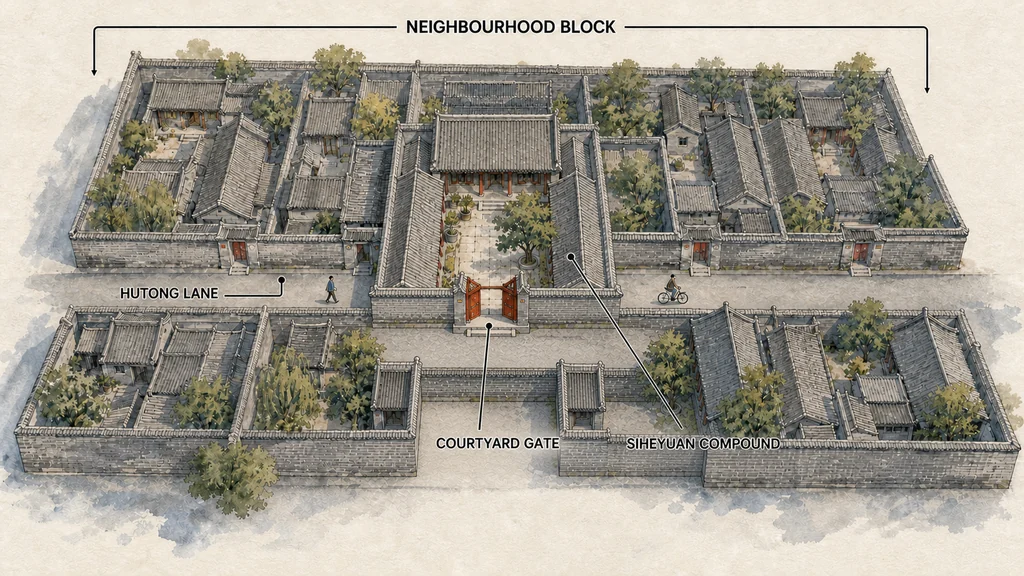
Walk along the narrow space between grey walls and you are in a hutong (胡同, hútòng): an alley or lane. Pass through one of its gates into a compound of buildings around a courtyard and you have entered a siheyuan (四合院, sìhéyuàn). One is the route outside; the other is an architectural unit behind the wall.
Beijing's Dongcheng District groups hutongs with secondary roads, local streets and small alleys in its street-management rules. The Imperial City conservation plan also treats principal and secondary hutongs as parts of a road system. Within that plan, some principal hutongs are generally wider than seven metres and may function as local roads; secondary ones are generally narrower and chiefly carry bicycles and pedestrians. Seven metres is a planning threshold for that area, not a universal test for every Beijing hutong.
A siheyuan is a group of buildings and enclosing walls organised around a courtyard—not simply the open space in the middle. Doors and windows commonly face inward, while the outer walls separate the compound from the lane. A courtyard may later be divided among several households or converted into a museum, shop or other use. Its occupants and use can change while parts of the courtyard form remain visible.
Courtyard plots line both sides of the lane
The walls beside a hutong do not enclose one continuous house. They mark a succession of plots, each with its own boundary and entrance. A person moves along the shared lane, passes through a gate and enters one compound. Repeated courtyards line the lanes; connected lanes form a larger neighbourhood.
Beijing's Regulations on the Protection of the Historic and Cultural City list traditional hutongs, historic streets and traditional place names as heritage objects. They also identify the “hutong–siheyuan architectural form” as part of the old city's spatial pattern. The linked phrase describes an urban fabric, not a single building type. Conserving a hutong may involve its route, scale, name and street frontage; conserving a siheyuan also requires attention to the compound boundary, building layout and historic fabric.
The guide to the central axis of a Beijing courtyard house explains how rooms are arranged inside. The article on Chinese screen walls follows the turn between an entrance and the courtyard. Here, the important point is simply that the gate joins the lane to the compound.
Hutong can also mean the neighbourhood around the lane
Hutongs carry traffic, but everyday life has often extended beyond courtyard gates. Research on Beijing's twentieth-century hutong districts records children playing, neighbours talking and household activities entering the shared alley space. Shops, trees, doorways and repeated encounters turned a route into a social setting as well.
This helps explain broader expressions such as hutong district, hutong neighbourhood and hutong culture. A café described as “in a hutong” may simply stand on the lane or within the surrounding district. A café inside a siheyuan occupies a courtyard compound. The neighbourhood sense of hutong does not make the two words interchangeable.
A hutong address does not guarantee an intact courtyard house
Today's hutong districts have passed through subdivision, infill construction, road changes, commerce and tourism. A study of the Nanluogu area found changes in the prominence of different streets, the placement of doors along them and the layouts inside courtyards. Beijing tourism material likewise notes that multi-household occupation and added structures have altered many compounds.
An address ending in Hutong therefore identifies a named lane; it does not prove that a complete traditional siheyuan survives behind the door. The long space you travel through is the hutong. A bounded compound with its own gate and inner courtyard is the siheyuan. The larger area made from several lanes and the properties beside them may also be called a hutong neighbourhood.
Use the boundary to identify what you are seeing
A single siheyuan can open onto a hutong, and several courtyard compounds can line the same lane. That relationship explains why photographs sometimes seem to use the words interchangeably: the street view shows gates and walls, while the plan behind one gate reveals the courtyard house. One term describes the route through the neighborhood; the other describes an architectural compound reached from it.
For field identification, ask where the boundary lies. If people and vehicles move along it and many properties open onto it, you are probably looking at a hutong. If rooms and walls enclose a private or institutional court, the plan is a siheyuan or a related courtyard arrangement. Neither term guarantees that the fabric is old or unchanged; Beijing lanes and compounds have both been subdivided, rebuilt, and adapted.
Sources and further reading
- Dongcheng District People's Government: Rules for the Management of Streets, Lanes and Hutongs
- Beijing Municipal Cultural Heritage Bureau: Conservation Plan for Beijing's Imperial City
- Beijing Municipal People's Congress: Regulations on the Protection of the Historic and Cultural City
- Huanxi Zhao: Spatial morphology and authenticity in the Nanluogu historic district
- Yiqiao Sun: The on-screen transformation of Beijing's hutong districts during modernisation
- ChinaCulture.org: Hutongs and Siheyuans
- Beijing government English portal: Dongsi Hutong Museum and Lao She Memorial Hall