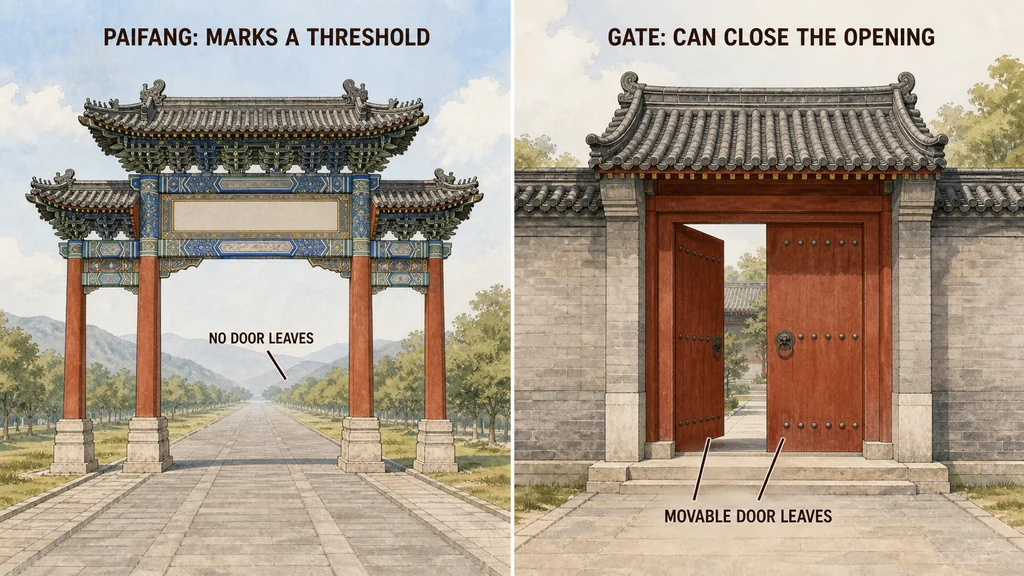
A road passes directly between tall posts and beneath an inscribed crossbeam. There may be roofs above, but there are no door leaves to swing shut. This is typically a paifang (牌坊, páifāng), also commonly called a pailou (牌楼, páilóu): a portal-shaped structure that marks a place, route or subject of commemoration.
An ordinary gate does a different job. In a narrow technical sense, Chinese architectural writing defines a door as two movable leaves fitted at an entrance. In a broader sense, a gate is the entrance structure equipped with a closing device. A house gate, palace gate and city gate differ greatly in scale and security, but their leaves can still change an opening from passable to closed.
Most free-standing paifang have no such mechanism. People and traffic continue through the opening, so translating both structures as “gate” can hide the crucial distinction: a gate can control access, while a paifang commonly marks a threshold without sealing it.
A paifang marks a place with position and inscription
Paifang were built in wood, brick, stone or glazed material and placed at street entrances, bridgeheads, temples, ancestral halls, tomb precincts and gardens. Their inscriptions might name a destination or building, or identify a person and event being honoured.
The wooden pailou formerly at the west end of the approach road to Beijing's Temple of Earth was described by the district government as a guide and marker for entering the temple grounds. It announced that the destination was near; the actual gates controlling access lay farther along the route. Palace Museum research likewise shows paifang placed at the front of an architectural axis or beside bridges, dividing a continuous approach into meaningful stages.
Passing beneath one can therefore create a spatial transition without a physical stop. A visitor may leave an ordinary street for a temple forecourt, or move from one section of a garden route to another. The structure defines a boundary but does not necessarily close it.
Memorial inscriptions put honour—and social rules—on display
Historical examples include arches honouring examination success, public generosity and conduct approved by the state. A paifang could turn the reputation of a person or family into a permanent public inscription, and permission to erect one might itself depend on official authority.
Chastity arches form only one category. They belonged to systems of official commendation and to moral demands placed especially on women in late imperial society. Treating them simply as timeless symbols of “traditional virtue” erases the power and gender conditions behind them. Many other paifang named streets, temples, bridges or gardens and commemorated no individual at all.
Earlier fang gates could have walls and door leaves
“A paifang cannot close” is a useful description of many familiar free-standing examples, not a definition valid for every period. Palace Museum research notes that before the Song dynasty, gates to enclosed urban wards could connect to ward walls and carry door leaves. As the closed ward system gave way to a street-and-lane system, walls disappeared, redundant leaves were removed, and surviving ward gates continued to mark place names. Independent structures spanning streets developed from that change.
Later exceptions also existed. A Qing-period “gate paifang” shown beside Luohan Hall in the Wanshou Tu opened through a wall but had no leaves. It functioned as a passage, yet the researchers concluded that it offered no defence. This is why the most reliable questions are practical ones: Are there working door leaves? Does the opening join a continuous wall? What does the inscription name? Where does the structure stand along the route?
The names paifang and pailou are not separated consistently by roofs. A familiar saying distinguishes a roofed lou from an unroofed fang, but local architectural material also notes that their forms converged and the terms became interchangeable after the Ming and Qing periods. The presence of a roof alone cannot tell you how the structure worked.
Test whether the opening can close
For other entrance forms, see how a moon gate frames and connects garden spaces, why a screen wall stands near an entrance, and how to recognise Chinese guardian lions.
A paifang can mark passage without sealing it. That difference—ceremonial or spatial marking rather than routine closure—is the quickest reason not to translate every example simply as a gate.
Sources and further reading
- Palace Museum Journal: Paifang of the Great Bao'en Yanshou Temple in the Wanshou Tu
- Beijing Cultural Heritage Bureau: Doors in traditional Chinese ritual architecture
- Palace Museum: Liao-dynasty stone lion door pillows
- Chongming District People's Government: Historic paifang on Chongming Island
- Dongcheng District People's Government: Beijing Temple of Earth
- Beijing Tourism: Chinese Memorial Archway
- Beijing Dongcheng Civilization Office: Historic pailou in Dongcheng
- UNESCO World Heritage Centre: “Jingnan Xiongzhan” Paifang